All posts by hsmoffice
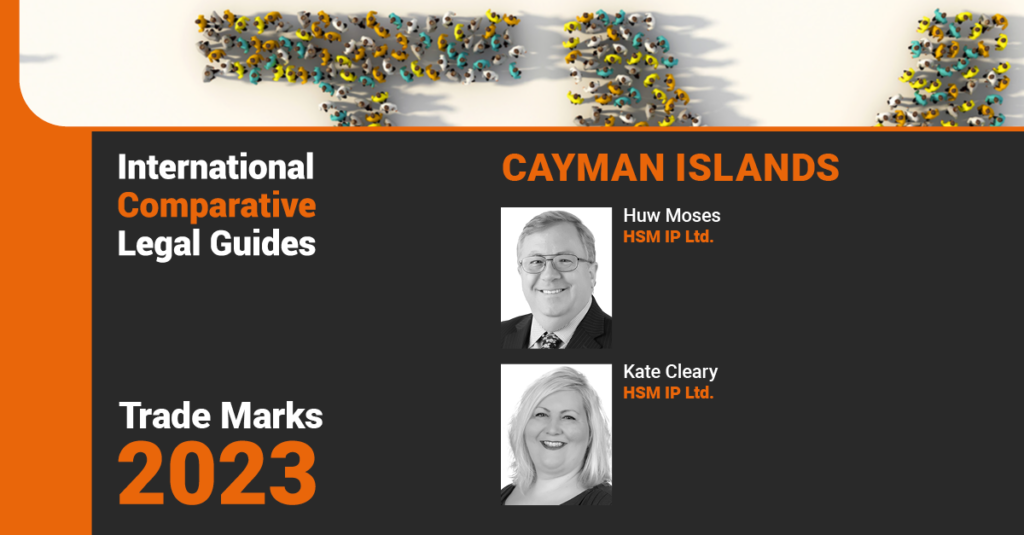
HSM IP has once again contributed to the International Comparative Legal Guide (ICLG) to Trade Marks. Click here to read our Cayman Islands 2023 Trade Mark chapter by Huw Moses and Kate Cleary.
This guide is now in its 12th edition and provides a practical cross-border insight into trade mark work. First produced by Global Legal Group, this guide covers common issues in trade mark law and regulation across 30+ jurisdictions.

HSM Chambers are delighted to see that the requirement for various expatriates to have and provide proof to the Department of WORC of undertaking a vaccine course to prevent / suppress COVID-19 (SARS-CoV-2), before being granted an Immigration permission has been withdrawn effective as of 7 June 2023.
On 22 May 2023, HSM Chambers put the Department of WORC on notice that unless HSM Chambers were provided with confirmation, within 14 days, that the mandate would be withdrawn, we were instructed by a client to challenge that mandate and the legality of it. The challenge to the mandate would be predicated on the basis that it breached our client’s Section 9 Rights as protected by the Bill of Rights.
HSM Chambers were clear in our client’s position that as of 1 May 2023 when the World Health Organisation declared the global emergency over, the requirement to be vaccinated to obtain an Immigration permission could no longer be justified (if it ever could) due to the fact that:
- Tourists could and had been staying in the Cayman Islands unvaccinated.
- The terms of the mandate were unequal in that it did not apply to all expatriate workers nor Caymanians.
On 6 June 2023, HSM Chambers were notified that:
- The requirement to be vaccinated against SARS-CoV-2 would be lifted.
- That it was not accepted that the mandate amounted to a breach of the Bill of Rights.
- That consideration was being given to the lifting of the vaccine requirement prior to the receipt of our letter.
Hopefully, such drastic measures will not have to be reintroduced again. However, in the event that they are, it is hoped that any mandate is reasonable, proportionate and applies equally to all residents and persons seeking to enter the Cayman Islands.
The Winner of the HSM IP Draw for a large Tortuga Rum Cake held during INTA 2023 in Singapore, was Mr. James Mitchiner, an attorney with Mitchiners, London, UK.
Don’t forget to visit the HSM IP stand in the Exhibition Hall in Atlanta, Georgia, USA in May 2024.
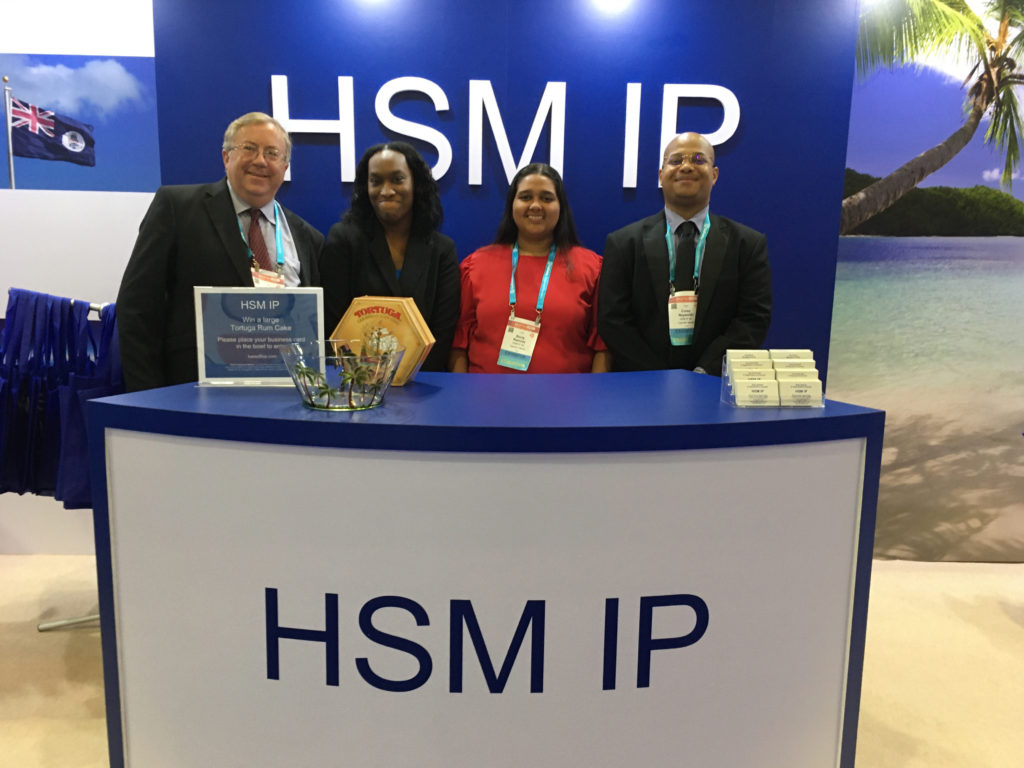
(L-R: Huw Moses – HSM IP Managing Partner, Lisa Chin-Forde – IP Registrations Coordinator, Shirly Ramirez – IP Administrative Assistant and Corey Neysmith – IP Renewals Coordinator)
In the second quarter of 2023, it is interesting to note for brand owners that official fees at Intellectual Property (IP) Offices across the Caribbean, Central and South America are on the rise. HSM IP’s Kate Cleary (Intellectual Property Manager) and Shirly Ramirez (IP Administrative Assistant) cover the latest trends in Caribbean Trade Marks and Intellectual Property.
As brand owners increasingly seek to protect their intellectual property in these jurisdictions, a number of IP Offices across the region are taking this opportunity (no doubt also influenced by the current general rise in living costs as well as the ongoing de-escalation of COVID measures and restrictions) to review and increase official fees. The last decade has seen a general trend of fee increases across the region, with increases ranging from as little as 3% up to 20%.
Brand owners would be wise to take note of this ongoing trend and to ensure that they do not delay what may be traditionally considered “non-urgent” updates to their IP portfolios. For example, while it is not mandatory in many jurisdictions for updates to the registered name or address of a trade mark proprietor to be recorded, brand owners should consider the trend for increases in official fees when evaluating whether it is prudent to delay such recordal projects. A 5% increase in official fees, such as that we have recently seen in Bermuda, can translate to a substantial outlay in fees payable, across a portfolio of just a couple of dozen trade marks.
The ongoing expansion in scope of work IP Offices are handling and the time staff are spending on IP matters has its own impact on the steady rise in official fees. The 5% increase in official fees in Bermuda took effect from 1 April 2023 and is reported to be valid until 2025. Savvy brand owners may seek to take advantage of this hiatus in fee increases to ensure their portfolios are in order and up-to-date, to avoid the impact of any subsequent official fee hikes.
While the most recent fee increase put in place was in Bermuda, fees or local taxes have also increased in the last 12 months in Dominican Republic, Suriname and Aruba, and further increases cannot be ruled out over the coming year. Indeed, anticipated implementation in 2023 of new Trade Marks Rules in Jamaica will be accompanied by a hike in official fees at the Jamaica Intellectual Property Office of roughly 75%.
HSM IP is equipped to assist brand owners with updates to proprietor details / changes in title against their trade marks throughout the Caribbean and in an effort to encourage timely attendance to such matters we offer large portfolios a discounted fee for such recordal projects.
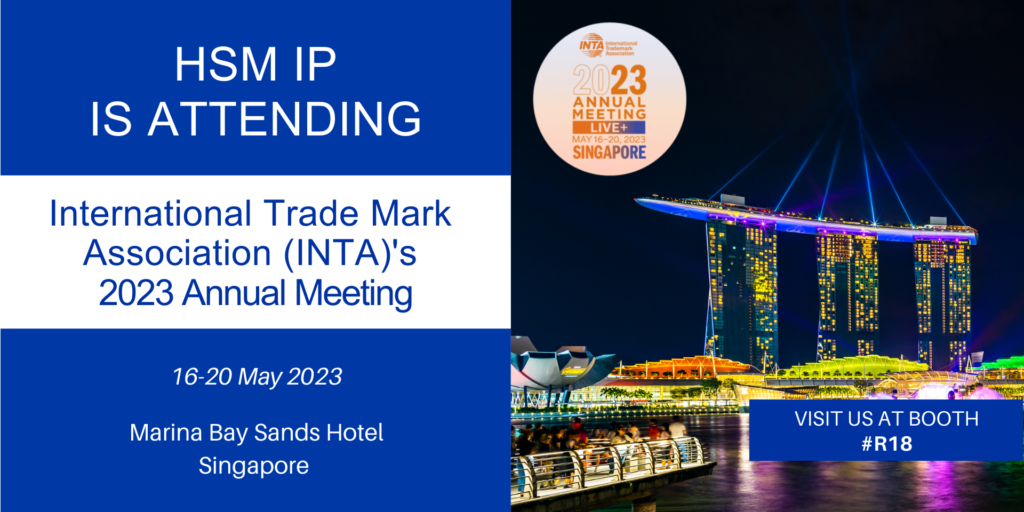
Our HSM IP team is gearing up to attend the International Trade Mark Association’s (INTA) Annual General Meeting in Singapore at the Marina Bay Sands Hotel from 16-20 May 2023.
Meet Huw St.J. Moses OBE (Managing Partner), Lisa Chin-Forde (IP Registrations Coordinator), Corey Neysmith (IP Renewals Coordinator) and Shirly Ramirez (IP Administrative Assistant).
You can visit the team at Booth R18 or if you would like to arrange a meeting, email us at ip@hsmoffice.com.
We look forward to seeing you there!
For many years persons seeking to obtain Permanent Residence in the Cayman Islands have taken a History and Culture Test. It started as a mechanism to attempt to measure a person’s assimilation into the Caymanian community. Being able to hum a verse of “Munzie Boat” and understanding that “Soldiers” wear shells not uniforms could get you part of the way there. No one had to study anything. Aspiring permanent members of our community simply lived it, and it was good.
Of course, the winds of change wreaked havoc on the boat in the Sound. All in the name (or in consequence) of progress, we crushed the Soldiers under our cars (to the extent we did not smash them for bait) and collected their homes as trinkets off the beach. At the same time, the Barcadere became the Cove, Dolphin became Mahi Mahi, Weeping Willows became Casuarinas and the Sea became the Ocean. Cocoplum went from being a fruit, to an address. Even our spelling is now changing, as has (seemingly) our ability to freely access and enjoy the coastline. It has all fundamentally happened in as little as 30 years. The pace of change (some call it progress) is accelerating.
The lyrics came true. At least in Grand Cayman it appears that “all the Soldiers are dead boys, all the Soldiers are dead”.
It used to be that Caymanian culture was learned enjoying a good rundown with friends, all the better if washed down with swanky. In that setting, on a moonlit porch, expatriates could learn of Christmas Breezes, Men of Iron in Wooden Ships, Smoke Pots and National Bulk Carriers. In moments of silence they could ponder the similarities between Wompas and Flip Flops, and the differences between types of Breadkind, as well as distinguish between Squabs and Prop Props.
Those days have passed.
Many people yearn for those simpler times, and the relative cohesiveness of the community. The legislation we operate under (first drafted in 1971) has always enshrined focus (whether agreed upon by those administering it or not) on “cushioning” the Caymanian way of life against the impact of inevitable change. Indeed, the Permanent Residence Points System, prescribed by the Cabinet, emphatically states that “an applicant’s integration into the Caymanian society will be measured by reference to his (sic) knowledge of local history, tradition, customs and current events.”
Despite the inherent legal (and political) expectations, the Permanent Residence history and culture test has (in reality) little to do with actual integration into the Caymanian society. It is a test of knowledge (or at least recollection). Reading books is good, and will help, but ultimately, and several years ago, the government decided to provide a course. The course has been spectacularly successful. Attendees seem to do extremely well on the test, sometimes scoring 100%. Unfortunately, often due to work or family commitments, not everyone can attend the course or spend the CI$200 required to participate.
Never mind, there has been even more progress. It appears that most of the questions (and answers) are freely available on an App, and otherwise in wide circulation. Some now accordingly suggest there is now no need for any prospective Permanent Resident to spend any time on a porch, read any history books, or attend a course.
Still, we accept, however they may be learned, it is better the facts be known, than not.
Incredibly (although not the fault of the initial authors of the test), some of the facts on which people are assessed, have not been consistently factual. The issue has been known (and attempts made to have it addressed have been ongoing) for a decade. Asking a PR applicant who the Minister of Tourism is, but failing to provide that Minister’s name amongst the options for the multiple choice response (thus making the question impossible to correctly answer) is not a good look – especially if such a thing were to happen multiple times (and seemingly for years) even following concerns being raised.
Some facts are important for people to understand who we are and where we come from. The Treaty of Madrid, Captain Pack and Long Celia are all highly relevant, and important (hey, Bodden Town, shouldn’t we get her a statue?). On the other hand, and although I am a fan of them all, it appears to me that Steel Pans, Jerk Chicken, and Batabano ought not be a focus on integrating expatriates (although recognition that these things are traditionally no more Caymanian than the internet or rum and coke, probably should be).
Let there be no doubt. Choosing who can and should gain and maintain the privilege of being a settled resident of these Islands should be firmly in the hands of the Caymanian people applying appropriate and transparent standards. That prospective permanent residents be asked to evidence their particular contribution, participation, and commitment is not offensive. The interests of these Islands and their people must be paramount.
However, the system (and every material aspect of it) must be fair and rational. The Constitution requires it, and our forefathers would expect no less.
The reality is, if we fail to treat people fairly, the Constitution will ultimately deprive the Caymanian people (through the actions of their elected representatives) of the right to determine who can stay, and (quite properly) hand that determination to the Courts.
The easy answer, of course, if we wish to avoid that, is to ensure our systems (however strict we wish them to be) treat everyone fairly.
Perhaps someone might (in furtherance of maintaining their prescriptive right albeit in polite disregard of any inappropriately located no trespassing sign), peaceably sit in the shade of a grape tree, stare at the sea, and contemplate that possibility. It is not too late.
On 30 March 2023, The Court of Appeal declared that Section 37 (3) Immigration (Transition) Act (2022 Revision) is incompatible with the constitution namely Section 9 of the Bill of Rights, which provides rights to family life and/or private life to residents in the Cayman Islands.
The relevant subsection of the Act, which the Court of Appeal has held is incompatible with Section 9 of the Bill of Rights is:
“(3) In considering an application for permanent residence under subsection (1), the Board or the Director of WORC upon applying the criteria set out in the points system shall only grant permanent residence to all applicants attaining one hundred and ten points or more.”
In the case of D’Souza & Buray, the appellants failed to obtain the required 110 points under the Points System to be granted permanent residency (PR). They appealed on the basis that this infringed their rights to a private life based on their individual circumstances.
This declaration of incompatibility will present immediate difficulty in the processing of PR applications, at least those where applicants are assessed to have less than 110 points. Up until now those individuals who did not achieve 110 points under the Points System and had no other way of remaining in the Cayman Islands were required to leave the Islands for at least 1 year.
The Cayman Islands Government will now need to act to amend the aforementioned Section 37 in order to make it compatible with the Bill of Rights and at the same time provide a revised legal framework for the consideration of pending and future PR applications so that an applicant’s Constitutional Rights can be considered.
It is difficult to know how the Government will react, but it is earnestly hoped that applicants who have achieved 110 points will have their applications progressed to a grant in any event. This is a particular concern when applications in some cases have been pending for more than a year. At the current time, applications for PR pursuant to the Points System are taking up 15 months to be concluded and it appears that the Caymanian Status and Permanent Residency Board are still not considering them.
Currently, it is understood that a Committee chaired by Mr. Steve McField, a well-known and experienced attorney, is looking at the Points System and no doubt this decision will be at the forefront of their minds when they make recommendations to Cabinet. This however is not the first similar committee in recent times and none of the previous committees/reports have led to the aforementioned sections or similar ones being amended so as to make them compatible with the Bill of Rights.
Alastair David appeared on behalf of the appellants and is a Senior Associate from HSM Chambers. Commenting on the Judgment, he shares “While it is gratifying to see that the Court of Appeal agree with our submissions that the current law is incompatible with the Bill of Rights, this has been something which HSM Chambers has been raising concerns with for over six years.”
In regards to the overall effect of the Judgment, Mr. David said “This Judgment should not be viewed as meaning that all expatriates will be able to obtain Permanent Residence in the Cayman Islands. Subject to any legislation change, I envisage it will mean that there will be an increase in numbers of expatriates who can stay past their notional roll over date on the basis of their strong family life or private life connections which they have established in the Cayman Islands.”
The HSM Group is delighted to announce the promotion of two lawyers, Hilary Brooks and Alastair David, to the position of Senior Associate within its Cayman Islands law firm.
Hilary specialises in employment and private client law. Hilary has exclusively practiced in the Cayman Islands since 2012 and has been a Notary Public since 2008. She is the go-to guru for all matters relating to employment law, including employment contracts and policy manuals as well as advice on workplace disputes. She also has experience in preparing wills, codicils and estate administration. In addition, Hilary teaches several legal courses each year with the Cayman Islands Chamber of Commerce and Cayman Islands Society of Human Resource Professionals.
Alastair has specialised in immigration and employment law in the Cayman Islands since his arrival here in 2016. Alastair advises on all aspects of those laws with a specific focus on contentious matters. Alastair has represented clients before the Labour Tribunal and Labour Appeals Tribunal in respects to employment issues and has represented clients before the Summary Court, Grand Court and Court of Appeal in regards to immigration matters in the Cayman Islands. Prior to joining HSM, Alastair practiced as a Barrister in the UK for 10 years.
Both are outstanding lawyers and have been with HSM for more than five years.
“These promotions reflect their dedication and proven track record of delivering results to our clients,” shares HSM Managing Partner, Huw Moses OBE. “I look forward to their continued success as valuable members of the HSM team.”

Our firm is thrilled to be recommended once again by Chambers and Partners in their new Global (Caribbean-Wide) Intellectual Property 2023 Guide.
HSM IP has been listed in their top tier, band 1 ranking for the past four years. This recognition highlights our ability to successfully handle Intellectual Property (IP) registrations, filings and infringement matters across the Caribbean.
Citing the Chambers website, they refer to HSM IP as a “compact, IP-focused law firm advising on regional portfolio management from its base in the Cayman Islands. The firm primarily assists with trade mark filings, prosecutions and renewals. It also regularly advises on region-wide brand protection strategies, and is highly experienced at overseeing revocation and opposition proceedings. The team acts for a myriad of high-end clients, including household names from the technology and consumer goods sectors. HSM IP is especially notable for its experience concerning contentious trade mark issues arising in Cuba. Huw Moses is a notable practitioner.”
Chambers and Partners is a prestigious hub for lawyer and law firm recommendations. They diligently research and feature the world’s best lawyers and have done so since 1990, covering over 200 jurisdictions.
HSM IP Ltd. provides worldwide intellectual property services and specialises in the Caribbean. The firm’s experienced team of attorneys and paralegals deliver a full suite of intellectual property services and serve a broad client base which includes major Fortune Global 500 brand owners, international law firms and other specialist IP practices.
World Trade Mark Review (WTR) has recognised HSM IP and Huw Moses in their latest guide: WTR 1000 2023 (Pan-Caribbean).
This is the sixth year in a row that HSM IP has been recommended by WTR 1000. HSM IP is honoured to receive this recognition as it highlights our practice as a world-class, go-to resource for trade mark services across the Caribbean.
Cited from WTR 1000’s website, commentators said:
“Managing partner Huw Moses has decades of experience in IP protection, enforcement, and dispute resolution in the Caribbean. A leader in the field, he is the founder and director of the Intellectual Property Caribbean Association. HSM IP is spot-on for managing vast Caribbean and Latin American portfolios. The team is professional, knowledgeable, and reliable in the prosecution and maintenance of trademarks, having years of experience in a vast array of countries. It offers practical solutions and prompt responses.”
The WTR 1000 identifies the leading trade mark practitioners and firms from around the globe, offering the definitive ‘go-to’ guide for those seeking legal trade mark expertise.

Fatal error: Uncaught Error: Call to undefined function twentythirteen_paging_nav() in /home/clients/d17af2243e6f179e393695ba6e9ce04e/hsmnew/wp-content/themes/hsm/author.php:52 Stack trace: #0 /home/clients/d17af2243e6f179e393695ba6e9ce04e/hsmnew/wp-includes/template-loader.php(86): include() #1 /home/clients/d17af2243e6f179e393695ba6e9ce04e/hsmnew/wp-blog-header.php(19): require_once('/home/clients/d...') #2 /home/clients/d17af2243e6f179e393695ba6e9ce04e/hsmnew/index.php(17): require('/home/clients/d...') #3 {main} thrown in /home/clients/d17af2243e6f179e393695ba6e9ce04e/hsmnew/wp-content/themes/hsm/author.php on line 52