All posts by hsmoffice
Sophie Peat (Partner at HSM IP) has contributed to Mondaq’s Comparative Guides for Trade Marks in the British Virgin Islands (BVI).
Mondaq’s comparative guides provide an overview of the key points of law by carefully selected and internationally recognised experts. This tool also allows the ability for users to compare regulatory environments and laws across multiple jurisdictions.
Sophie covers trade mark classifications, registration procedure, appeals, oppositions, rights, protection, enforcement and more. In addition to this BVI guide, HSM IP have also contributed to the Cayman Islands trade mark guide.
HSM IP are intellectual property specialists across the Caribbean and their offices are based in Grand Cayman.

The Cayman Islands Parliament has taken a significant step towards improving access to justice in the Cayman Islands by passing for a second reading, the Private Funding of Legal Services Bill, 2020 (“Bill”).
The key elements of the Bill are as follows:
- Attorneys and their clients will be permitted to enter into a Contingency Fee Agreement (“CFA”) for legal services to be provided where the attorney’s fees are contingent, in whole or in part, on the successful disposition or completion of the matter. CFA’s will be permitted for all types of legal services except for proceedings under the Penal Code (2019 Revision), any other criminal or quasi-criminal (i.e. traffic offences) proceedings, or legal services relating to the care of a child or any order under the Children Law (2021 Revision); and
- Third-party litigation funders will be permitted to fund, in whole or in part, the provision of legal services by an attorney to a client outside of the liquidation context (third party litigation funding is permitted within liquidation proceedings due to a special statutory exemption).
Contingency fee arrangements and litigation funding agreements are currently illegal in the Cayman Islands pursuant to the doctrines of maintenance and champerty and are contrary to public policy, thus limiting an impecunious litigant’s ability to pursue legitimate legal actions.
Maintenance involves the act of a person directly or indirectly providing monetary assistance to another person where the person providing the financial assistance lacks any lawful interest in a legal action or lawful justification to interfere in a legal action (i.e. an attorney working for a client on the basis where their fees were contingent upon the results of the legal action). Champerty is similar to maintenance but involves the act of a third party providing financing and sharing in the proceeds of the litigation (i.e. litigation financing).
The Bill will repeal the common law offences and torts of maintenance and champerty.
Contingency Fee Agreements
In its present form (as of 18 December 2020), the Bill sets out the following key features and requirements for contingency fees:
- Attorneys can charge a success fee which is a fee higher than an attorney’s normal fees, as long as the success fee does not exceed 100% of the attorney’s normal fees (i.e. if an attorney charges $500 per hour, the success fee can be no more than an additional $500 per hour, for a total of $1,000 per hour inclusive of the success fee).
- Attorneys will be permitted to charge fees based on a percentage of the total dollar amount awarded or the value of property recovered in an action or proceedings which shall not exceed the maximum prescribed percentage (it is expected the regulations accompanying the Bill will set the maximum prescribed percentage at 33.33%).
- Attorneys may be permitted to charge a higher fee or percentage (up to a maximum of 40%) than those outlined in items 1 and 2 only upon approval of the Grand Court which will consider various factors including the nature and complexity of the action or proceedings, the expense or risk involved, and any other factors the Grand Court considers relevant.
- The CFA must be in writing and signed by the attorney and the client or the client’s appointed guardian, trustee, attorney under a power of attorney, or the client’s authorised personal representative.
The Bill provides various protections and mechanisms for clients and attorneys related to a client’s withdrawal from the CFA, restrictions on contracting out of liability and professional obligations, the determination of disputes under the CFA, and the enforcement of a CFA.
Litigation Funding Agreements
The Bill permits parties to enter into a litigation funding agreement (“LFA”) where a funder agrees to fund, in whole or in part, the provision of legal services by an attorney to a client, under which the client agrees to pay a sum to the funder as set out in the LFA.
LFA’s must be in writing and comply with the prescribed requirements (as set out in the regulations, if any). Unlike with the provisions for CFA’s, the Bill does not place a limit on the fees to be charged or measures of compensation payable.
The Bill is subject to further revisions and debate by the Parliament of the Cayman Islands. Our team at HSM Chambers will update you as and when the Bill is enacted.
HSM IP is pleased to once again present the International Trademark Association’s (INTA) Unreal Campaign to over 200 students at the Cayman Islands Further Education Centre (CIFEC) in December 2020.
In order to reach the entire school population, the HSM IP team hosted two presentations. Natasha Whitelocke (Head IP Paralegal) delivered both sessions and was joined by Corey Neysmith (Senior IP Administrative Assistant) on 1 December and Lisa Chin-Forde (Senior IP Administrative Assistant and past CIFEC student) on 3 December.
INTA’s Unreal Campaign is a consumer awareness programme aimed at educating teenagers about the importance of trade marks, intellectual property and the dangers of counterfeit products.
This is a global programme taught all over the world and while INTA shifted gears in 2020 to offer this presentation virtually, the Cayman Islands is fortunate to be essentially COVID-19 free due to strict government regulations. As a result, schools are functioning as normal and HSM IP was able to deliver these presentations in person.
With the holidays around the corner and people buying more products, the team explained the importance of recognising trade marks. A trade mark can be a word, design, service mark, building shape and more. They also stressed the economic impacts of people purchasing knockoffs and how these inferior products can affect people’s health as well as safety.
As part of the presentation, the students enjoyed a game of “spot a fake”, where they had to guess between two similar looking products and identify the reasons as to why one of them was the fake.
“Our team is passionate in the fight against counterfeits,” shares HSM IP Managing Partner, Huw Moses. “It is important now more than ever to get this message across due to the economic downturn caused by COVID-19.”
HSM IP is a specialist intellectual property law practice based in the Cayman Islands and this is the sixth time that they have presented INTA’s Unreal Campaign. The last presentation took place on 30 April 2019 at the Clifton Hunter High School in North Side.
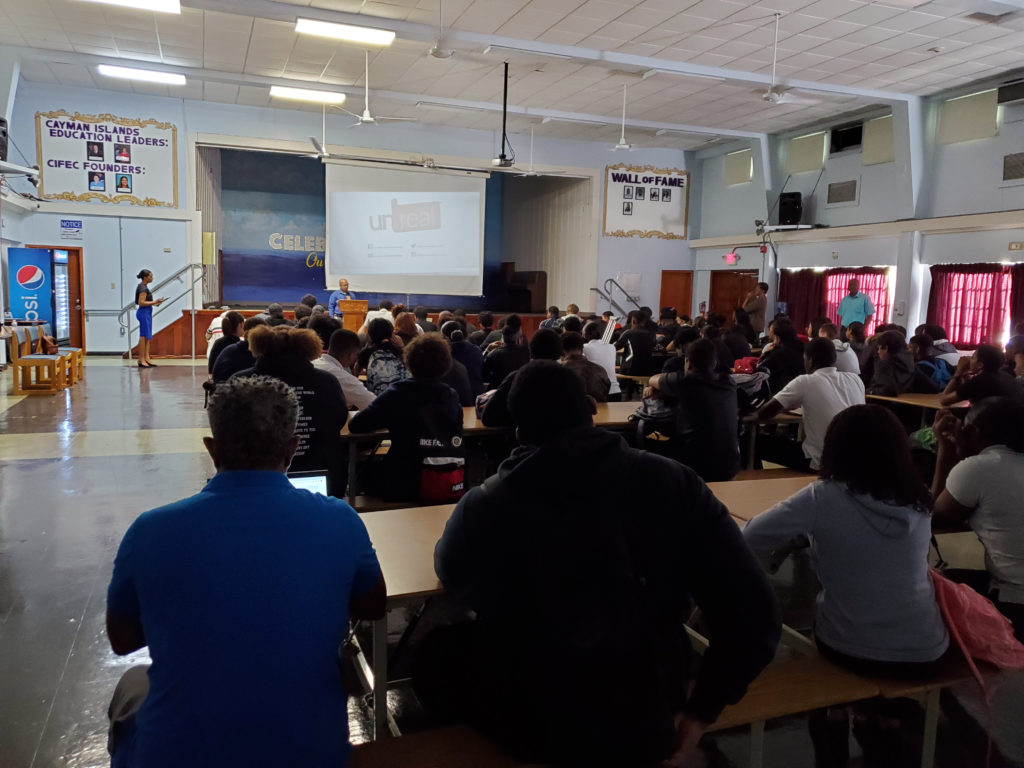
Students Await INTA’s Unreal Campaign
Who’s Who Legal (WWL) has recommended HSM Partner Ian Lambert in their recently released 2021 Restructuring and Insolvency Guide (Cayman Islands).
Ian has been featured by WWL for the past several years and this is testament to the high quality of service he delivers to his clients. He has been with HSM since 2013 and has more than 15 years of experience in major, complex litigation cases, with significant concentration in the areas of insolvency/bankruptcy litigation, asset recovery, fraud litigation, trust litigation, commercial litigation and contract disputes.
WWL identifies the foremost legal practitioners in multiple areas of business law and recognition is based strictly on merit – you can’t buy entry into their publication. Recipients must be nominated for their expertise in the field by at least four independent sources, either from clients or peers.
Congratulations to our HSM Lawyer in the Cayman Islands, Ian Lambert.
The HSM Group is proud to once again offer a legal internship for the 2020/21 academic year in partnership with the Cayman Islands Further Education Centre (CIFEC).
The team at HSM has welcomed 11 interns: Destiny Russell, Shyanne Stewart, Paris Jackson, Anabelle Bush, Johanna Dixon, Kevaughn Hutchinson, Latoya Frazer, Jaysie Allen, Christopher Herrera, Aliyanna Fisher and Christopher Myles.
HSM is a full-service law firm and corporate services provider, which offers students the ability to gain experiences across a wide-range of practices including immigration, debt collection, intellectual property, corporate services and even areas outside of law, such as finance and marketing.
Typically the interns are recruited from the annual CIFEC Career Fair, but this event did not take place due to COVID-19. Instead the interviews were conducted using video conferencing.
Natasha Whitelocke coordinates the CIFEC Internship Programme on behalf of HSM. Natasha along with HSM’s Managing Partner, Huw Moses, carefully select and pair an intern with a lawyer or expert at HSM. These personnel will monitor the student’s work and provide mentoring.
As part of the CIFEC curriculum, the internship runs until April 2021 and each student attends work twice a week during school hours. When the programme ends, there may also be some opportunities for the students to attain a summer work placement at HSM.
HSM Managing Partner, Huw Moses OBE shares: “We look forward to the programme each year and are thrilled to be able to participate again despite COVID-19. You can’t replace the hands-on experience the programme gives to the students.”
HSM has worked with the CIFEC programme since its formation and currently employs seven former CIFEC graduates fulltime.
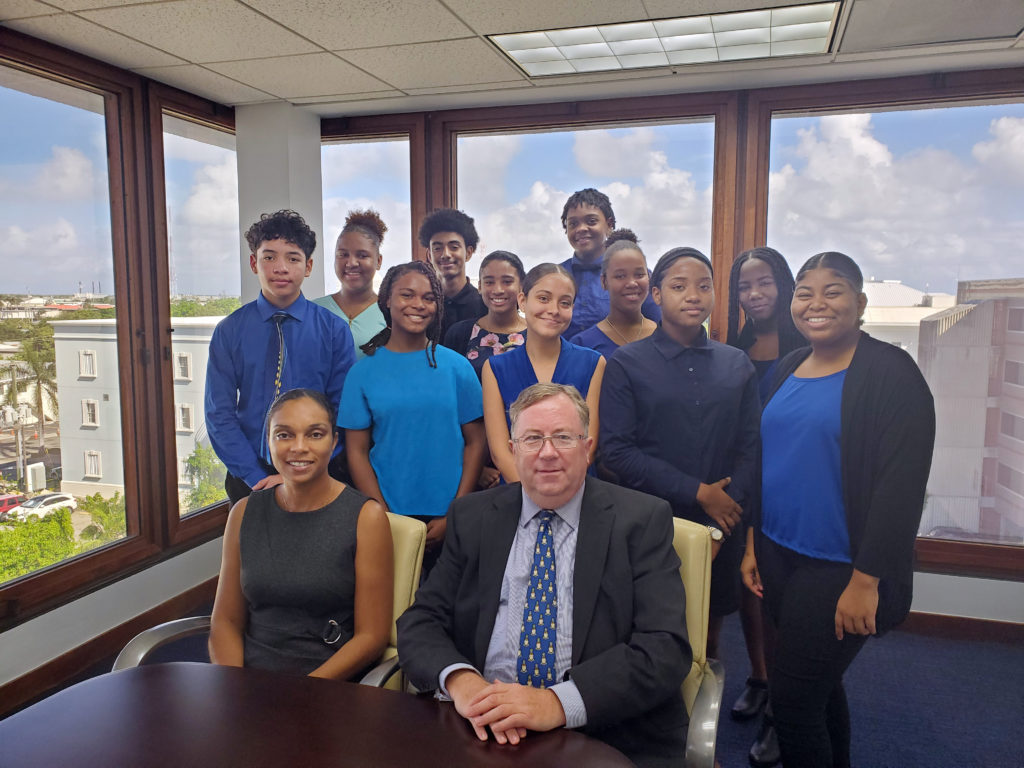
Seated (L-R): Natasha Whitelocke (HSM IP Head Paralegal) and Huw Moses (HSM Managing Partner). Front Row (L-R): Christopher Herrera, Paris Jackson, Jaysie Allen, Latoya Frazer and Johanna Dixon. Second Row (L-R): Annabelle Bush, Destiny Russell, Shyanne Stewart and Aliyanna Fisher. Third Row: (L-R): Christopher Myles and Kevaughn Hutchinson.
Global Restructuring Review (GRR) has just released their GRR 100 2020 Guide and HSM has made its debut on this list. GRR 100 is an annual publication that features the world’s leading law firms for cross-border restructuring and insolvency matters.
HSM’s Restructuring and Insolvency practice is led by Partner Ian Lambert and has grown significantly over the last year, especially due to the demand in service caused by COVID-19. GRR notes that Ian “has chalked up many years’ experience in the Cayman Islands and Canada”. Ian was also recognised as a “Name to Know” in the Cayman Islands by GRR 2019.
HSM’s Senior Associate Adam Crane was referenced for his arrival to HSM in 2018 from Patterson Law and notes “Adam was named one of the 15 “rising stars” in the International Institute’s ninth annual NextGen leadership programme in June 2020.”
Sarah-Jane Allison (HSM Partner) and Shula Sbarro (Associate) were also highlighted as names to know.
HSM was one of five international firms that were newly added to this list. GRR states: “In its relatively short existence, HSM has played a role in some of the most high-profile matters playing out in the Cayman Islands, including the fraud trial of Saudi conglomerate Ahmad Hamad Al-Gosaibi & Brothers (AHAB) and the Singular is liquidation.”
This recognition testifies that HSM is a recommended firm for carrying out insolvency and restructuring work with an international dimension.
HSM’s Dispute Resolution practice has once again been recommended as a leading firm (Cayman Islands) in The Legal 500 Caribbean 2021 edition. Our attorneys Ian Lambert (Partner) and Adam Crane (Senior Associate) received a special mention in their analysis.
The Legal 500 has been analysing the capabilities of law firms across the world for more than 30 years. Law firms and attorneys are ranked by thorough research processes and are highly credited if featured.
This recognition highlights HSM’s ability to successfully handle litigation and dispute matters.
Citing The Legal 500 website, they refer to HSM as a firm that “acts for a variety of stakeholders in cross-border restructuring and insolvency matters, with particular expertise in representing investment funds and banking and financial services clients.”
“Ian Lambert is a first class insolvency and restructuring lawyer. He is regularly involved in high profile and contentious engagements and he constantly delivers. He is a strong advocate.”
Who’s Who Legal (WWL) has recommended Robert Mack in their recently released 2020 Private Client Guide (Cayman Islands).
Robert Mack is the Head of Private Clients and Trusts at HSM and specialises in private and commercial trusts including purpose/STAR, reserved powers, unit, charitable and fixed interest trusts.
Robert has been featured by WWL for the past several years and this is testament to the high quality of service he delivers to his clients. Robert has been practicing Cayman Islands law exclusively since 2007. Prior to that he was an English qualified solicitor practicing in London. Robert is a long-standing Society of Trust and Estate Practitioners (STEP) Cayman Islands Council Member and is the current Deputy Secretary of that branch. Robert sits on the STEP legislative review sub-committee and the STEP Mental Capacity Special Interest Group.
WWL identifies the foremost legal practitioners in multiple areas of business law and recognition is based strictly on merit – you can’t buy entry into their publication. Recipients must be nominated for their expertise in the field by at least four independent sources, either from clients or peers.
Congratulations to our HSM Lawyer in the Cayman Islands, Robert Mack.
Work remotely in paradise? The Cayman Islands has made this a reality with their Global Citizen Concierge Programme, which allows persons with financial independence to live in the Cayman Islands for up to 24 months. It is available to anyone who can demonstrate their existing (and anticipated ongoing) employment outside of the Cayman Islands.
Key characteristics of Cayman’s Global Citizen Concierge Programme include:
- Created in October 2020.
- Available until 30 November 2023.
- Individual applicants must make a minimum household income of US$100,000 for single households.
- Applicant with an accompanying spouse/civil partner must make a minimum household income of US$150,000 for two person households.
- Applicant with a spouse/civil partner and dependent child or children must make a minimum household income of US$180,000.
- The government fee (per annum) for up to two persons is US$1,469 and an additional $500 per dependent.
- The holders of these certificates are expected to reside in the Cayman Islands for a minimum of 90 days each year.
HSM’s Immigration team is available to assist with these applications and have prepared a guide of the different options available for residency in the Cayman Islands.
Click on the icon below to download this guide.

Last updated: 22 October 2020.
This guide is intended only to provide a summary of the subject matter. It does not purport to be comprehensive or to provide legal advice. No person should act in reliance on any statement contained in this guide without first obtaining specific professional advice. Alternative solutions also exist which may better suit the requirements of a particular individual or entity.
On 8 October 2020, the Court of Appeal of the Cayman Islands, affirmed the earlier Judgment of Williams J in finding that Section 82 of the Immigration Law (2015 Revision) and Section 109 of the Customs and Border Control Law, 2018 are incompatible with the Cayman Islands Bill of Rights.
The Judgment in the case of Ellington v Chief Immigration Officer, in which Mr Alastair David of HSM Chambers represented Mr Ellington both before the Grand Court and Court of Appeal of the Cayman Islands made it clear that the previous Law in respects to Prohibited Immigrants and its current incarnation are incompatible with the Bill of Rights and in particular the right to the family and private life.
It is hoped that this decision will lead to a much needed change in the Law which will lead to clarity in how the relevant authorities deal with Prohibited Immigrants. The Court of Appeal noted with some concern that there are no directives or rules governing Prohibited Immigrants and it is hoped that this will also be addressed shortly. Furthermore, it is also hoped that at the same time thoughts can be given to amending other sections of the Immigration Law which may be incompatible with the Bill of Rights.
Click here to read more details on The Effect of Ellington v Chief Immigration Officer of the Cayman Islands.
Fatal error: Uncaught Error: Call to undefined function twentythirteen_paging_nav() in /home/clients/d17af2243e6f179e393695ba6e9ce04e/hsmnew/wp-content/themes/hsm/author.php:52 Stack trace: #0 /home/clients/d17af2243e6f179e393695ba6e9ce04e/hsmnew/wp-includes/template-loader.php(86): include() #1 /home/clients/d17af2243e6f179e393695ba6e9ce04e/hsmnew/wp-blog-header.php(19): require_once('/home/clients/d...') #2 /home/clients/d17af2243e6f179e393695ba6e9ce04e/hsmnew/index.php(17): require('/home/clients/d...') #3 {main} thrown in /home/clients/d17af2243e6f179e393695ba6e9ce04e/hsmnew/wp-content/themes/hsm/author.php on line 52