All posts by hsmoffice
HSM celebrates eight years in business in the Cayman Islands. Named after Huw St. J. Moses OBE. HSM was founded on 1 October 2012.
HSM is comprised of these entities: HSM Chambers, offering a full-suite of legal services; HSM Corporate Services Ltd. and HSM Corporate Services & Management Ltd.; corporate service providers and HSM IP, a specialist intellectual property law practice. The Group has grown rapidly over the years of its existence and proudly employs nearly 60 members of staff with the majority being Caymanian.
The year 2020 has proved to be a challenging one for many businesses in the Cayman Islands and while no exception at HSM, the team was able to persevere and quickly adapted to working from home as mandated by the Cayman Islands Government. Operations have now returned back to our physical building on 68 Fort Street in George Town.
HSM’s lawyers were at the forefront of this global crisis and provided professional support to many businesses and individuals in the Cayman Islands. In addition to producing a client guide and media interviews, the team facilitated webinars in partnership with the Cayman Islands Chamber of Commerce where they discussed employment and immigration, wealth management, financial strategies and business liabilities. Click here for more details and to view the webinar recordings.
HSM continued to grow through the promotion of 4 Senior Associates: Linda DaCosta, Kerrie Cox and Sarah Allison became Partners of HSM Chambers.
Another milestone included HSM’s acquisition of H&J Corporate Services following the closure of Higgs & Johnson’s Cayman operations. Higgs & Johnson is headquartered in the Bahamas and anticipates a continued business relationship with HSM on Cayman related matters to enhance their offshore reach.
Reflecting back on the past year, Huw Moses commented “I am proud of HSM’s continued growth despite these challenging times. This is testament to our firm’s resilience and the support we receive from our clients, staff and the community at large.”

HSM Scholarship Fund recipient, Tarec Francis, has successfully completed his two year Associate of Applied Science Hospitality Management Degree (AAS) at the University College of the Cayman Islands. Tarec will be graduating in November with honours and is acknowledged on the President’s List.
Prior to his university stint, Tarec attended Clifton Hunter High School and was a part of many notable extracurricular activities such as Key Club, Junior Achievement, Debate Club, Youth Culinary Program and was a Prefect as well as an Executive Member and Head Boy of the Student Council. Tarec was also selected to attend the 2018 Global Youth Leaders Conference in Washington and New York.
The HSM Scholarship Fund is not tied to legal studies and unlike many local scholarships, eligibility is open to all residents in the Cayman Islands who are aged between 16 and 25 years old.
Tarec at 19 years old aspires to become an Executive Chef. He plans to further his education by going overseas. “My associate’s degree provided me a valuable stepping stone towards my career and I am forever grateful to HSM,” shares Tarec.
Commenting on his achievements, Huw Moses (HSM Managing Partner OBE) said “Tarec has done exceedingly well and we are extremely proud of him. We cannot wait to see his impact in Cayman’s culinary industry.”
Applications for the HSM Scholarship Fund are accepted throughout the year. Email octagon@candw.ky for more details and to apply.
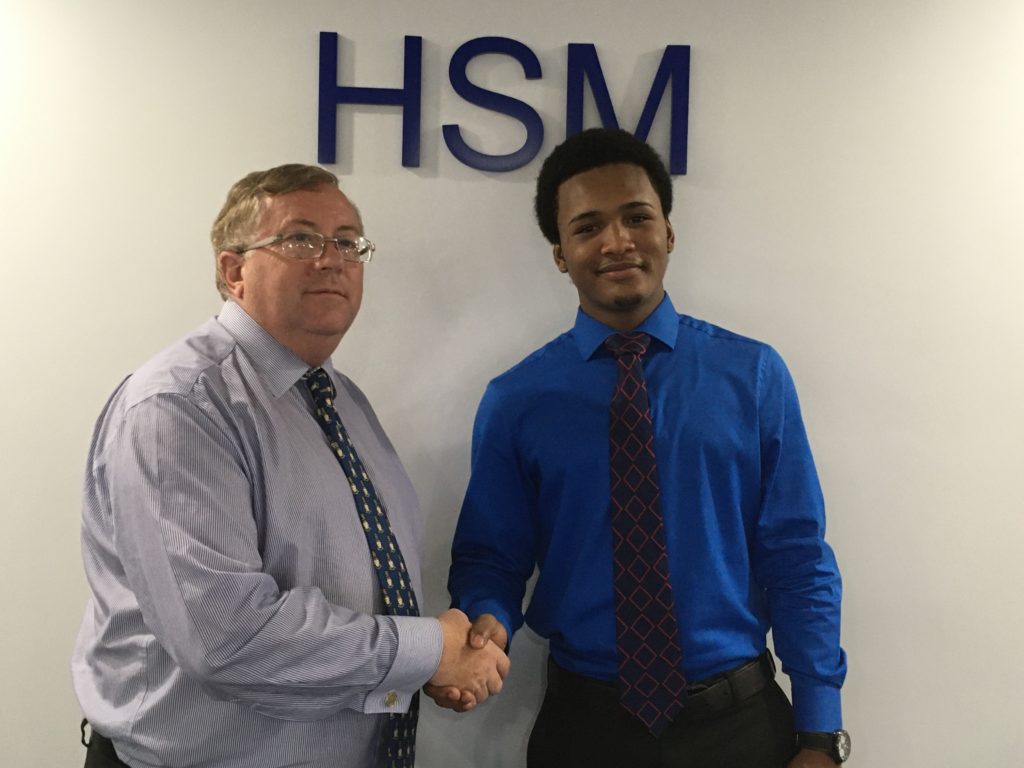
Photo (L-R): Pictured above is HSM Managing Partner, Huw Moses OBE with Tarec Francis
On 17 August 2020, the Cayman Islands Monetary Authority (“CIMA”) wrote to the heads of several private sector associations in the Cayman Islands, including the Cayman Islands chapter of the Society of Trust and Estate Practitioners (“STEP”) seeking their views regarding a proposal to introduce a new rule which would require Cayman Islands private trust companies (“PTC’s”) to inform CIMA if they intend to cease conducting ‘trust business’ (as defined in the Banks and Trust Companies Law (2020 Revision)), and to enable CIMA to de-register any PTC that they deem to be in breach of Anti-Money Laundering Regulations or in circumstances where the directors and officers of any PTC cease to be ‘fit and proper persons’ (as defined in the Banks and Trust Companies Law (2020 Revision) (the “New Rule”).
By way of background PTC’s are permitted to act as a corporate trustee for one or more CIMA approved family connected trusts and they cannot offer their services to the general public in competition with commercial trust corporations.
HSM is at the forefront of this process as Robert Mack sits on the STEP Legislative Reform Sub-Committee and is working to provide commentary on the proposal during the prescribed consultation period.
The nub of the problem lies in the fact that while every PTC must seek the prior approval of CIMA to conduct ‘trust business’ in the Cayman Islands and to be granted PTC status prior to assuming any trusteeships, however, there is currently no mechanism to de-register a PTC if it wishes to cease conducting ‘trust business’ for whatever reason.
In addition, there is no de-registration sanction which CIMA can impose where a PTC is in breach of Anti-Money Laundering Regulations or where the persons controlling the PTC cease to be ‘fit and proper persons’ in the opinion of CIMA. The New Rule, if implemented, will allow PTC’s to be deregistered either by their own volition or by CIMA acting independently with a view to maintain compliance with Cayman Islands laws and regulations.
A PTC wishing to de-register under the New Rule will be required to submit an application to CIMA within 21 days of ceasing to carry on ‘trust business’, and such application must be supported with a License Termination/Surrender/Deregistration Form, a resolution signed by at least two directors of the PTC indicating on what date the PTC ceased carrying on ‘trust business’, together with a declaration signed by at least two directors of the PTC confirming that (1) all clients have been informed of the de-registration (2) all outstanding liabilities of the PTC have been settled (3) all outstanding complaints (if any) against the PTC have been resolved, (4) there are no pending or threatened legal proceedings against the PTC, and (5) the PTC is not acting as trustee of any trusts.
The New Rule, if implemented, should further enhance the reputation of the Cayman Islands as a well-regulated financial centre and place the jurisdiction on par with other competing onshore and offshore centres. Also, it will create a clear procedure for PTC’s wishing to voluntarily deregister and will further enhance the powers of CIMA to oversee and regulate PTC’s and is therefore a welcome enhancement to the regulatory regime of the Cayman Islands.

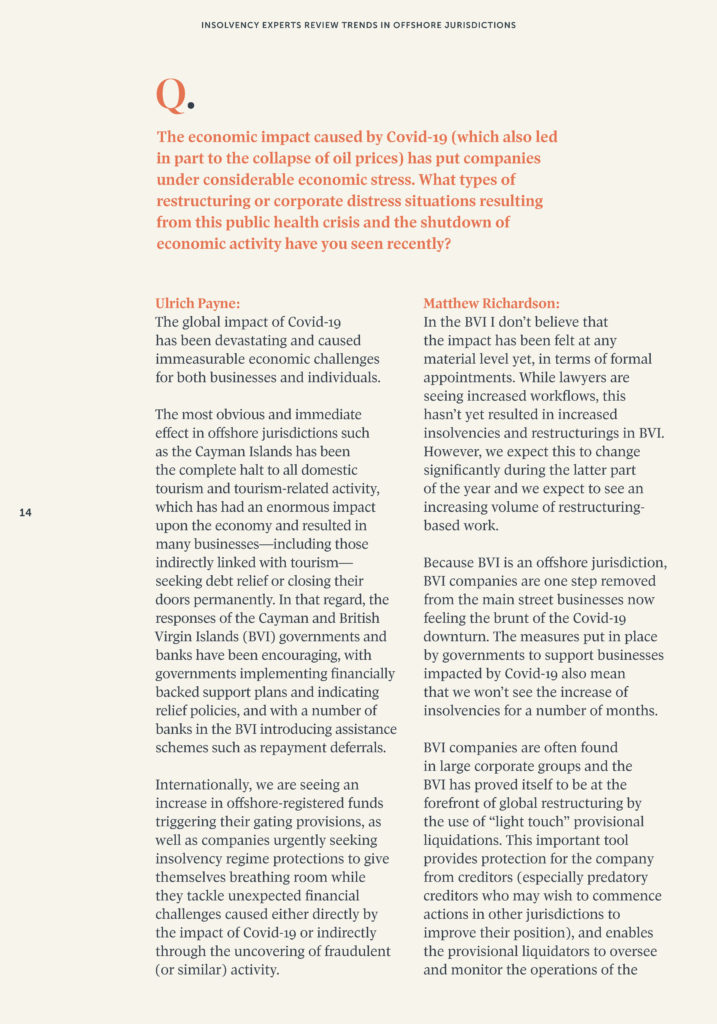
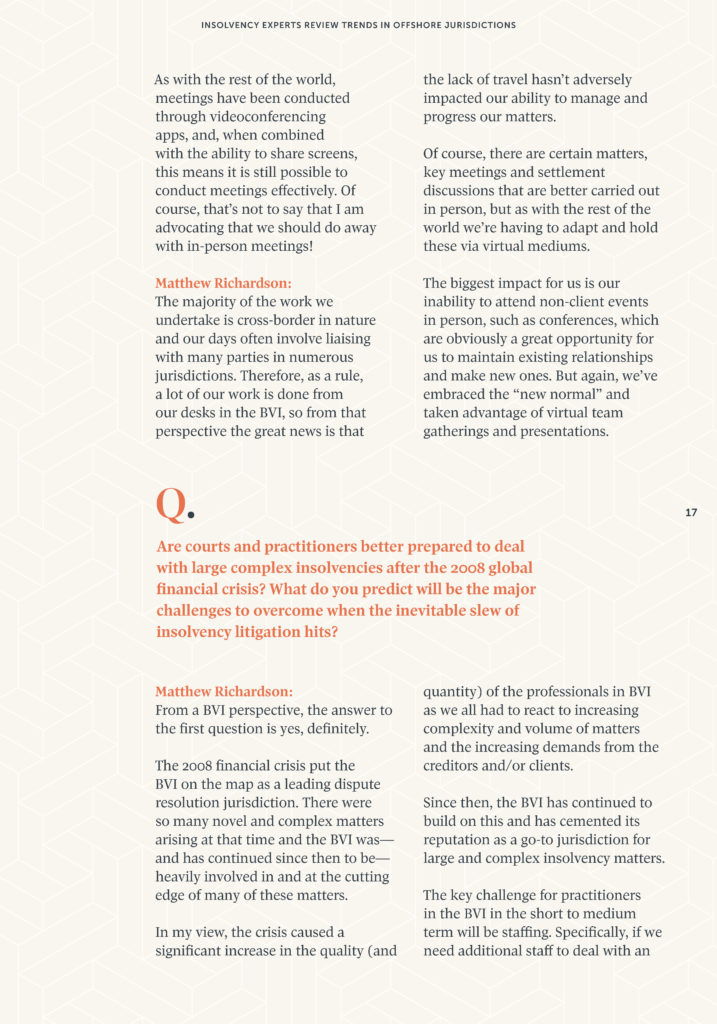
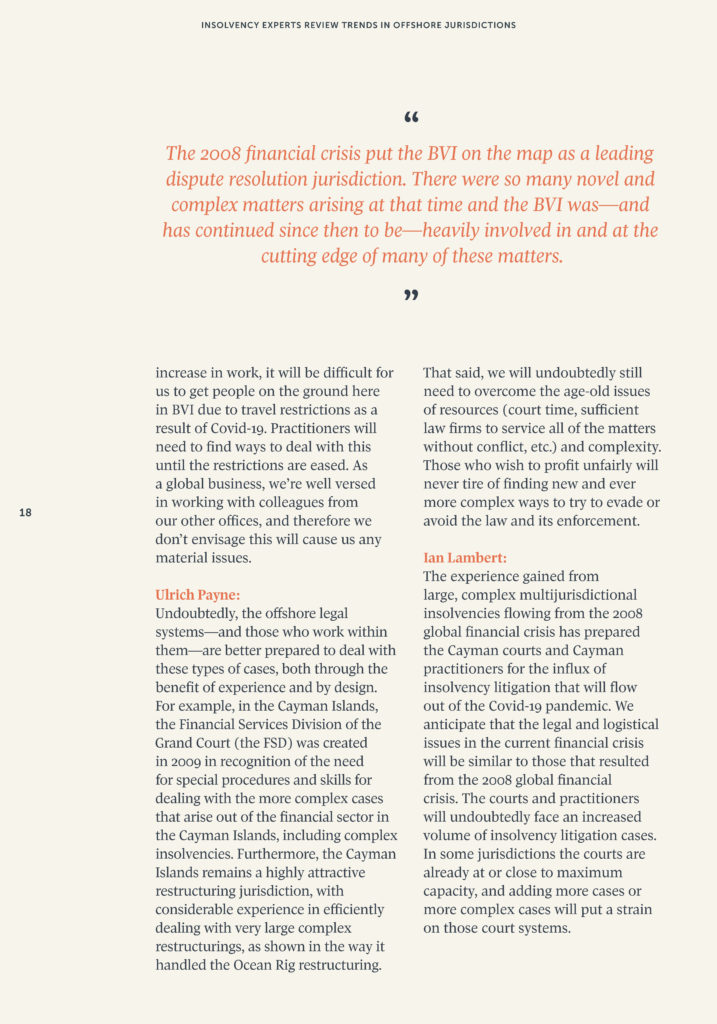
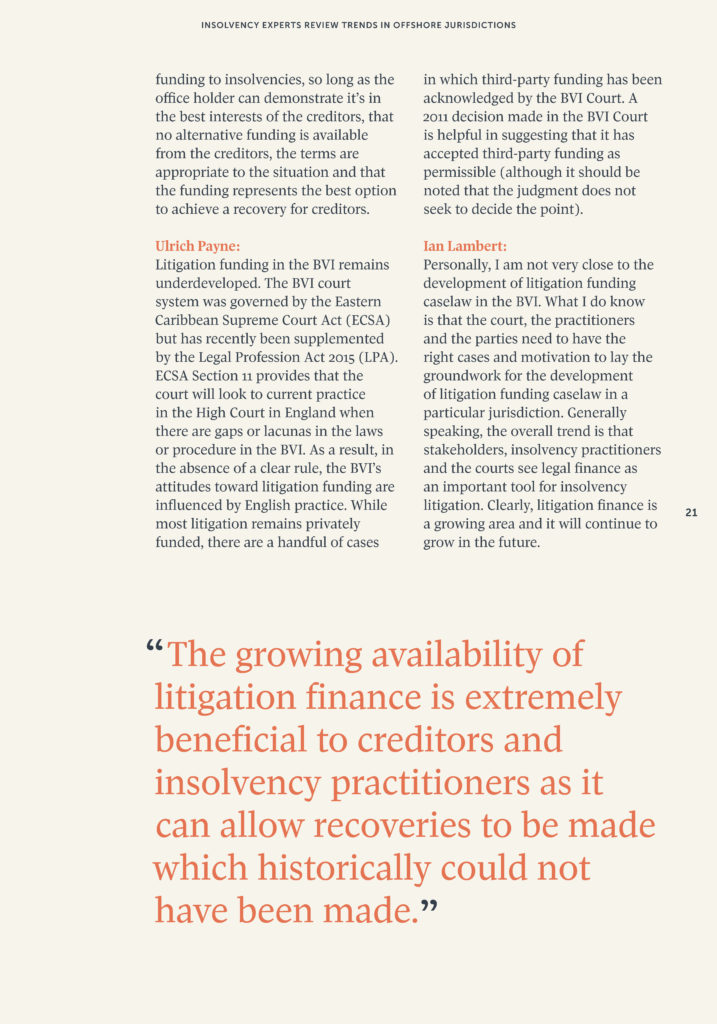
HSM’s Ian Lambert, Partner and Head of Litigation, Restructuring and Insolvency, has taken part in a Q&A covering insolvency trends in offshore jurisdictions alongside other experts in Burford Capital’s Q4 2020 report. Ian reviews the Cayman Islands and weighs in on the impacts of COVID-19.
Source – ‘Insolvency Experts Review Trends in Offshore Jurisdictions?’, The Burford Quarterly (No. 4 2020), pp.12-23: https://www.burfordcapital.com/insights/insights-container/2020-burford-quarterly-issue-4/.
Article Clip









HSM’s Robert Mack, Head of Private Client & Trusts, explores the possibility of personal data becoming a trust asset. The value of personal data to the private client industry has not been heavily explored. Trustees and personal representatives should acknowledge the power of personal data and plan for its exploitation.
Source – ‘Personal data trusts – for the masses?’, STEP Journal (Vol28 Iss4), pp.42-43: https://www.step.org/step-journal/back-issue-archive.
Article Clip


In November 2018, the Law Reform Commission published a Discussion Paper entitled “The Enforcement Of Mortgage-type Security Over Real Estate: Is Reform Of The Law Necessary?” which sought to consider whether reform of the law in relation to the enforcement of residential mortgages was necessary.
HSM is at the forefront of this discussion and its attorneys Huw Moses (Managing Partner), Sarah Allison (Partner) and Shula Sbarro (Associate) as well as other local attorneys have responded to the Law Reform Commission with an in-depth overview of the mortgage enforcement procedure in the Cayman Islands together with suggested amendments.
On 28 August 2020, the Law Reform Commission published Cayman’s Registered Land (Amendment) Bill, 2020 for public review and comment. The consultation period ends on 16 October 2020.
Notably, the proposed amendments to the legislation would see the introduction of a “Lending and Pre-action Protocol” which aims to encourage greater pre-action engagement between the parties and ensure that both the lender and borrower act fairly and reasonably.
The proposed pre-lending requirements would place obligations upon the lender to: provide the borrower with a prescribed list of information regarding the terms of the contract and consequences of breach prior to the creation of a legal charge; urge the borrower to seek independent legal advice; require the borrower to sign a special acknowledgment regarding their understanding of s.64(1) of the Law; and provide the borrower with a 5 day right of cancellation after entering into the legal charge.
Prior to exercising its power of sale in respect of a residential dwelling, the proposed new amendments mandate that a lender must comply with the Pre-action Protocol requiring the lender to, inter alia, explore solutions to enable the borrower to remedy any default in light of their individual financial circumstances.
The Bill also codifies the procedure for valuing, marketing and selling a charged property which is not dissimilar to the current procedure laid down by the Grand Court Practice Directions. Notably, there is an amendment to a lender’s power of sale which permits a sale of the charged land by public auction, private treaty, Cayman Islands Real Estate Brokers Association (CIREBA) MLS or any other method prescribed by Cabinet.
The Bill introduces a statutory right to apply to the Court for directions including an Order for access but critically, there remains no right to possession until the lender has sold the property.
The Law Reform Commission invites the general public to make comment on the proposed Bill by forwarding submissions to the Director of the Law Reform Commission, 4th Floor Government Administration Building, Portfolio of Legal Affairs, 113 Elgin Avenue, George Town, Grand Cayman, P.O. Box 136, Grand Cayman, KY1-9000 either (1) electronically to jose.griffith@gov.ky or (2) in writing, by post or hand delivery by the deadline of 16 October 2020.

Why should you hire a property attorney in the Cayman Islands? Most people would not dream of entering a courtroom without a lawyer. Yet, many forget that legal situations are not confined to the courtroom. Whilst most people will hire a lawyer to help with legal problems which have already arisen, most forget that ‘prevention is better than the cure’.
Purchasing a home is one of the most significant financial investments an individual will make during their lifetime. Selling a home also has its own unique challenges and requires an understanding of a broad range of factors.
Whether you are buying or selling real estate, hiring a property attorney offers you protection against the unexpected, and will ensure that the transaction will go as smoothly and as stress-free as possible. Hiring a property attorney can help buyers and sellers navigate and negotiate the transaction for the best possible outcome. Attorneys can nip problems in the bud before they become a problem, saving you time, energy and money in the long run by protecting you against any costly pitfalls.
I have a real estate agent. Do I still need an attorney?
The Cayman Islands has many experienced and knowledgeable real estate agencies that can work with your bank, developer and attorney when you are buying or selling property. The Cayman Islands Real Estate Brokers Association (CIREBA)[1] has a standard Offer to Purchase contract (basic form) which is often used by real estate agents.
Whilst these are often signed before the property attorney is instructed, it is always a good idea to have an attorney look over any contract you are planning to sign before you sign it…“sign in haste and repent at leisure”. Your real estate agent can offer good advice, however; they are not as well-versed in the law and they are not contract experts; having an attorney involved can only help. An attorney can ensure that all the proper wording is included in the contract to protect you in any situation that could arise.
Even if you already have a signed Offer to Purchase or have exchanged contracts, an attorney can provide you with valuable advice throughout the transaction. Parties often believe that using form contracts and documents will prevent legal issues from occurring, however, given the complexities of the law, and the multitude of issues that might arise over the course of the transaction, it is always a good idea to have legal representation.
What does a real estate attorney do?
Once the selling price and terms have been established by the parties, a real estate attorney can either assist in preparing the Sale and Purchase Agreement, or in reviewing the contract and all other relevant documents. Thereafter, they can assist you with negotiations and making any necessary adjustments to the terms of the deal to accurately reflect the agreement reached between the parties and ensure the terms and conditions are consistent with the other terms of the agreement and the relevant law. Your attorney will also prepare all required closing documents, provide you with a completion statement breaking down your financial obligations and will attend your closing along with your real estate agent and possibly a representative from your lender to ensure it goes smoothly.
That all sounds great, but do you actually need one?
We typically see buyers and sellers hiring an attorney where:
Buyers are:
- living outside the Cayman Islands;
- buying a property that is for sale by the bank (i.e. a foreclosure);
- buying a property that is part of an estate sale;
- buying a commercial property;
- buying a property that could potentially have some structural issues;
- buying a property where there will be multiple owners or
- buying a property using a company or buying from a company.
Sellers are:
- selling property that is in some state of distress;
- they are the heir or executor of the property owner;
- selling a house where another owner does not agree to its sale or
- selling a property subject to a caution, lien or other security interest.
However, even if none of the above scenarios apply, you should still hire a real estate attorney. Why?
1. Your attorney has no personal interest in the outcome of the transaction other than making sure you are taken care of. All other parties assisting you in the transaction may have a financial interest in the outcome (e.g. real estate agents wish to earn their commission).
2. Your attorney will review and modify the contract and all relevant documents to ensure your needs are met and your interests are protected, helping you avoid complications or unforeseen situations. Having a qualified expert available to explain the terms of the contract and/or propose modifications to it is in your best interest, especially when purchasing a pre-construction or development property.
3. If there is an issue with your deal, what are your legal obligations if you back out of the contract? Can you get your deposit back? Will you owe the other party any money for changing your mind? A real estate attorney has the experience and training to handle these types of issues and problems. They can explain the repercussions of backing out of the contract and set out all your options so you are fully informed before making a decision.
4. Negotiations can be difficult to navigate and there can be many other parties involved in your purchase or sale. Your attorney acts as an intermediary, working with your mortgage loan officer, the real estate agents and strata managers (where applicable) and can expertly negotiate with the other party’s attorney to make sure that the transaction runs smoothly from start to finish and is closed without unnecessary delays.
5. Your attorney will also prepare and/or review all documents, including the land register, mortgage loan, conveyancing and other closing/strata documents (where applicable) to ensure there are no unpleasant surprises. Even minor mistakes in these documents can create big issues and significantly delay your transaction. It can be very difficult to correct errors after a real estate transaction is closed and unless these complex documents are reviewed closely by a legal expert, it’s easy to overlook errors.
6. What happens if the property has an illegal structure, termites, lead paint, asbestos, or other potentially hazardous conditions? What if the property you are trying to purchase is involved in a legal dispute? Certain conditions need to be clearly defined and met to ensure you know exactly what you are getting into for your purchase. Your attorney can help you draft these conditions to help you avoid making a poor investment and properly advise you before you get locked into an unconditional contract so that you don’t end up unknowingly buying a home or property with costly defects.
7. Your attorney will investigate complex issues such as whether the seller is the registered proprietor and has the ability to sell the property. Legal problems can arise if, for example, the seller is partial-owner of the property, and attempts to sell without getting approval from the other owner. Your attorney will carefully review the land register, making sure there are no errors in the legal description and explaining the effects of easements, restrictions and zoning laws. They will also review any relevant documents, so that you can avoid many other potential problems including border disputes, strata disputes etc.
8. Real estate attorneys can be essential when you are considering the financial impact of the proposed financial transaction. They are well versed in advising on closing costs and the timing and distribution of such payments that can sometimes come as a surprise, derailing a purchase. Factors such as insurance, valuations, inspections, strata fees and upcoming strata assessments or stamp duty re-assessments need to be properly considered. Our property team will prepare your completion statement ahead of closing and review all relevant documents so you know exactly what to expect at closing and subsequently.
If the other parties involved have their own attorneys and you do not, you will be at a disadvantage. For all these reasons and more, hiring a real estate attorney is well worth the cost for the peace of mind that comes with having an experienced professional on your side throughout the transaction, and knowing that, once closed, you received everything you were entitled to during the process with no surprises.
[1] A Cayman Islands corporate body that regulates real estate agents

Sophie Peat (Partner at HSM IP) has contributed to Mondaq’s Comparative Guides for Trade Marks in the Cayman Islands.
Mondaq’s comparative guides provide an overview of the key points of law by carefully selected and internationally recognised experts. This tool also allows the ability for users to compare regulatory environments and laws across multiple jurisdictions.
Sophie covers trade mark classifications, registration procedure, appeals, oppositions, rights, protection, enforcement and more.
Beyond trade marks in the Cayman Islands, HSM IP are intellectual property specialists across the Caribbean and their offices are based in Grand Cayman.

With the reopening of the real estate and construction sectors of Cayman’s economy, potential customers are most likely purchasing within a strata community. HSM Property Attorney Oscar DaCosta equips buyers with everything they need to know when it comes to strata properties in the Cayman Islands.
A Strata Title is a form of ownership of multilevel apartment buildings, condominiums or horizontal buildings, townhomes with shared areas or common grounds. The “strata” being the strata lot which is your apartment, condo or townhome in the community is governed by the strict rules and regulations found in the Strata Bye-Laws. These bye-laws are either by statute or most commonly found with condominium or townhome developments, drafted to include specific requirements that are unique to the development in which you may wish to purchase.
The strata usually covers the general maintenance of the grounds and exterior buildings, common areas as well as any amenities within the community (pools, gyms, tennis courts). Insurance is also included and some strata’s may include a basic cable package as well. These costs are covered by the owners who pay a regular sum to the strata either monthly or quarterly in advance.
The bye-laws are registered as “the Proprietors Strata Plan No. X”. The bye-laws always state that an executive committee is to be formed and an Annual General meeting held each year with the owners (Proprietors) of the Strata Lot. The Executive can also call meetings in addition to the Annual General meeting known as an Extra Ordinary General meeting if they see fit. A quorum must be met in order to hold these meetings and to vote on any proposed amendments to be made in regard to the strata and bye-laws. However, this is probably the only thing that all strata’s have in common.
Strata bye-laws state the obligations of the Proprietor and of the Strata Corporation (Executive Committee). Some strata bye-laws have obligations on the Proprietor in regards to conducting business from their strata lot (unit) regarding working from home. Thus if you propose to conduct business from your strata unit, permission would have to be sought from the Executive Committee in order to do so. With working from home being the new normal because of the current shelter in place regulations, and some persons wishing to continue to do so even after their offices have reopened, they may need to seek clarification from their strata as to not be in contravention of the strata.
Potential buyers may also be looking to purchase in developments for investment property. Some strata’s include in their bye-laws, the minimum length of term one can lease their strata lot (unit) to a tenant. Most do not allow for leasing the unit for less than 31 days and others require a minimum lease of 6 months. So, if a purchaser is thinking of investing in a property with an eye to list their property on short stay vacations sites such as Airbnb, VRBO and the like, they should definitely review the strata bye-laws of their favoured development to ensure they can do so.
Many are pet lovers as well. So, when looking at potential property in a strata community, the bye-laws would speak to this. Some strata’s do not allow pets at all, others may limit the number of pets, as well as limiting the pet to a specific size and weight. Some strata’s also state that the pet may only be a cat or a dog, therefore if you wanted to own a bird or other type of animal they may not be allowed and special approval would need to be sought from the Strata Committee. Funnily enough, in my research for this article there was no mention of fish as pets in any of the bye-laws researched.
The bye-laws also hold all the restrictions within the community and rules from parking spots, washing of motor vehicles and the parking of boats if not in a waterfront community. Also stating what type of window dressings may be used and colour of same. What can be placed on porches or balconies and what cannot.
Stating the above, my research also found that some strata communities will seek to interview a potential owner of a property in order to authorize the purchase of a unit in that particular strata, including reference letters addressed to the strata.
In summation, a strata is usually well maintained and equipped, rather easy to live in (as all the usual maintenance of the grounds and common areas and exterior repair of buildings is included) within the confines of the bye-laws. However, you should always read the bye-laws before making the decision to purchase as the rules vary between the developments, and some of the restrictions might not suit your lifestyle.
HSM’s team of property attorneys are well-versed in these types of contracts and can assist buyers as well as developers with drafting and understanding strata bye-laws. This article provides a general overview and we encourage you to reach out to an attorney for appropriate legal advice that is unique to your circumstances.

Congratulations to our Head of Private Client and Trusts, Robert Mack, for being ranked by Chambers and Partners in their High Net Worth (HNW) Guide 2020 for Offshore: Trusts in Cayman Islands.
Cited on the Chamber website, an offshore commentator shares this about Robert: “He really goes above and beyond to promote the Cayman Islands as a place to do business for the international market...he is on the STEP council and is respected.”
Robert has been featured by Chambers and Partners for the past several years and this is testament to his ongoing success in the field.
Chambers and Partners is a prestigious hub for lawyer recommendations. They diligently research and feature the world’s best lawyers and have done so since 1990, covering over 185 jurisdictions.
Key Contact

Robert Mack
Head of Private Client and Trusts
Tel: 1 345 815 7356
rmack@hsmoffice.com
Fatal error: Uncaught Error: Call to undefined function twentythirteen_paging_nav() in /home/clients/d17af2243e6f179e393695ba6e9ce04e/hsmnew/wp-content/themes/hsm/author.php:52 Stack trace: #0 /home/clients/d17af2243e6f179e393695ba6e9ce04e/hsmnew/wp-includes/template-loader.php(86): include() #1 /home/clients/d17af2243e6f179e393695ba6e9ce04e/hsmnew/wp-blog-header.php(19): require_once('/home/clients/d...') #2 /home/clients/d17af2243e6f179e393695ba6e9ce04e/hsmnew/index.php(17): require('/home/clients/d...') #3 {main} thrown in /home/clients/d17af2243e6f179e393695ba6e9ce04e/hsmnew/wp-content/themes/hsm/author.php on line 52