All posts by hsmoffice
As communities at large look towards their physical health, businesses are looking at their financial health. One question which has arisen is whether a contract containing a Force Majeure clause is, or can be, triggered by the COVID-19 pandemic. Further, if there is no such clause in the contract can one of the common law doctrines apply, such as frustration and illegality, due to a supervening event.
Force Majeure Clause
Force Majeure clauses are usually contained in commercial type leases, but not always. The contract/lease should be considered in the first instance and, if present within the contract, then it will become a question of construction. These types of clauses are generally recognizable but they do not always state what they are. These clauses are generally present to alter one or various rights and obligations of the contracting parties when one of the events detailed in the clause occurs or, depending on the construction of the clause, some other supervening event occurs. The event prevents the parties from complying with their obligations under the contract and the clause may set out what is supposed to happen at that point between the parties.
These types of clauses can be drafted very differently and, the consequences of this, can result in various possible outcomes for the parties. The clauses can be written broadly and/or be more specific.
Force Majeure is contract based as opposed to a general common law doctrine, described in 1902 in Lebeaupin v Richard Crispin and Company [1920] 2 K.B. 714 as:
“… a “force majeure” clause should be construed in each case with a close attention to the words which precede or follow it, and with a due regard to the nature and general terms of the contract. The effect of the clause may vary with each instrument”.
The general approach taken by the Courts is one which is viewed as fairly restrictive, which likely stems from the Courts’ general restrictive approach throughout the years to exemption type clauses. In the Cayman Islands, this may still be the approach because, unlike in some other jurisdictions, Cayman does not necessarily have the statutory restrictions placed on these types of clauses. If they are not restricted by implied statutory provisions then the Courts will likely maintain the restrictive approach, when considering reliance on the clause. It is highly likely that in Cayman the Courts will first look to the common law doctrine of frustration and how it has been applied and then interpret the Force Majeure clause. Certainly the Courts would have no shortage of case law to refer to from other jurisdictions, given that Force Majeure clauses have been well litigated.
The burden of proof lies with the party who seeks to rely on the clause. They will have to prove:
- That the clause should apply in light of COVID-19
- It is beyond the control of the parties
- Inability to mitigate – this will be timing and fact specific
- Foreseeability may or may not be a consideration (depending on the contract)
- Relevant Notice (whether there is a requirement to serve notice when seeking to rely on the force majeure clause)
There is no reason, unless the contract specifically provides something else, why the parties cannot agree to suspend performance on both sides during this pandemic or ‘forgive’ non-performance for a period without specifically bringing the lease to an end. Whereas the other common law doctrines bring the contract itself to an end.
Going forward parties to a contract may wish to be more specific with the allocation of risk in the lease as well as when the clause could be triggered.
No Force Majeure Clause
If there is no such clause in the contract then the question no longer focuses on the construction of the contract. Instead the focus reverts back to legal principles and common law cases applying the other doctrines.
Frustration
This doctrine has only been applied in a limited way by the Courts historically. The case of Davis Contractors Ltd v Fareham UDC [1956] AC 696 is still the defining case in relation to what constitutes frustration, being that:
- it was a supervening event – neither party defaulted (no blame on either party)
- parties have become incapable of performing because performance would be radically different from what was originally undertaken by the parties under the contract.
The lease/contract should be explored at this point.
There are similarities to Force Majeure in that:
- foreseeability is a component (the event must be unforeseen)
- it renders the contract impossible to perform or changes the main purpose of the contract
- there must be a supervening event for which neither party is responsible
Whereas a Force Majeure clause can end a contract in a specific way (allocating risk and loss in a specific way between the parties), the doctrine of frustration will likely mean that losses incurred will crystalize at termination and the respective parties will shoulder whatever the loss is, at that point. Landlords in this scenario are more likely to shoulder more of the financial loss e.g. unpaid rent/utilities and so on.
In some jurisdictions, including Cayman, there are statutes which protect parties from the ‘fall out’ of the application of the doctrine of frustration e.g. statute allocating obligations and losses. It may still be possible to recover monies or have the Court address apportionment of risk and loss/costs when a contract has been found to be frustrated or impossible to perform. In Cayman there is the Contracts Law (1996 Revision) under which a statutory claim may be made. Sections 5 and 6 of the Contracts Law potentially allow for claims for monies owed, prior to discharge of the contract and claims for non-monetary benefits as a result of the contract having been found to be frustrated. This is an unsettled area of common law and certain types of contracts are excluded e.g. insurance contracts. However, the common law may again come into play, via a claim for unjust enrichment, when a certain type of contract is excluded under this law.
There is much case law surrounding the application and extent, not only of Force Majeure clauses but the other doctrines as well. It must be borne in mind that every case will turn on its own facts and the length of the COVID-19 pandemic compared to the length of the lease will be a factor considered.
Illegality (some other supervening event)
The doctrine of illegality, if the supervening event results in a contract being illegal – then performance is illegal. However, the facts of the case are important. If a contract is merely partially unable to be performed or the contract is more difficult to perform – this is not adequate to satisfy the strict criteria which would allow the reliance on this doctrine. Again there is much case law surrounding the application of this doctrine.
Practical Considerations
The Landlord at this time should:
- Look to the Lease
- Is there a Force Majeure clause and what does it say?
- What are the Landlord’s obligations and what are the Tenant’s usual remedies in relation to these?
- Explore the possible areas where the Tenant may seek to rely on any such clause
- Consider cover under any insurance policy
- If the property is mortgaged – speak to the lender
The Tenant at this time should:
- Look to the Lease
- Is there a Force Majeure clause and what does it say?
- What are the Tenant’s obligations and what are the Landlord’s usual remedies in relation to these?
- Explore the possible areas where the Landlord may seek to rely on any such clause
- Consider abatement clauses and other restrictions clauses e.g. where it is illegal to carry on business in this case due to Government restrictions
- Other clauses which allow cessation or reduction in rent payable and the circumstances surrounding the use of such clauses
- Consider cover under any insurance policy (may cover loss of income)
- If the business has a loan – speak to the lender
Conclusion
If there is no Force Majeure clause in the lease, we strongly suggest you seek legal advice and our team is ready to assist you through this time of uncertainty.
Key Contact
Shula Sbarro
HSM Associate
Tel: 1 345 936 7417
ssbarro@hsmoffice.com
HSM’s Head of Private Client & Trusts, Robert Mack, discusses the impact of COVID-19 on the trusts and private client industry in the Cayman Islands – setting out what practitioners could be doing now to prepare for potential issues in the future.
Robert was interviewed by Katharina Byrne from LexisNexus. This was first published by LexisPSL Private Client.
How has the Trust and Private Client in the Cayman Islands reacted to COVID-19?
The industry has reacted swiftly by implementing work-from-home policies and procedures across the board, maintaining a high level of client service despite temporary office closures due to ‘shelter-in-place’ orders and curfews implemented by the Cayman Islands Government.
The local council of the Society of Trust and Estate Practitioners (“STEP”), of which I am a member, has continued to function and hold virtual meetings. They have been focusing their efforts on entering into dialogue with the Cayman Islands Government and the local regulator, the Cayman Islands Monetary Authority (“CIMA”) to address the various challenges brought on by the COVID-19 pandemic impacting the local industry.
What is the current state of the Trust and Private Client Industry in the Cayman Islands?
Private client practitioners are reporting an increase in estate planning instructions as clients seek to get their affairs in order partially out of fear of COVID-19 and partially due to the fact that many clients are in self-isolation and therefore have more time to dedicate to personal matters.
There is a noticeable increase in lifetime planning instructions using trusts and foundation companies, while some reports indicate that clients are putting matters on hold while they await global developments on COVID-19.
Trustees are experiencing increased client contact on a number of fronts, including tweaking existing structures and considering techniques to improve tax efficiency of their structures; for example, by taking advantage of recent stock market losses to capitalise on losses.
Sadly, it is expected there will be an increase in estate work, especially given the global nature of the client base in the Cayman Islands and the fact that COVID-19 is now present in the vast majority of countries in the world. While the virus is present in the Cayman Islands the numbers infected are very modest at present, and it is hoped the measures taken by the Cayman Islands Government, which include closure of the borders, curfews, and social distancing will halt the spread of the virus allowing the local economy to re-open.
What are the current challenges facing the Trust and Private Client industry in the Cayman Islands?
The primary challenge is the uncertainty COVID-19 has introduced into the market, and the resulting decease in wealth felt at all levels of society, including high-net-worth individuals and families, particularly those with a large exposure to the global equity markets who have suffered historical losses. It is impossible to predict what effect this will have on the industry as a whole, but most practitioners agree that wealth and estate planning remain vital tasks for their clients despite the state of the economy. That said, activity in the commercial trust sphere (such as investment unit trusts) are likely to see a decrease in the short to medium term while the global economy remains unstable.
There are also practical problems with respect to the collection and verification of client due diligence and the execution/notarisation of documents, particularly Wills which require two witnesses to be present at the time of execution to be formally valid as a matter of Cayman Islands law. Will practitioners are having to become creative to overcome such limitations, but it certainty remains possible to comply with the current formalities by taking precautions, such as ensuring witnesses wear suitable protective equipment (gloves, masks) and by maintaining a certain distance (six-feet minimum) from the testator/testatrix and the other witness at all times.
Face-to-face meetings with clients have ceased and have been replaced with teleconference or video conferencing meetings. This has introduced some challenges dealing with elderly clients who may not be familiar with teleconferencing and may be more used to face-to-face meetings, as well as making it more difficult for private client practitioners to detect the presence of undue influence or lack of mental capacity in their clients.
Clients who are hospitalized for COVID-19 present a particular challenge and would require private client practitioners to exercise extreme caution when taking instructions to ensure such clients have the requisite mental capacity to provide instructions, and would also require special procedures to be observed to ensure the witnessing of documents is compliant with local formalities as previously mentioned. It should be possible for medical staff to act as witnesses on documents such as Wills (if they are permitted to do so by their employers) so long as they are given sufficient coaching by the private client practitioner.
Has the Cayman Islands Government responded to these challenges?
CIMA have been in regular dialogue via video conferencing with the local branch of the Society of Trust and Estate Practitioners (“STEP”), and CIMA is in separate dialogue with the Cayman Islands Government on the concerns raised by STEP. It is possible the Cayman Islands will follow other jurisdictions to allow virtual witnessing of Wills and other documents, however, that is not yet confirmed.
CIMA continues to function well despite staff working from home. There are several reports from practitioners that CIMA has been highly responsive during this period, which is reassuring.
The Court continues to function well and has implemented several new polices such as video-link hearings to enable its business to carry on.
The General Registry remains open and is fully functional.
As a result of COVID-19, the Cayman Islands Government has extended the 2019 FATCA reporting deadline to 16 November 2020 in response to the US Government relaxing its deadlines.
The Cayman Islands Government has also extended the 2019 CRS reporting deadline to 18 September 2020.
What should private client practitioners and professional trustees be doing now to prepare for potential and current issues in the future as a result of COVID-19?
There should be a recognition that the global COVID-19 crisis will continue to have powerful and unpredictable effects on the way private client and trust business is done during the crisis and in the foreseeable future. Even as the pandemic subsides, clients and service providers may be more reluctant to conduct face-to-face meetings, with virtual meetings likely becoming the preferred option.
Working from home will likely become more commonplace, so it is important for our industry to invest in the necessary infrastructure to enable its workers to adapt to this new reality.
I expect to see a bump in trust and estate litigation in the medium term to address losses to trusts and estates arising as a result of the collapse in global equity markets. Trustees and other fiduciaries with investment responsibilities should be implementing steps to mitigate losses as well as being extra vigilant in the management and deployment of assets until global markets settle.
Dialogue is continuing with CIMA and the Cayman Islands Government to ensure that appropriate legislation and regulations are introduced in a timely manner to further enhance the position of the Cayman Islands as a premier trusts and private client jurisdiction. Practitioners will need to be aware of changes as they arise so they can be put into practice quickly.
Lastly, we have to be able to anticipate the needs of our clients in advance and listen carefully to our clients’ needs to ensure we continue to deliver a high level of professional service despite any challenges COVID-19 brings. The Cayman Islands has weathered many challenges in the past and we have learned to adapt and overcome adversity. The Cayman Islands remains very much open for business and we will continue to take such steps as are necessary to maintain our position as a premier financial center, and we hope to play a key part of reviving the global economy once the pandemic passes.
The coronavirus (COVID-19) is causing economic concerns around the world and our home-base in the Cayman Islands is no exception. Our lawyers are carefully monitoring and complying with the guidelines as set by the Cayman Islands Government. We make it our mission to keep abreast of these changes and how they may affect you, our valued clients.
As Cayman’s go-to legal experts, HSM has put together a guide to help advise a number of persons and businesses as to the requirements/expectations of the Law, covering areas under corporate and commercial, debt solutions and recovery, employment and immigration, insolvency, insurance, private client and property.
Ultimately we are all in this together and HSM is on-hand to assist you during these unprecedented times.
This situation and its effects are ever-changing so we will be updating this guide on our website. If you have a question that is not covered in this guide, please reach out to a member of our team. Our expertise enables us to provide clear, sound and timely advice on any concerns that you may have.
Click on the icon below to download this guide.

Last updated: May 4, 2020.
This guide is intended only to provide a summary of the subject matter. It does not purport to be comprehensive or to provide legal advice. No person should act in reliance on any statement contained in this guide without first obtaining specific professional advice. Alternative solutions also exist which may better suit the requirements of a particular individual or entity.
As COVID-19 impacts the Caribbean and Latin America the intellectual property (IP) world keeps on spinning, with IP practitioners and IP offices and registries finding new ways of working to ensure that the rights of brand owners and innovators are still protected during the global crisis. Whilst things naturally change and develop daily at different paces in each respective country, with local governments taking steps to ensure that proportionate protective measures are put into place to protect citizens and residents, HSM IP is also constantly monitoring the situation in each country from an IP perspective, to ensure that clients have the most up-to-date information about what is possible.
Our team at HSM IP is available to help clients find the most practical solutions to the various issues posed. In this article, we hope to give you a flavour of the key types of approaches being adopted to date so that you have an idea of what you may expect.
As those with international IP portfolios will be aware, many countries in this part of the world are not yet set up for online filing and much of the work is typically conducted through the physical submission of original documents by hand, which often need to be notarised and/or legalized in advance of submission. Given the various curfews in place, this can make it very difficult for IP practitioners to make such filings even where the registries are still operational. Some of the countries which can already process certain applications online include the likes of Argentina, Brazil, the Caribbean Netherlands, Chile, Colombia, Curacao, the Dominican Republic, Ecuador, Puerto Rico, St. Maarten and Uruguay.
However, countries which usually fall into the latter category, such as Antigua and Barbuda, have now implemented progressive measures to ensure that trade mark applications can be submitted via email during their current lockdown period with an undertaking that fees and the original application with supporting documents will be submitted at a later date. The date of receipt of the email with the scanned application form and supporting documents will be honoured as the filing date, even though applications may not be processed until the Registry reopens.
Furthermore, if priority is claimed, the proprietor will have three months to submit the supporting documents once the local lockdown period is over. Similar steps have been taken in Anguilla, the Bahamas and in the Turks and Caicos, with the submission of applications by email being permitted during this period. Trinidad and Tobago has implemented a new online filing and e-payment system. It seems that the pandemic is pushing the rate of modernization in this part of the world.
Other registries have been able to stay open for reduced hours to date. For example, the Bermuda Registry, whilst still requiring the submission of documents by hand, has been accepting new filings at set time-periods on a couple of designated days per week. However, with the country set to go into 24/7 lockdown for two weeks as of 4 April 2020, it is yet to be announced whether the Registry will accept filings made by email during this period.
The Cayman Islands IPO (‘CIIPO’) was also working on a reduced-hours basis until 25 March 2020. At the time of writing CIIPO is set to tentatively reopen on 6 April and all filings made by email during the period of closure will be processed thereafter. The Ministère du Commerce et de l’Industrie in Haiti was completely closed until this week and is now operating on a reduced hours basis. The Bureau of IP in Suriname is also currently working on a reduced-hours basis.
Elsewhere, registries are closed completely until further notice and are not currently accepting new filings and applications. At the time of writing, this is the case in Aruba, Barbados, Dominica, El Salvador, Grenada, Guatemala, Honduras, Montserrat, Panama, Peru and Venezuela. However, most registries are automatically extending key deadlines (e.g. renewal and office action deadlines) during the period of closure.
This is the case in Barbados, Bermuda, the BVI, the Cayman Islands (deadlines falling between 26 March and 30 April 2020 will currently be extended for a period of 30 days from their expiry), Cuba (deadlines falling between 27 March and 4 May 2020 will be extended to 5 May 2020), the Dominican Republic, Ecuador, Guatemala, Jamaica and Puerto Rico, amongst others. Trinidad and Tobago will comply with all extension of time requests during the shutdown period (29 March to 15 April 2020) other than in respect of opposition deadlines and priority filing deadlines, which are determined by statute and will not be extended.
This article should be treated as a rough guide only as things are changing daily. HSM IP will continue to monitor developments in each country and is ready and able to provide tailored advice on specific queries as and when they arise. For further updates and information, please contact our Senior Associate, Sophie Peat at speat@hsmoffice.com.
Further to the Cayman Islands Governments’ recent changes to the Anti Money Laundering (AML)/Combatting the Financing of Terrorism (CFT) regime to include virtual asset services as “relevant financial business” the jurisdiction is now set to implement a registration and licensing regime for virtual asset service providers.
Virtual Asset (Service Providers) Bill (the “Bill”/the “Law”)
The Bill is currently in a consultation phase during which time comments can be provided to the Cayman Islands Government up until 8 April 2020 (date extension provided on March 21 due to COVID-19), but should the Bill be passed into Law in its current form we can expect the following:
Virtual Asset Services
The Bill defines virtual asset services as providing one or more of the following services or operations for or on behalf of a natural or legal person—
(a) exchange between virtual assets and fiat currencies;
(b) exchange between one or more other forms of convertible virtual assets;
(c) transfer of virtual assets;
(d) safekeeping or administration of virtual assets or instruments enabling control over virtual assets; or
(e) participation in, and provision of, financial services related to a virtual asset issuance or the sale of a virtual asset.
Virtual Assets are defined as “a digital representation of value that can be digitally traded or transferred and can be used for payment or investment purposes but does not include a digital representation of fiat currencies”.
It is important to note that under the Bill, Virtual Utility Tokens are not deemed to be virtual assets and a person or legal arrangement that provides services that involve these tokens only do not require registration or licensing under the Bill.
Registration/Licensing
Under the Bill a person (being a Cayman Islands company, a Cayman Islands general partnership, a Cayman Islands limited partnership, a Cayman Islands exempted limited partnership, a foreign company registered in the Cayman Islands, a Cayman Islands Limited Liability Company (LLC) or a Cayman Islands Limited Liability Partnership (LLP)) shall not carry on or propose to carry on any virtual asset services unless they are registered with the Cayman Islands Monetary Authority (“CIMA”) as a registered person, hold a virtual asset service licence, a sandbox licence or is otherwise already licensed by CIMA and has been granted a waiver from further licensing or registration.
It will be an offence to carry on business without a licence, registration or waiver and those found guilty will be liable on summary conviction to a fine of CI$25,000 and imprisonment for one year, and in the case of a continuing offense, to a fine of CI$10,000 for each day during which the offence continues.
Registered Persons
Any persons wishing to provide a virtual asset service which is not the provision of virtual asset custody services or the operation of a virtual asset trading platform will need to register with CIMA as a ‘registered person’.
Registered persons will need to apply with CIMA and be bound by the Anti-Money Laundering Regulations (as Revised) and the senior officers and trustees of the applicant will need to be ‘fit and proper persons’.
Once the application is approved the applicant will need to pay an application fee and annual renewal fees, which will be due on or before 15 January.
In considering the application to be a registered person CIMA will also consider whether a full licence or a sandbox licence should instead be applied for.
Virtual Asset Service Licence
Those applying for a virtual asset service licence (to provide virtual asset custody services or to operate a virtual asset trading platform) will also apply to CIMA who will consider whether:
(a) the applicant will be able to comply with the Law;
(b) the applicant will be able to comply with the relevant requirements of the Anti-Money Laundering Regulations (as Revised);
(c) an approval of the application is not against the public interest;
(d) the applicant has —
(i) personnel with the necessary skills, knowledge and experience;
(ii) facilities, books, records and accounting systems;
(iii) adequate capital and cybersecurity measures, as the Authority considers appropriate having regard to the size, scope and complexity of the business;
(e) the applicant’s senior officers and trustees are fit and proper persons to hold the respective positions;
(f) the applicant’s beneficial owners are fit and proper persons to have such control or ownership; and
(g) the applicant has complied with such other requirements under this Law which the Authority requests that the applicant complies with.
The application will need to be accompanied with an assessment fee.
CIMA may refuse or grant the licence or direct the applicant to apply for a sandbox licence or another licence under one of the regulatory laws where the virtual asset service is similar in nature to a service for which registration or a licence is required.
CIMA may also impose further regulatory requirements which it considers necessary based on its assessment of the virtual asset services to be provided by the applicant, the nature of supervisions required for the virtual asset service etc.
Where CIMA deems it necessary a licensee shall have its accounts audited at such times as CIMA may require.
Sandbox Licences
A sandbox licence is a temporary licence which can be granted for a period of up to one year and is subject to CIMA review as such times as CIMA deems appropriate.
CIMA will likely direct a registered person applicant or licence applicant to apply for a sandbox licence where:
- the virtual asset represents an innovative use of technology or uses an innovative method of delivery that requires supervision and oversight that is not offered by a licence or registration under this Law or any other law;
- it is in the best interest of the public, existing licensee or the financial markets for the virtual asset service to be temporarily restricted or for specific requirements to be placed temporarily on the provision of the virtual asset service;
- the virtual asset service uses or promotes technology or method of delivery that may create systemic risk to the financial markets or otherwise to the jurisdiction; or
- the virtual asset service poses an anti-money laundering, terrorism financing or proliferation financing risk that is not properly mitigated by the Anti-Money Laundering Regulations (as Revised) or the Law.
Amendments to the Securities Investment Business Law (“SIBL”)
In line with the proposed Virtual Asset (Service Providers) Bill the SIBL is being amended to include virtual assets in the definition of securities. In particular virtual assets which can be sold, traded or exchanged immediately or at any time in the future that (a) represent or can be converted into any other securities listed on schedule 1 of the SIBL or (b) represent a derivate of any of the securities listed in Schedule 1 of the SIBL.
With the above in mind, SIBL licences and or registration will likely become necessary in the near future for those dealing with Virtual Assets.
HSM’s Employment and Immigration lawyers are advising a number of persons and businesses as to the requirements and expectations of the Cayman Islands Law during COVID-19, in particular where businesses may be required to make staff redundant.
Redundancy is defined in Cayman Islands Law as “a situation in which, by virtue of a lack of customers or of orders, retrenchment, the installation of labour-saving machinery an employer’s going out of business, force majeure or any other reason, tasks which a person was last employed to perform no longer exist.”
Cayman Islands Labour Law
A redundancy is a form of “fair dismissal” provided it is carried out in accordance with the Labour Law. The Law provides for preference in employment. If a group of persons carrying out a specific role within an organization are to be made redundant, the Law requires that preference be given according to immigration status. It follows that work permit holders are expected to be made redundant before permanent residents, permanent residents are expected to be made redundant before the spouse of a Caymanian holding a Residency and Employment Rights Certificate, and Caymanians are expected, by Law, to be the last to face redundancy. This is entirely academic if a business is closing down. All persons (without regard to immigration status) will likely be made redundant together. That is perfectly lawful.
Given that a redundancy constitutes a form of termination, it triggers a series of entitlements.
These include severance pay, notice pay, and accrued (but untaken) vacation pay.
Severance Pay is calculated as being one week’s pay, at the latest “basic wage”, for each completed year of service. “Basic wage” means the ordinary wage due to an employee under his or her contract of employment. It does not include such matters as future anticipated gratuities and commissions. Accordingly, for many, the basic wage will be CI$6.00 (or such other higher number set out in their contract of employment. Where no formal contract exists, the amount can be determined by reference to the conduct of the employer and employee – i.e. what is the basic wage that has in fact been paid.
Notice pay is determined by reference to the contract of employment. Where no notice period is prescribed it is deemed to be the interval between pay days.
Accordingly (by way of example) an employee who is made redundant on 31 March and who:
- has been employed by that employer for 3 years and 2 months
- earns CI$6.00 per hour at basic wage for a 40 hour week (CI$12,480 per annum); and
- has a 10 day annual vacation entitlement and has taken none this year;
would generally expect to be entitled to payment on redundancy of:
- 3 weeks severance of CI$720
- One month’s notice pay of CI$1,040 (assuming the employee is not asked to work during their notice period); and
- 2.5 days accrued but untaken vacation pay of CI$120.
A person in this situation would accordingly expect payment on redundancy of CI$1,880. Such payment is payable immediately on termination.
National Pensions Law
There is generally no entitlement to access pension monies prior to retirement. However, severance payments made on redundancy are not pensionable, but accrued untaken vacation pay, and any payment due in lieu of notice, are considered to be pensionable under the National Pensions Law. Also it should be noted that any additional voluntary contributions made by the employee can be withdrawn due to unemployment.
Health Insurance Law
All residents in the Cayman Islands are required to have “adequate” health insurance. As a general rule the obligation to ensure that health insurance is in place rests with employers. Upon termination of employment employers are generally required to ensure that health insurance is maintained for 3 months following the termination of employment. Employers are however entitled to charge those premiums to the employee. The employer’s obligation to maintain health insurance ends upon the person becoming employed elsewhere, being covered by an alternative qualifying policy of insurance, upon the expiry of 3 months, or upon the person leaving the Cayman Islands (whichever happens first). It follows that it may be of direct economic benefit for persons who held work permits, but who have been made redundant (or otherwise terminated), to leave the Islands as soon as practicable.
Immigration Law
Regulation 9 of the Immigration Regulations provides that where a person on a work permit is no longer employed, any work permit ceases to be valid, and the employer must forthwith notify the Department of Workforce Opportunities & Residency Cayman. Redundant employees who were on a work permit to be in Cayman have no right to remain once their employment ends. In normal circumstances that means that persons are expected to register as tourists and remain in accordance with permissions extended by WORC/Customs and Border Control. Customs and Border Control have announced that where a permission to work in Cayman ends before 22 March persons can simply proceed to leave before the anticipated 22 March, 2020 closure, without first having to “regularize” their permission to be in the Islands.
As matters stand, no expatriate can work in the Cayman Islands without express permission or exemption from requirements. It will not be impossible for an expatriate made redundant to seek and obtain alternative employment without first having to leave, and if normal rules continue to apply, Caymanians, Spouses of Caymanians and Permanent Residents will be given preference for any opportunity.
Rent
The obligation to pay rent will be based on the terms of any applicable lease. In normal circumstances appropriate notice will need to be given, and deposits may be forfeited if notice is not given or there is damage to the rented unit. Some leases may provide for the lease to end upon the termination of a work permit.
Repatriation
Unless provided for by contract, there is no obligation on an employer to ensure that an expatriate employee is able to return to their home country. It is worthy to note that employers have paid substantial “repatriation fees” to the Cayman Islands Government in the expectation that those funds could be applied towards the costs associated with workers getting to their homeland. For some, returning home is not a reasonable possibility. It requires closed third party borders to be crossed, even if flights are available. They may be stuck in Cayman, perhaps for an extended period. The Government has recognized this and it, employers, and the community will have to come together (maintaining social distancing) to ensure that everyone’s basic needs can be met.
We are ultimately, all in this together.

This article is intended only to provide a summary of the subject matter. It does not purport to be comprehensive or to provide legal advice. No person should act in reliance on any statement contained in this article without first obtaining specific professional advice. Alternative solutions also exist which may better suit the requirements of a particular individual or entity.
Key Contacts

Alastair David
Senior Associate
adavid@hsmoffice.com

Hilary Brooks
Senior Associate
hbrooks@hsmoffice.com
HSM is proud to welcome Associate Oscar DaCosta to their law firm in the Cayman Islands.
Oscar has worked with several local law firms across Grand Cayman and has gained a wide-range of experiences in Litigation, Employment, Banking/Commercial and Property Law.
Oscar obtained an LLB (Hons) Degree from the University of Liverpool (Truman Bodden Law School) in 2014 and also received a Commendation in the Professional Practice Course in 2017. Oscar is also an Accredited Civil and Commercial Mediator by the ADR Group – Civil Mediation Council (CMC) in London.
Addressing the court, Oscar shared his passion for the law and his desire to make a positive impact in the community.
Oscar is a qualified lawyer in the Cayman Islands and will be assisting HSM’s property team with development transactions, acquisitions and disposals as well as landlord/tenant matters across residential and commercial properties.
Managing Partner, Huw Moses, OBE notes, “We are thrilled to have Oscar on our team and with Cayman’s enticing property market, we are equipped to provide a high quality of service to this industry.”
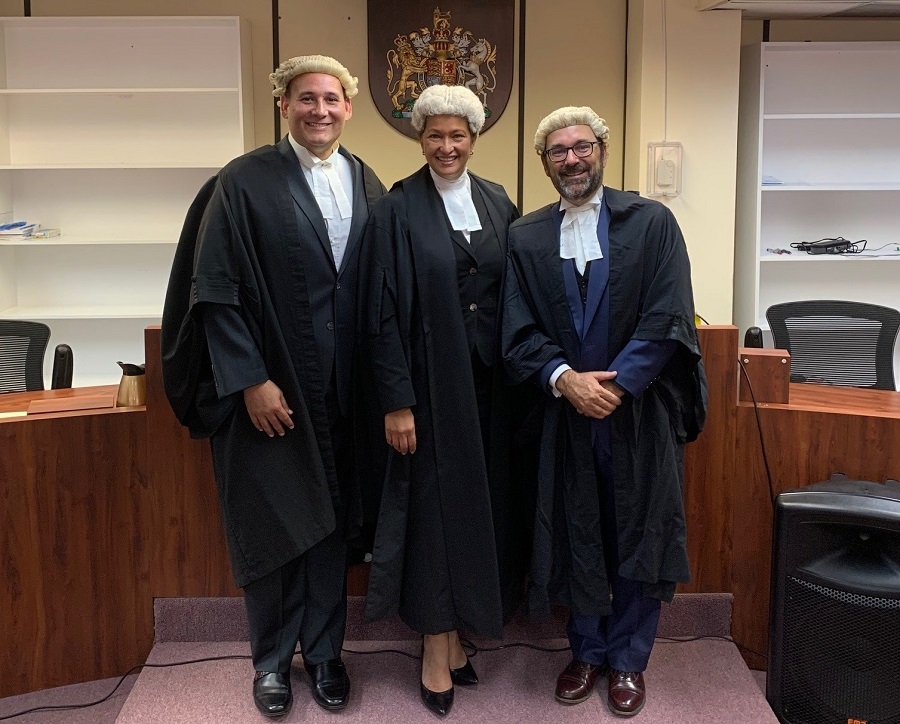
(L-R): Oscar DaCosta (HSM Associate) and Justice Margaret Ramsay-Hale
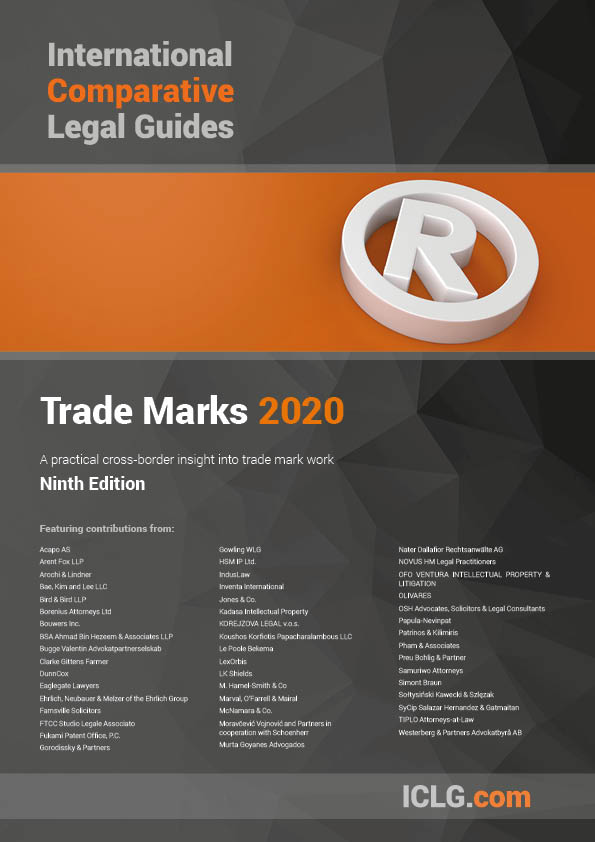
HSM IP has once again contributed to the International Comparative Legal Guide (ICLG) to Trade Marks. Click here to read our Cayman Islands 2020 Trade Mark chapter.
The International Legal Comparative Guide (ICLG) to Trade Marks is now in its ninth edition and provides a practical cross-border insight into trade mark work.
The HSM Group (comprising of HSM Chambers, HSM Corporate Services Ltd. and HSM Intellectual Property) remain committed to their clients during the coronavirus (COVID-19) crisis. Our physical office in Grand Cayman is temporarily closed, but our team is working remotely until the shelter-in-place regulations are no longer required.
We are carefully monitoring and complying with the guidelines as set by the Cayman Islands Government. We make it our mission to keep abreast of these changes and how they may affect you, our valued clients.
Our lawyers in the Cayman Islands have curated a local guide to help advise a number of persons and businesses as to the requirements/expectations of the Law with COVID-19 in mind. Covering areas under corporate and commercial, debt solutions and recovery, employment and immigration, insolvency, insurance, private client and property.
Follow this link to download Cayman’s Legal Guide to COVID-19: https://staging.hsmoffice.com/law/caymans-legal-guide-to-covid-19-5283/.
This situation and its effects are ever-changing so we will be updating this guide as well as providing targeted articles on our website.
Our team is also proud to partner with the Cayman Islands Chamber of Commerce to provide informational webinars on some of these topics and recordings can be found at https://chambercovidupdates.ky/webinars/.
If you have any questions or need assistance, please reach out to your usual HSM contact or email us at info@hsmoffice.com.
Ultimately we are all in this together and HSM is on-hand to assist you during these unprecedented times.
World Trademark Review (WTR) 1000 has once again recommended HSM IP as a top tier law firm and Sophie Peat as a leading trademark practitioner in the 2020 edition of WTR 1000 – The World’s Leading Trademark Professionals.
This is the third year in a row that we have been recommended by WTR 1000 and this highlights our practice as a world-class, go-to resource for trademark services across the Caribbean.
WTR 1000 features the top trademark legal service providers in more than 70 jurisdictions. Rankings involve qualitative research to identify both firms and individuals, which have been included due to substantial positive feedback. Featured firms also take into account depth of expertise, market presence and the level of work on which they are typically instructed.
Cited from WTR’s website, commentators said:
HSM IP’s pan-Caribbean practice is a client magnet, serving some of the world’s largest multinational companies from its Cayman Islands headquarters. Described by a client as “the go-to firm for all trademark matters in the region”, the boutique capitalises on the newest software to provide “highly skilled, efficient and cost-effective” prosecution services, doing so in a “reliable, responsive and capable manner”. The practice also displays top-class dispute resolution and litigation abilities, offering a full menu of IP services in over 60 jurisdictions worldwide. In Sophie Peat, service users find a trusted adviser who helps them to “navigate trademark applications and disputes across multiple Caribbean jurisdictions” and is “doing a fantastic job coordinating matters in tricky legal landscapes”.
Our WTR 1000 listings can be found at:
- Sophie Peat: https://www.worldtrademarkreview.com/wtr1000/individuals/sophie-peat
- HSM IP: https://www.worldtrademarkreview.com/directories/wtr1000/firms/hsm-ip

Fatal error: Uncaught Error: Call to undefined function twentythirteen_paging_nav() in /home/clients/d17af2243e6f179e393695ba6e9ce04e/hsmnew/wp-content/themes/hsm/author.php:52 Stack trace: #0 /home/clients/d17af2243e6f179e393695ba6e9ce04e/hsmnew/wp-includes/template-loader.php(86): include() #1 /home/clients/d17af2243e6f179e393695ba6e9ce04e/hsmnew/wp-blog-header.php(19): require_once('/home/clients/d...') #2 /home/clients/d17af2243e6f179e393695ba6e9ce04e/hsmnew/index.php(17): require('/home/clients/d...') #3 {main} thrown in /home/clients/d17af2243e6f179e393695ba6e9ce04e/hsmnew/wp-content/themes/hsm/author.php on line 52