All posts by hsmoffice
The HSM Group has welcomed a new Immigration attorney, Mr. Alastair David. Alastair’s practice focuses primarily on Immigration Law, Employment Law and Litigation.
Alastair practiced as a Barrister in the UK for 10 years before joining HSM and has substantial experience with cases regarding the UK Immigration Rules and associated Acts, asylum claims, the Points Based Visas scheme, deportations, applications for leave to enter and leave to remain, indefinite leave to remain, visit visa applications, and bail applications.
Mr. David’s diverse legal expertise includes advising on a wide range of employment matters including: Race, Disability, Sex discrimination, unfair dismissal, matters arising from Protected Disclosure, breach of contract, and equal pay. His experience further involves civil practice areas which include: personal injury, breach of contract, credit hire agreements, fraudulent personal injury claims, landlord and tenant claims and building disputes.
Partner, Nicolas Joseph explains: “We look forward to Alastair working with us. His expertise will offer great value to our clients and also to those prospective clients seeking experienced legal practitioners to assist with their immigration needs and queries.”
The HSM Group has added a new dispute resolution attorney, Mr. Kerrie Cox, to its expanding practice. Mr. Cox, a highly regarded attorney in the jurisdiction is bringing his experience to the commercial sector at HSM Chambers.
Kerrie (a qualified mediator) practiced as a Barrister in the UK for 12 years, he was admitted as an attorney in the Cayman Islands in 2010. He spent two years with a local law firm before leaving the islands in 2012 to join a niche family practice in Gibraltar. In 2013 he left the practice to serve as Principal Crown Counsel in the British Virgin Islands and then returned to the Cayman Islands in 2015.
In his role at HSM, Kerrie will undertake a wide spectrum of general dispute work: commercial and civil litigation, trusts, corporate, employment, judicial review, personal injury and family matters, including divorce and private/public child law. He is an active member of the newly formed Cayman Islands Family Law Bar Association.
Partner, Huw Moses OBE notes: “Kerrie brings years of valuable experience to the firm. We are looking forward to extending his services to our valued clients.”
On 30 June 2016, the Copyright (Cayman Islands) Order 2015 and the Copyright (Cayman Islands) (Amendment) Order 2016 came into force. They extend a customized version of Part 1 of the UK’s Copyright, Designs and Patents Act 1988 (including Schedule ZA1 and Schedule 1 of the Act) to the Cayman Islands. Usefully, the Ministry of Financial Services and Commerce has released an Unofficial Consolidation of the new law in advance of implementation.
The modernized law has broadened the types of works protected in the Cayman Islands, as well as expanding the range of acts restricted by copyright. Literary, dramatic, musical and artistic works are now protected, as well as sound recordings, films and broadcasts to name but a few. For the first time computer programs are protected under the “literary work” umbrella.
The provisions of the 1956 copyright legislation limited copyright subsistence in broadcasts to television broadcasts and sound broadcasts (being broadcasts consisting of wireless transmissions) made by the BBC or by the Independent Television Authority. Cable broadcasts were not protected. The definition of “broadcast” has been extended under the new law to include wireless transmissions and cable transmissions of a broadcast.
Furthermore, the owner of a copyright in a published literary, dramatic or musical work, or sound recording or film, may give notice to the Collector of Customs that he is the copyright owner of that work and request the Collector of Customs to treat infringing copies of his work as prohibited goods for a specified period. The details of the expected importation into the Cayman Islands must be provided. Notice must be provided on the prescribed form found in Schedules 1 or 2 of The Copyright (Customs) Regulations 2016 respectively and must be accompanied by a copy of the work and the appropriate fee.
You can read more about the new law in HSM IP’s Copyright Client Guide.
The General Registry of the Cayman Islands has issued Practice Note No. 01/2016 which states that starting 1 August 2016 patent and trade mark annual fee payments will no longer be accepted in advance of 1 January in the year in which they fall due.
It is therefore no longer possible to pay annual fees up to the year of renewal of a trade mark, or the year of expiry of a patent, in advance. Instead, annual fees due in 2017 must be paid on or after 1 January 2017. Annual fees due in 2018 must be paid on or after 1 January 2018, etc.
Where annual fees remain unpaid on 31 March of each year, a penalty fee will continue to accrue. Furthermore, the Registry will not accept payment of the outstanding annual fee unless the applicable penalty is paid simultaneously and together with any outstanding fees (including outstanding penalty fees) due in respect of prior years.
What steps should trade mark and patent owners take?
Trade mark and patent owners should review their Cayman Islands portfolios to check whether annual fee payments are paid up to date, and if not, ensure that any outstanding years are paid along with the next due annual fee payment on 1 January 2017.
HSM IP Ltd. is pleased to win the prestigious Corporate INTL’s Intellectual Property (IP) Law Firm of the Year Award for the Cayman Islands.
This award, presented to IP industry leaders across various jurisdictions, has been won by HSM IP after an extensive nomination process, which included the review of several thousand global nominations in order to create a short list of prospective winners from which HSM IP was chosen.
“We are pleased to accept this award and to have been recommended for the quality of our IP services. With our firm expanding, it is a positive sign for us and a reassurance that our clients and peers recognise our thoroughness and dedication to this industry,” said HSM IP Managing Partner, Huw Moses OBE.
On 1 October 2015, the Bureau of Intellectual Property (BIP) Curaçao ceased handling trade mark matters relating to the country of St. Maarten. On 5 October 2015, the newly formed BIP of St Maarten (BIP SMX) became the competent authority for such work, working in conjunction with the Benelux Office for Intellectual Property (BOIP). An online trade mark registration route is now available (BOIP is a paperless office).
All trade mark applications, searches and renewal requests for St Maarten trade marks filed up until 30 September will continue to be processed by (BIP) Curaçao, and any similar requests received on or after 1 October 2015 will be handled by BIP SMX. New official government fees can be found on the following website: http://www.bip.sx/fees.
A new National Ordinance is planned to come into effect during the course of October 2015. Pursuant to Article 15 of the amended Ordinance (AB 2014, no. 83) a new definition of a trade mark representative has been agreed upon. As of 1 October 2015, trade mark representatives must be: an attorney at law or Notary practicing in St Maarten; a professional in the field of trade marks established in St Maarten and registered as such at the Chamber of Commerce; or an employee of a company established in St Maarten that specializes in trade marks and the registration thereof and that are registered as such a the Chamber of Commerce.
Other key changes are as follows:
1. Powers of Attorney are no longer required
2. Scanned copies of documents will be accepted (originals are not required)
3. A scanned copy of an extract from the Chamber of Commerce is now required for recordal of change of name
4. English will be the official language at BIP SXM
5. Claims relating to colour should be made using standardised colour coding systems, such as Pantone
6. Online searching of the Registry database is now possible
For more information please contact Sophie Davies at sdavies@hsmoffice.com.
HSM IP Attorney Sophie Davies has been published in the ITMA Review’s September 2015 issue where she shared her thoughts and expert opinion on US brand owners facing potential battles as diplomatic relations with Cuba begin to thaw.
The article offers readers an introduction to law and practice in Cuba, insight into challenges faced by US brand owners, and some tips on considerations that US brand owners should make in relation to the current climate.
To read Sophie’s article, click here.
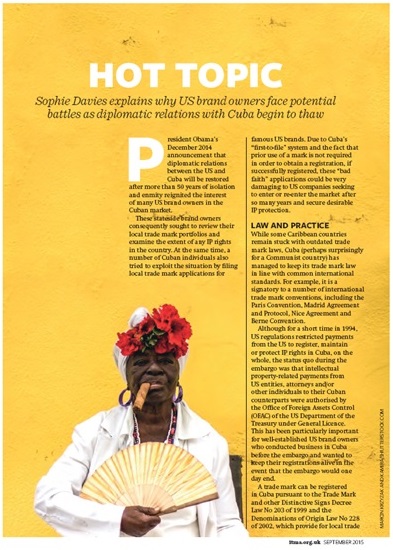
Source Credit: This article was first published in the September 2015 issue of the ITMA Review, the journal of the Institute of Trade Mark Attorneys (ITMA). For more information on ITMA, please visit itma.org.uk
UPDATE: TRINIDAD & TOBAGO
A new Trade Marks Law is hoped to come into effect in Trinidad & Tobago was assented to in June 2015, but it is unclear when it will be implemented. Trinidad’s current trade marks law is already well developed, but the new law makes further welcomed modernisations.
In particular, once the new law is implemented, Trinidad will become one of the few Caribbean countries to accede to the Madrid Protocol and consequently it will be possible to designate Trinidad as part of an International Registration or base an International Registration on a Trinidad base application/registration.
Other changes include: further rights and remedies for the owners of well-known trade marks; a longer non-use period (the current period of 3 years from registration will be increased to 5 years from registration); associated trade marks will be no more; collective trade marks will be introduced; and specifications will be examined in accordance with the latest version of the Nice Classification.
A new Trade Marks Act is scheduled to come into effect in the British Virgin Islands (BVI) on 1 September 2015, ending the current dual filing system currently in place for trade marks. It will therefore no longer be possible to register marks in the BVI on the basis of an existing UK registration. Under the new law there will be provision for the registration of service marks and specifications drafted in accordance with the latest version of the Nice Classification will be accepted by the Registry. The Registrar will also have discretion under the new law to reclassify specifications previously classified in accordance with the outdated system previously in place, after giving notice to the trade mark proprietor. However, at this stage it is difficult to predict to what extent this discretion will be exercised. Other changes include the shortening of the 14 year renewal period to 10 years, and the introduction of Paris Convention priority being accepted.
“HSM are knowledgeable and willing to do the work necessary to obtain the best results for their clients”.
Fatal error: Uncaught Error: Call to undefined function twentythirteen_paging_nav() in /home/clients/d17af2243e6f179e393695ba6e9ce04e/hsmnew/wp-content/themes/hsm/author.php:52 Stack trace: #0 /home/clients/d17af2243e6f179e393695ba6e9ce04e/hsmnew/wp-includes/template-loader.php(86): include() #1 /home/clients/d17af2243e6f179e393695ba6e9ce04e/hsmnew/wp-blog-header.php(19): require_once('/home/clients/d...') #2 /home/clients/d17af2243e6f179e393695ba6e9ce04e/hsmnew/index.php(17): require('/home/clients/d...') #3 {main} thrown in /home/clients/d17af2243e6f179e393695ba6e9ce04e/hsmnew/wp-content/themes/hsm/author.php on line 52