Category Archives: HSM LAW
Employers in the Cayman Islands are faced with a new challenge: how do we keep our doors open and our staff safe? In an effort to achieve this, some employers have been asking staff to disclose whether or not they have taken the COVID-19 vaccine.
HSM Paralegal Cory Martinson explores if employers are legally able to record this data and areas that should be considered:
Q: Does the Data Protection Act (2021 Revision) (DPA) apply if I want to record the vaccination status of my employees?
A: Absolutely the DPA applies. Any information about your employees is personal data under the DPA. Vaccination information is medical data which falls under the definition of sensitive personal data in the DPA which means an employer must meet stricter legal requirements before processing. Processing is broadly defined as recording, holding, obtaining or carrying out any operations on the personal data.
Q: What is meant by “stricter legal requirements” when it comes to processing sensitive personal data?
A: Under the DPA, to legally process sensitive personal data the data controller (i.e. the employer) must identify a legal basis for processing from both Schedule 2 and Schedule 3 of the DPA.
Additionally, the more sensitive the personal data the more security is required to ensure against unlawful processing. Security measures can include policies, access controls, technical and physical measures.
Q: What are the appropriate legal bases for processing sensitive personal data under Schedule 2 and 3 in this context?
A: The appropriate legal basis for processing will vary depending on the specific employer, the employee’s position within the organization and any legal framework to which the employer must adhere. For example, there will be a stronger legal basis for knowing the vaccination status of an ICU nurse than a dump truck driver. Legal frameworks will be employment sector specific but the Labour Act (2021 Revision) has a general requirement under section 58 that “Every employer shall ensure so far as is reasonably practicable the health, safety and welfare at work of that person’s employees.” This may provide a legal basis for processing, however, an argument exists that the interpretation of the words “necessary” and “reasonably practicable” are open to distinction.
Q: Is the collection of vaccination data a reasonably practicable measure and, if so, is the collection of the vaccination data then necessary as required by the DPA?
A: The answer to this question will vary from employer to employer as well as between occupations. However, before asking this question the organization should first consider less privacy intrusive means of achieving the same goal. For example, can the risk to employees be sufficiently reduced through mandatory mask requirements, social distancing and hand hygiene? Can employees work from home or alternate between home and the workplace so not all employees are in the workplace at once? Is a blanket policy necessary or is a more strategic approach just as effective but less privacy intrusive? There is no “one size fits all” solution. If in doubt, you should seek legal advice.
Q: What are the possible repercussions to my organization if I collect vaccination data in contravention of the DPA?
If the Ombudsman receives a complaint, or initiates their own investigation, and finds that the business is not in compliance with the DPA, they can issue an Enforcement Order which may require the cessation of processing and that the data be destroyed. Non-compliance with an Enforcement Order is an offence and the business and/or director(s) could face a fine of up to $100,000KYD or imprisonment for up to five years, or both, as a result of court proceedings. Enforcement Orders are routinely published on the Ombudsman’s website so this type of enforcement action also has a high likelihood of becoming public knowledge.
Additionally, if there has been a “serious contravention” of the DPA and “the contravention was of a kind likely to cause substantial damage or substantial distress” the Ombudsman may levy a monetary penalty of up to $250,000KYD.
Under section 13 of the DPA an individual who has suffered damage as a result of a contravention of the law also has a cause of action for compensation against the organization. It should be noted that courts in the European Union have now recognized that damages include mental distress.
Conclusion
Vaccination status and data protection laws worldwide are a rapidly evolving area of jurisprudence. Some governments are taking legislative measures to mandate vaccinations in an attempt to provide a degree of certainty and it is only in the event of a judicial challenge will more “comprehensive” legal guidance be available.
As we navigate through this COVID-19 era, HSM strongly encourages people to reach out to their legal advisors to assess whether or not they are within their legal rights.
Key Contact

Cory Martinson
Paralegal
Tel: 1 345 815 7420
cmartinson@hsmoffice.com
Cory Martinson previously worked for the Office of the information and Privacy Commissioner for BC, Canada where part of that time was spent working with Elizabeth Denham who is currently the Information Commissioner for the UK. He is a Certified Information and Privacy Professional with the International Association of Privacy Professionals, is certified at the Master level with the Canadian Institute of Access and Privacy Professionals and has a Post Graduate Diploma in Information Rights and Practice Law. Cory was also a member of the legal committee that drafted the Data Protection Act Regulations in the Cayman Islands. Cory is currently pursuing his LLB.
HSM is proud to be ranked by The Lawyer as one of the Top 30 Offshore Law Firms for 2021 and be featured in The Lawyer Magazine July 2021 edition.
HSM is listed within their Top 10 Headcount Growers, highlighting HSM’s increase in Partners over the past year. HSM has also been listed in their Top 10 Most Diverse Firms for having the second highest ratio of female to male Partners.
This ranking highlights HSM’s ability to continuously grow while valuing diversity and inclusion to create a dynamic workforce in the offshore legal industry.
In addition, the HSM Group was mentioned for its acquisition of the Cayman based corporate services operations of Higgs & Johnson.
The HSM Group is delighted to once again offer their summer internship programme and has welcomed five students from the Cayman Islands Further Education Centre (CIFEC).
Jaysie Allen, Destiny Russell, Shyanne Stewart, Paris Jackson and Jahzarah Bush have joined the HSM team for the summer. As a full-service law firm in the Cayman Islands, HSM provides interns with a variety of practice areas including Corporate Services, Debt Collection, Immigration and Intellectual Property.
The summer internship falls shortly after an 8-month long work experience scheme with the CIFEC programme. HSM’s summer internship will enable these students to gain valuable experience and develop the necessary skills required to evolve onward with their future careers while making meaningful contributions to the firm.
“Seeing students so eager to apply and advance themselves is truly refreshing to witness,” shares HSM Managing Partner, Huw Moses OBE. “The arrival of the summer interns is highly anticipated each year and our team aims to instill lifelong skills and valuable work experience into each intern to help shape them into young working professionals.”
HSM is an avid supporter of the CIFEC programme and will be participating at CIFEC’s annual career fair in September. HSM has supported the CIFEC programme since they opened their doors in 2012 and employs seven CIFEC graduates full-time.
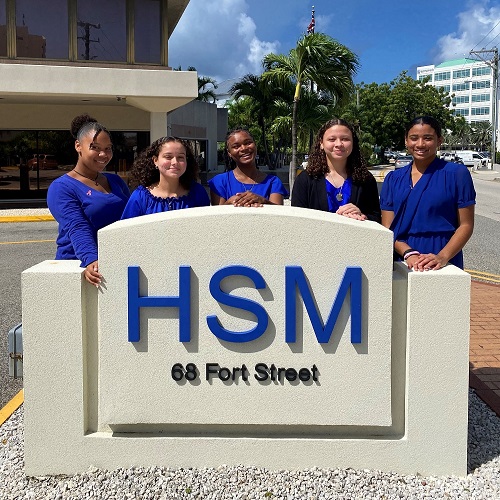
(L-R): Shyanne Stewart, Jaysie Allen, Paris Jackson, Jahzarah Bush and Destiny Russell.
The HSM Group is delighted to welcome back The Hon. Robin McMillan to their ever-growing law practice.
With a wealth of experience under his belt, Robin is a well experienced and skilled Senior Counsel. In recent years, Robin has served as a Judge of the Grand Court dealing with both interlocutory hearings and trials in the areas of insurance law, corporate insolvency and restructuring, funds investment law, family law and criminal law.
Robin has previously served on Cayman Law Society Committees where he was actively involved in various areas, along with overseeing a sub-committee of the Financial Services Division Users Committee. Robin continues to sit as a Judge occasionally. From 1974 to 1998, Robin was called to the bar in many different countries around the world including England and Wales, Bermuda, Northern Ireland, Hong Kong, California and the Cayman Islands.
HSM Managing Partner, Huw Moses, OBE notes: “Robin brings years of valuable and extensive experience to the firm. We are excited to have him as a highly respected addition to our team and look forward to growing the firm with him.”

HSM is delighted to yet again be ranked by Benchmark Litigation Latin America 2021 where they have recognized HSM Managing Partner Huw Moses, HSM Partner Adam Crane, HSM Partner Sarah Allison and HSM Consultant William Helfrecht as ‘Litigation Stars’. In addition, Benchmark Litigation Latin America 2021 has also recognized HSM Partner Kerrie Cox as a ‘Future Star’.
Benchmark Litigation Latin America shares:
“The George Town, Cayman Islands-based full-service law firm HSM is among the fastest growing firms in the region and maintains a strong presence in the country and beyond, servicing legal needs throughout the Caribbean. The firm provides premier legal services in an abundance of practice areas, such as dispute resolution, insolvency and restructuring, immigration law, trusts and private client, labor and employment, corporate services, and intellectual property to name a few. The firm’s legal team is equipped with strategic relations with leading firms across the United States, Europe, Asia, Australia, and Canada as well as engaging in regular collaboration with leading attorneys in the US, the United Kingdom, and Australia with the express purpose of providing counsel of the highest possible caliber. In both 2019 and 2020, the firm was named one of Benchmark Latin America’s Recommended Firms for the region.
The firm’s leadership presents a diversity of legal backgrounds. Managing Partner Huw Moses has extensive experience and high-caliber expertise in the practices of labor and employment as well as in commercial and civil litigation. In March of 2021, the firm promoted Adam Crane from the position of senior associate to partner and head of the firm’s insolvency department. In addition to Crane’s subject matter expertise in insolvency, he also specializes in restructuring and commercial litigation.”
HSM is pleased to announce the elevation of Adam Crane to Partner and Head of HSM’s Insolvency and Restructuring team, effective 1 June 2021.
Adam focuses his practice on commercial litigation, insolvency and restructuring matters acting for insolvency practitioners, shareholders, directors, officers and companies; and routinely represents clients in complex cross-border proceedings. He has worked on some of the largest and most prominent disputes and insolvency matters in the Cayman Islands in recent years.
He has consistently been recognized for his litigation prowess by Benchmark Litigation (Latin America) as a Star in 2020 and Future Star in 2019, in Benchmark Litigation (Canada) as a Future Star in 2018, and was named to Benchmark Litigation’s 40 and Under Hot List (Canada and USA) in 2018 and 2017.
In 2020, Adam was inducted to the International Insolvency Institute’s NextGen Leadership Program and appointed to the program’s Executive Committee in late 2020. Adam holds leadership positions and is actively involved with many international insolvency organizations including the American Bankruptcy Institute, INSOL, Turnaround Management Association and RISA Cayman.
HSM Managing Partner, Huw Moses, OBE shares: “Adam will make an excellent addition to the partnership team at HSM and I wish him every success in this new role at HSM.”

The HSM Group has welcomed Travis Ritch to their growing law practice.
Travis has over 10 years of legal experience with a wide-range of skills in the practice areas of Litigation, Public and Administrative Law, Company, Insolvency, and Employment Law. Prior to beginning his career, Travis graduated from King’s College, London (LLB) and was previously educated in the Cayman Islands, Massachusetts, USA and Ontario, Canada.
In 2011, Travis was called to the bar in England and Wales after completing the Bar Professional Training Course at City Law School. He was subsequently called to the bar in the Cayman Islands in 2015 and joins HSM having previously practiced with Ritch & Conolly.
Travis has worked on a number of high-profile insolvency and litigation matters in the Cayman Islands. Travis has been a trusted adviser to several statutory authorities. Since 2016 he has served as Deputy Chairman of the Planning Appeals Tribunal.
HSM Managing Partner, Huw Moses, OBE notes: “Travis is a valued addition to our team. With extensive experience and having grown up in the Cayman Islands, he brings a deep understanding of the local legal landscape. We look forward to strengthening our firm with him.”

HSM participated in the Layman E. Scott Sr. High School Career Fair which was held on Friday, 19 March.
This fair is organised by the Cayman Islands Further Education Centre (CIFEC) and helps to give students first-hand experience at applying for jobs and learning what career opportunities exists in the Cayman Islands.
HSM is a full-service law firm based in Grand Cayman and offers several internship positions each year. Natasha Whitelocke (Head IP Paralegal) attended on behalf of the firm and spoke with students about a career in the legal profession. She also spoke about the different areas of expertise, including Intellectual Property, Litigation, Immigration, Finance, Corporate Services, Marketing and more.
“I left the fair feeling proud,” shares Whitelocke. “These students are well positioned to begin their careers and I look forward to seeing them make their mark in our community.”
HSM has worked with the CIFEC progamme since the firm’s inception in 2012.
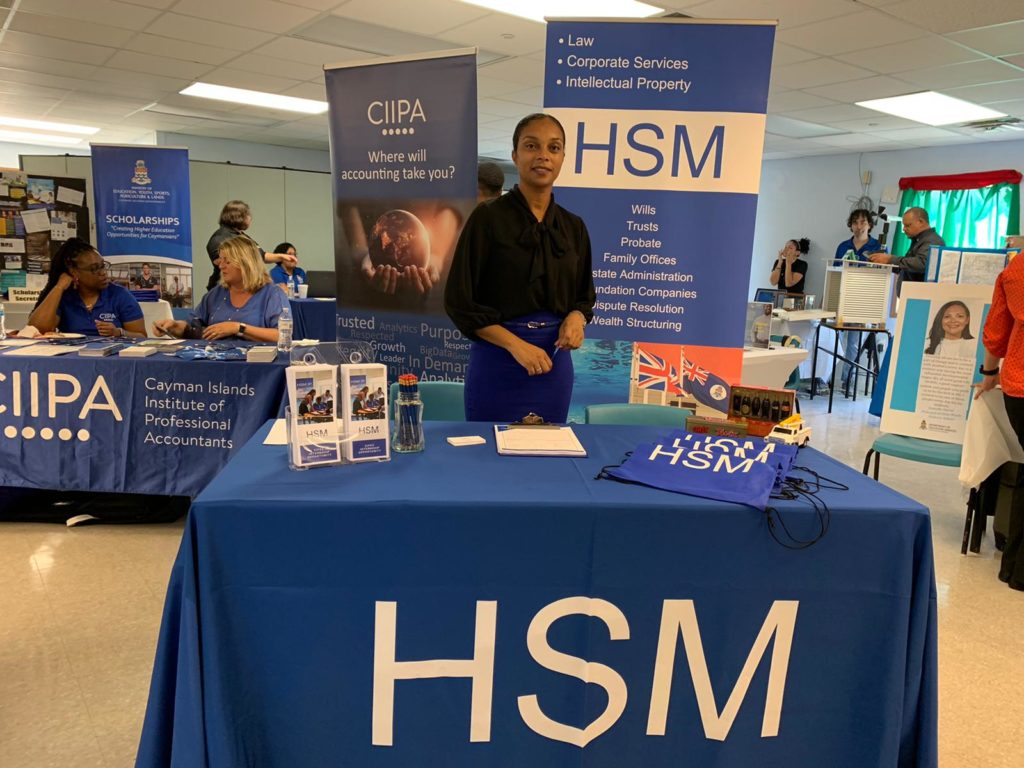
Natasha Whitelocke (HSM IP Head Paralegal) behind HSM’s Career Fair Booth.
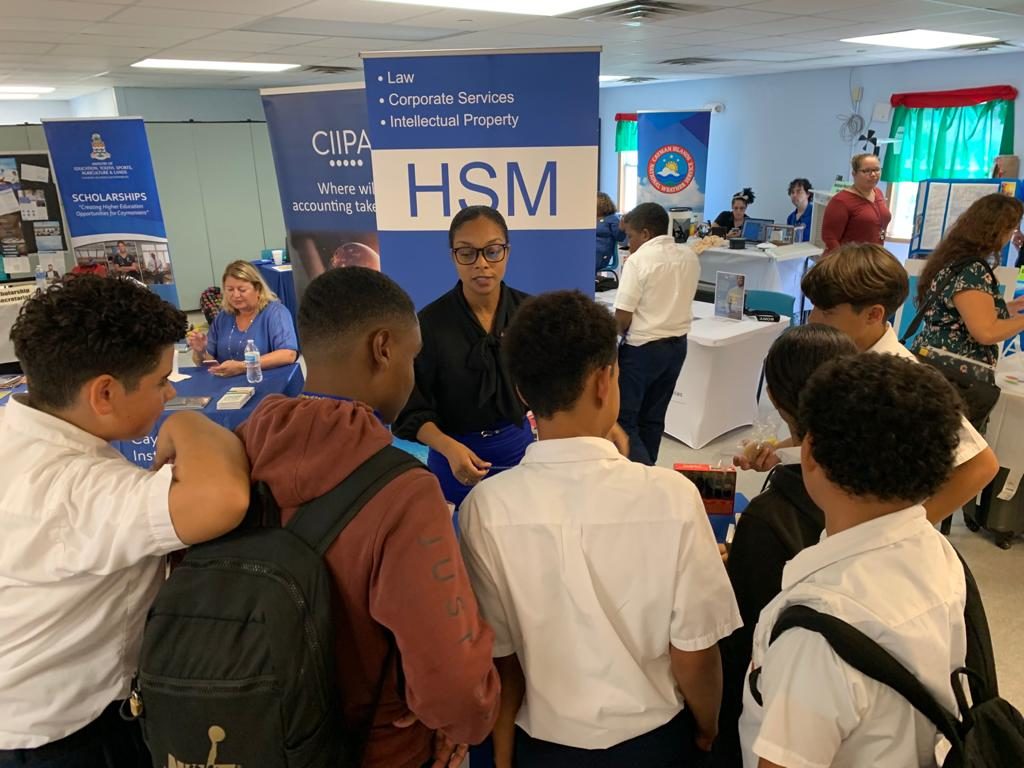
The HSM Group opened their doors to welcome 18 students from the Cayman Islands Chamber of Commerce Mentoring Cayman Programme on 25 February 2021.
The students were given a tour of the HSM offices by HSM’s Managing Partner, Huw Moses and Chief Executive Officer, Donna Farrow.
Afterwards they were given a presentation on the legal industry and career details, which included a panel of HSM staff across various sectors and the students got the opportunity to ask questions.
HSM is a full-service law firm in the Cayman Islands that offers a wealth of employment opportunities, including immigration, intellectual property, litigation, property, private client, corporate services and more. They also have areas outside of law such as finance, secretarial and marketing.
Chamber’s Mentoring Cayman Programme offers experiences for professionals to mentor students on the verge of graduating. It also serves as an introduction to the many career paths available on island.
“Our company is always looking for ways to support young adults,” shares Huw. “We are proud to offer them insight into the working world and help mold them professionally.”
In addition to this initiative, HSM is a proud supporter of the Cayman Islands Further Education Centre (CIFEC) Internship Programme since 2012 and offers sponsorship opportunities for further education. HSM also employs seven former CIFEC graduates fulltime.
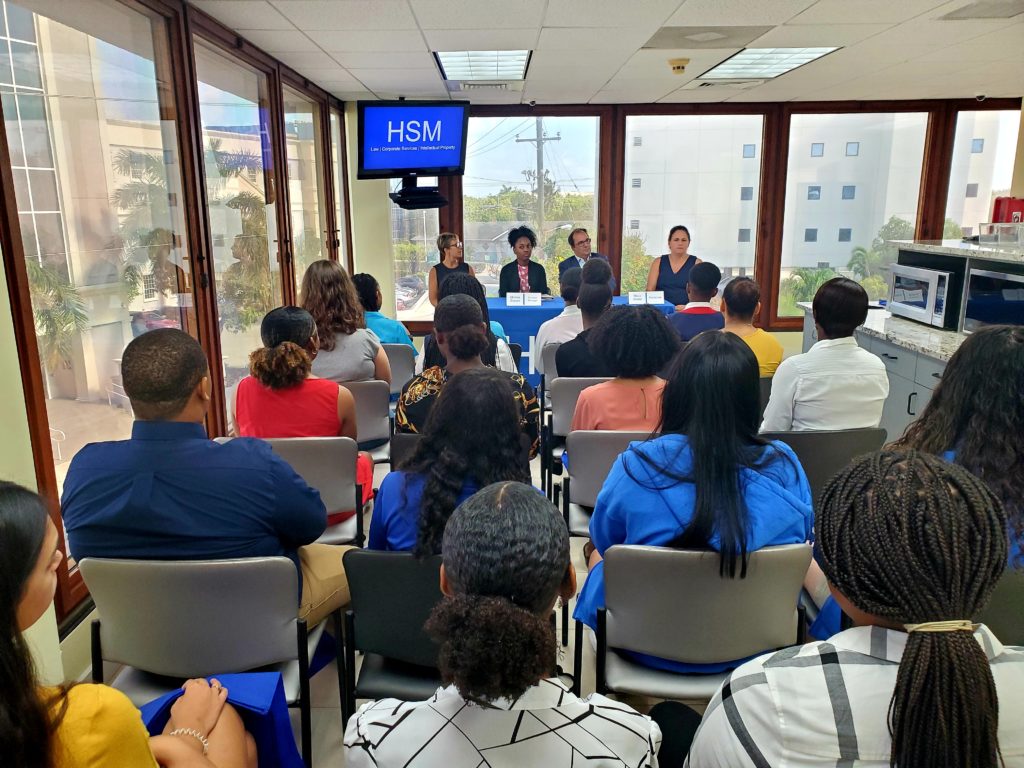
In December 2020, the Premier announced that a mass vaccination campaign to prevent the spread of COVID-19 will be rolled out across the territory in January. In unveiling the plan, he stressed that inoculation will be voluntary but encouraged the public “to do due diligence, and to keep their minds open to the benefits that participation will offer”.
As the roll-out of the COVID-19 vaccination builds momentum in the Cayman Islands, employers will be considering the implications for their staff and workplace.
Many employers are likely to opt to encourage employees to take up the vaccine, without mandating it. However, there will be some who in taking account of the needs of the business, may be contemplating whether to impose compulsory vaccination. Requiring employees to be vaccinated raises a number of matters which will need to be thought through before implementation. HSM Partner Kerrie Cox explores the legal issues that could arise.
Can employers mandate vaccination?
A direction to take the vaccine could be regarded as a ‘reasonable instruction’ on the part of the employer, depending on the individual circumstances of the business. For example, employers in the social care sector may be able to issue a reasonable instruction to employees to take the vaccine because refusal could put vulnerable people at risk. Conversely, employers in other business sectors will not have the same strong rationale for mandating staff inoculation.
Clear communications and engagement with the workforce would assist an employer who does wish to pursue the mandatory route.
Can employers dismiss for failure to follow a reasonable instruction to vaccinate?
Failure to follow a reasonable instruction can lead to a fair dismissal, most likely ‘dismissal for some other substantial reason’ (SOSR). Again, using the social care example, a care home employer could well be able to rely on a refusal to seek vaccination to dismiss an employee – based on the instruction itself being reasonable. Nonetheless, the dismissal process also has to be fair, with each case considered on its own facts. Only an employee who unreasonably refuses to be vaccinated could be fairly dismissed. There must be an opportunity for the employee to set out the basis for their refusal, and the employer will need to consider those reasons in the context of its business.
One of the challenges for employers will be in justifying why accommodation can be made for those employees who are, for example, pregnant, or because of a health condition, cannot take the vaccine. This is likely to go to the proportionality of the approach and will be relevant should there be any legal challenge to a dismissal.
An employer seriously considering dismissing an employee as a result of a refusal to be vaccinated will need to give careful thought to whether there are any alternatives to dismissal – for example, reallocating the employee to another role where this does not amount to a detriment to the business in the particular circumstances.
Could an employee in the Cayman Islands bring a discrimination claim against his/her employer if dismissed?
Any inconsistency in the treatment of employees who have or haven’t been vaccinated may amount to indirect discrimination. The most likely protected characteristics which will be asserted are those of age, disability, sex and pregnancy, and potentially religion or belief.
Potential scenarios in which a claim for indirect discrimination may be advanced include where an employee cannot return to site without vaccination or a decision is taken not to pay sick pay to an employee who has refused the vaccine and then subsequently becomes ill with COVID-19.
In the Cayman Islands, there are constitutional prohibitions against discrimination as contained within the Bill of Rights, Freedoms and Responsibilities which apply essential human rights and freedoms to all individuals. These rights, however, are enforced against Government only and not against private individuals (which includes private businesses).
As concerns to the private sector, there are three pieces of discrete legislation which are applicable:
- Section 80(1) of the Labour Act (2011 Revision) states that:
“No person (whether an employer or an employee) shall discriminate with respect to any person’s hire, promotion, dismissal, tenure, wages, hours or other conditions of employment, by reason of race, colour, creed, sex, pregnancy or any reason connected with pregnancy, age, mental or physical disability (provided their ability to perform the job is not impaired), political belief or the exercise of any rights under this or any other Law.”
Whilst this resonates towards discrimination claims being brought by employees, in truth, section 80(1) is in reality, a basic homage to the principle that employers should not discriminate against a certain class of its employees. The provision is placed within Part IX of the Labour Act under ‘General Penalties and Miscellaneous’ and the prescribed penalty for statutory breach by an employer is liability on summary conviction to a fine of five thousand dollars and to imprisonment for twelve months.
Importantly, the legislation is silent as to whether a breach of the section creates a right of civil action against an employer by an employee. The general rule is that ‘where an Act creates an obligation, and enforces the performance in a specified manner…that performance cannot be enforced in any other manner’. [1]
Against the general rule, Lord Diplock in Lonrho Ltd v Shell Petroleum Co[2] considered that whether or not a private cause of action is granted is a question of statutory construction. He recognised two exceptions to the general rule, the first being where the obligation or prohibition was imposed for the benefit or protection of a particular class of individuals. Subsequent case law, however, suggests that even where a statute is undeniably passed for the protection of a specific class of individuals, the question of whether a private cause of action exists is not conclusive.[3]
There are no reported decisions in which an employee has sought to exercise a private cause of action under section 80(1). If such were to be the case, the court would attempt to ‘discover’ the intention of Parliament using the rules of statutory interpretation as balanced against the presumption that the Labour Act prescribes its own remedy. Nonetheless, it raises an interesting question of law due to the number of contradictory judicial statements in the UK which makes it impossible to forecast how the courts would deal with a stand-alone discrimination claim under the Labour Act.
- The Gender Equality Act 2011 (“GEL”)
The legislation seeks to eliminate discrimination in employment, training and recruitment on the basis of sex, marital status, pregnancy or gender and to promote the payment of equal remuneration to male and female employees who perform work of equal value.
As the vaccine is not recommended for those who are pregnant, breastfeeding or even planning conception, an employee who is dismissed because she has not been vaccinated may be able to assert discrimination under the GEL if she has been subjected to unfavourable treatment. Maximum compensation is limited to CI$20,000 although unlike complaints to the Labour Tribunal, the Gender Equality Tribunal has a discretionary power to make an award for costs.
- The Disabilities (Soloman Webster) Act 2016 (“DSWA”)
The general purpose of the DSWA is set out in the pre-amble to the legislation:
“A Law to promote, protect and ensure the full enjoyment of human rights and fundamental freedoms, by persons with disabilities, on an equal basis with other persons; to promote respect for the dignity of persons with disabilities; to establish the National Council for Persons with Disabilities; and for incidental and connected purposes.”
‘Discrimination’ is defined as any distinction, exclusion or restriction, on the basis of disability, which:
- has the purpose or effect of impairing or nullifying the recognition, enjoyment or exercise, on an equal basis with others, of all rights and freedoms in the political, economic, social, cultural, civil, or any other field; and,
- cannot be shown to be a proportionate means of achieving a legitimate aim.
The broad scope of any other field combined with the general purpose of the DSWA, infers that the prevention and remedy for disability discrimination within employment would be a remit of the legislation. However, the National Council for Persons with Disabilities (the body established to promote and reinforce the principles under the DSWA) is not empowered to perform any quasi-tribunal/judicial tasks and as similar to section 81(1) of the Labour Act, there is no express right of civil action which could be brought under the legislation.
Furthermore, the key provisions to the DSWA contained in Part 4 (Access to Rights) which entitles a disabled person to the enjoyment of rights, privileges, interests, benefits and treatment (whether directly, or through contractual, licensing or other arrangements) is not in force.
Taking the three pieces of ‘discrimination’ legislation together, this potential area of claim is uncertain although specific proceedings brought under the GEL is likely to have a far more meritorious course in the right circumstances. As seen above, a more general claim under section 80(1) of the Labour Act will require a court to declare that a breach of the section gives rise to a civil cause of action.
Are there health and safety issues around mandating vaccination?
Under Part VIII of the Labour Act and under common law, employers also have obligations to ensure, so far is reasonably practicable, the health, safety and welfare at work of his employees;[4] in other words, to reduce health risks to employees and others to a level which is as low as reasonably practicable.
The vaccine should be considered as part of COVID-19 risk assessments, as a potential additional measure to control the risks associated with contracting the virus at work. However, health and safety considerations also need to take account of any health risks associated with the vaccine itself for certain groups or even for individual employees. Mandating the vaccine could give rise to claims from employees who suffer an adverse reaction to the vaccine if a link can be established, so medical advice for employees may be required.
What about data protection issues?
Requiring evidence of vaccination gives rise to significant data protection issues. Employers would have to carefully consider why they need evidence of vaccination and whether it is appropriate for their business. The employer must consider not only the reasons for requiring the data but also issues like how it will be held securely, who will have access and whether it is appropriate to hold more than a simple ‘yes’ or ‘no’.
Conclusion
There is no doubt that this topic will gain traction throughout the course of this year and not only in the employment context. Media reports indicate that international air travellers, for example, will in future need to prove they have been vaccinated against COVID-19 in order to board Qantas flights. How then, would that policy impact on customer facing employees of the airline who for all practical purposes, must be compelled to vaccinate?
As previously explained, an employer seeking to impose compulsory vaccination is likely to raise a number of legal issues. The most practical approach would be for employers to engage with staff and encourage, perhaps writing a non-contractual policy outlining the benefits of taking the vaccine and assisting in any arrangements for staff to be immunised. Any employees who refuse the vaccine could be met privately to explain the benefits again, but employers should be cautioned about forcing or disciplining staff who refuse.
[1] Lord Tenterden CJ in Doe d Bishop of Rochester v Bridges (1831) 1 B&Ad 847, 859
[2] [1982] AC 173
[3] X (minors) v Bedfordshire CC [1995] 3 WLR 152 (per Lord Browne-Wilkinson at pp. 180-1)
[4] Section 58
Fatal error: Uncaught Error: Call to undefined function twentythirteen_paging_nav() in /home/clients/d17af2243e6f179e393695ba6e9ce04e/hsmnew/wp-content/themes/hsm/category.php:31 Stack trace: #0 /home/clients/d17af2243e6f179e393695ba6e9ce04e/hsmnew/wp-includes/template-loader.php(86): include() #1 /home/clients/d17af2243e6f179e393695ba6e9ce04e/hsmnew/wp-blog-header.php(19): require_once('/home/clients/d...') #2 /home/clients/d17af2243e6f179e393695ba6e9ce04e/hsmnew/index.php(17): require('/home/clients/d...') #3 {main} thrown in /home/clients/d17af2243e6f179e393695ba6e9ce04e/hsmnew/wp-content/themes/hsm/category.php on line 31