Category Archives: HSM LAW
As a result of financial losses caused to some businesses since the start of the COVID-19 pandemic, commercial insurance policy holders turned to their insurers to make claims under Business Interruption (“BI”) insurance policies. As one might expect, this led to wide-ranging disputes in the interpretation of policy wording, as insurers sought to limit their indemnity exposure under the policies. HSM Partner Kerrie Cox brings some important issues and case examples to light that may apply to Cayman.
In the UK, under pressure from small business owners particularly, the Financial Conduct Authority (“FCA”) stepped in and in conjunction with eight insurers, selected a representative sample of 21 policy wordings as a test case for the High Court to consider and rule upon.[1]
The policies selected were those that offered protection where businesses were affected by:
- disease outbreaks (known as “Disease Clauses”);
- the denial of access to premises by virtue of a public authority decree; or,
- a mixture of the two (known as “Hybrid Clauses”).
In September 2020, the High Court delivered its judgment. Hailed as a victory for policyholders, the court favoured the arguments put forward by the FCA in the majority of the considered clauses, based primarily on well-established rules of construction.
Unsurprisingly, the insurers issued expedited appeal proceedings to the Supreme Court[2] and in January 2021, the Court dismissed the insurers’ appeal which will bring comfort to the estimated 370,000 policyholders affected in the UK.[3]
The following is a summary of the Supreme Court’s judgment in FCA v Arch Insurance (UK) Ltd:
Disease clauses
Such clauses provide cover in respect of business interruption in consequence of or following the occurrence of a “Notifiable Disease”. These clauses generally provide for the occurrence of the disease within a specified distance of the policyholder’s business premises. COVID-19 became a Notifiable Disease in the UK from 5 March 2020.
The Supreme Court agreed with the High Court that a general exclusion to the BI policy which stated that “the insurance by this Policy does not cover any loss or Damage due to … epidemic and disease”, did not exclude claims arising out of the COVID-19 pandemic. It found that a policyholder had cover where the business interruption was caused by any COVID-19 cases that occurred within a specified radius (as defined in the policy) of the insured premises.
Prevention of Access and Hybrid Clauses
Prevention of access clauses provide cover for business interruption losses resulting from public authority intervention preventing or hindering access to, or the use of, the business premises. Hybrid clauses combine the main elements of disease and prevention of access clauses.
In both the lower and appellate courts of the UK, the following clause was examined where cover was provided for business interruption caused by:
“your inability to use the insured premises due to restrictions imposed by a public authority”.
In giving its consideration to the interpretation of the clause, the Supreme Court confirmed a ‘broader’ approach to that of the High Court. Whereas, the High Court had been correct that “restrictions imposed” by a public authority would be understood to mean mandatory measures “imposed” by the authority pursuant to its statutory or other legal powers, the Supreme Court determined that such a restriction did not always require the force of law before it could fall within that description.
A mandatory instruction might be given by a public authority in the anticipation that legally binding measures would follow shortly afterwards, or would do so if compliance was not obtained. That was capable of being a “restriction imposed”, as was an instruction from the Prime Minister to businesses to close “tonight”. The test was how they would be understood by a reasonable person, and a reasonable policyholder would not understand the word “imposed”, without more, as making cover conditional on the existence or immediate prospect of a valid legal basis for the restriction.
Thus, for example, the measures announced by the Prime Minister to close certain businesses or schools were a clear and mandatory instruction given by the government that people would understand needed to be complied with.
Further, the High Court had also held that where there is an “inability to use” premises, coverage would not be afforded if the insured can use some part of the premises. Again, the Supreme Court went further and determined that if the policyholder is unable to use the premises for a discrete part of its business activities or if it is unable to use a discrete part of its premises for its business activities, then the policy responded since in both those situations there is a complete inability of use. It recognised that there would only be cover for that part of the business for which the premises could not be used. By way of example, the Supreme Court said that if a restaurant stayed open during lockdown periods for take-away (take-out), it could still claim for the loss of that part of the premises usually used for customers dining at the restaurant.
Causation
Causation was extensively considered by the Supreme Court, particularly as it applied to Disease and Hybrid Clauses.
The insurers took the view that a policyholder would have to demonstrate losses that would not have been sustained but for the occurrence of COVID-19. They argued that because COVID-19 was so widespread, policyholders would have suffered the same or similar losses in any event and, therefore, the policy did not respond.
The Supreme Court disagreed. It held that the “but for” test is sometimes inadequate and that there can be situations where a series of events cause a result even though none of them was individually either necessary or sufficient to cause the result by itself. So, if an insured event occurs, in combination of many other similar but uninsured events, which causes a loss with a sufficient degree of inevitability, there will be cover.
As such, in relation to the Disease and Hybrid Clauses, there will be cover for losses resulting from any local occurrence of COVID-19 together with the government’s response to the wider pandemic. So, there would still be cover, even if the local occurrence of COVID-19 would not have been sufficient on its own to cause any losses.
Trends Clauses
Trends Clauses provide a mechanism for calculating loss to ensure that the amounts recovered under a policy are not artificially reduced or inflated. More commonly, damages assessment is approached by adjusting the results of the business from the previous year to take account of “trends” or other circumstances affecting the business in order to estimate better what the results would have been.
The insurers had argued that as a result of how widespread the COVID-19 pandemic is, they would not be liable to indemnify policyholders for losses as they would have suffered these losses in any event: relying on the authority of Orient-Express Hotels Ltd v Assicurazioni General Spa.[4] However, the Supreme Court agreed with the court at first instance and held that unless the policy wording states otherwise, Trends Clauses should not be construed so as to remove cover on the basis of concurrent causes of losses. In the court’s view, these clauses should be construed so that profits derived from previous trading are adjusted only to reflect circumstances affecting the business unconnected with COVID-19.
The Application of the Supreme Court’s decision in FCA v Arch Insurance (UK) Ltd and others to the Cayman Islands
There is little doubt that the principles derived from the judgment of the UK’s Supreme Court would be highly persuasive in the Cayman Islands; it is but a decision on the construction and interpretation of insurance contracts.
Notwithstanding, there are a couple of points to note:
Firstly, the BI policies considered for examination in the UK included coverage for instances of disease and where access to business premises were restricted; whereas, certainly in the Cayman Islands, we are aware of commercial policies which expressly exclude ‘infectious diseases’ which lead to the imposition of quarantine or restrictions in the movement of people by a national or international body or agency. However, in light of the Supreme Court’s conclusions on the operation of the general exclusion to the BI policy pertaining to ‘epidemic and disease’, this may restrict the reliance of local insurers accordingly.
Secondly, even if such coverage was found to be within the scope of a BI policy which might give rise to a claim, a condition precedent to cover will invariably include timely notification to the insurers within a prescribed period of time. Therefore, it is likely that for an insured business to avail itself of the recent decision in the Supreme Court, that business would almost certainly have had to make a claim to an insurer during the notification period to which that claim had been declined by the insurer.
Although the Supreme Court’s decision will make it far more difficult for insurers to deny claims based on some of the standard wording in policies, it must be remembered that individual claims will be decided on both specific wording in the relevant policy and the circumstances of the insured party. It is therefore highly likely that the Supreme Court’s decision in FCA v Arch Insurance (UK) Ltd and others is only the first in a wave of insurance-related claims destined for judicial determination. Moreover, it is only a matter of time before prospective Plaintiffs begin to give serious consideration to negligence claims against their insurance brokers, either in addition to or as an alternative to any claims they may have against their insurers.
[1] FCA v Arch Insurance (UK) Ltd and others [2020] EWHC 2448 (Comm)
[2] As provided by the Administration of Justice Act 1969
[3] [2021] UKSC 1
[4] [2010] EWHC 1186 (Comm)

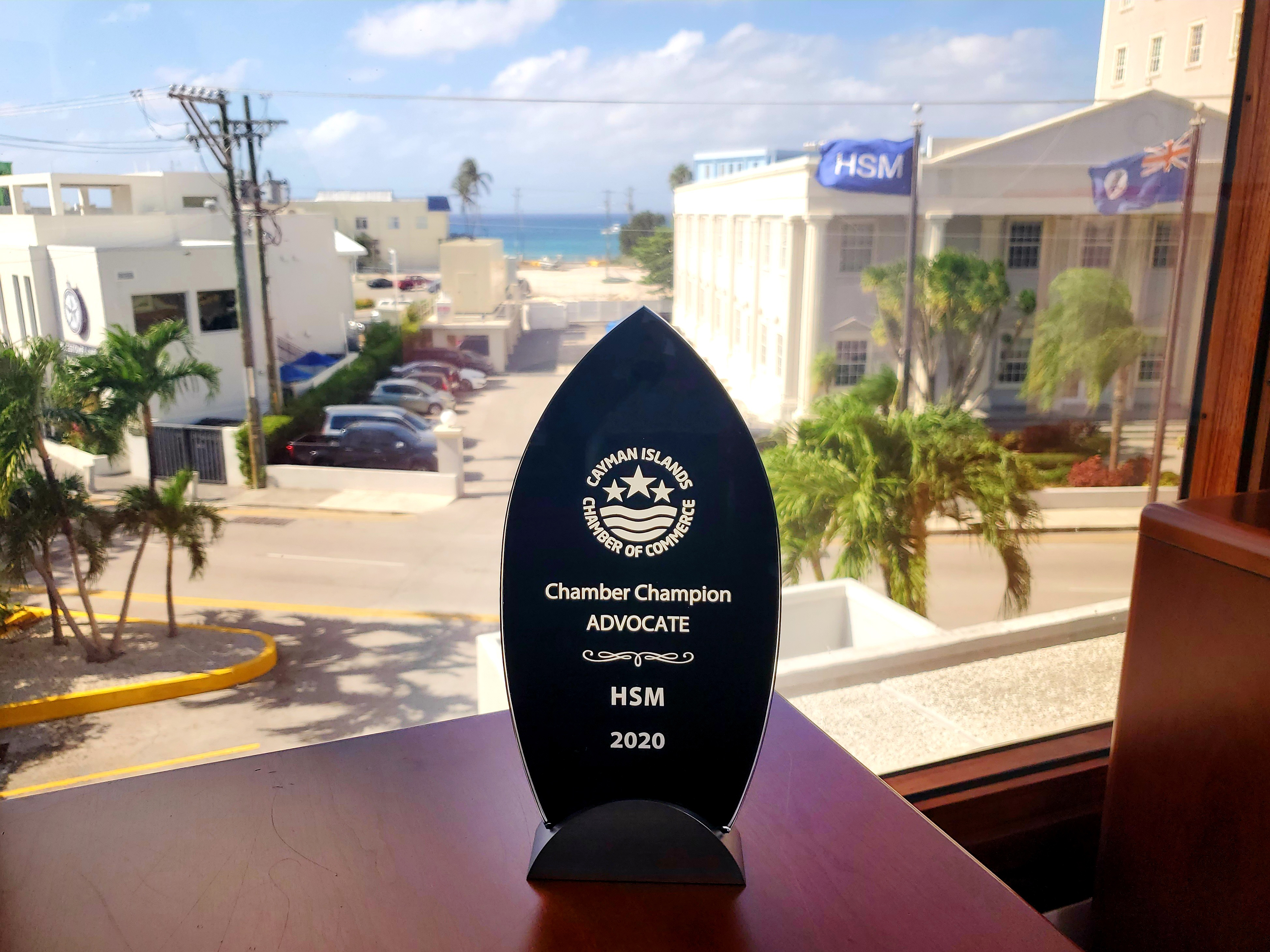
HSM was recognised as a Chamber Champion Advocate at the Cayman Islands Chamber of Commerce Annual General Meeting on 28 January 2021 at The Ritz-Carlton, Grand Cayman.
This recognition highlights HSM’s philanthropic contributions to the Chamber and businesses in the Cayman Islands in 2020. Members in the top category of Chamber Advocate invested staff hours and contributed more than $10,000 in kind or in sponsorship over the past year.
Most significantly, HSM’s lawyers were at the forefront of the COVID-19 lockdown and quickly facilitated free webinars in partnership with the Cayman Chamber where they discussed employment and immigration, wealth management, financial strategies and business liabilities. Click here for more details and to view the webinar recordings.
HSM has been an active member of the Cayman Chamber since opening its doors in 2012 and offers regular training seminars on an array of legal topics each year.
Robert Mack (HSM’s Head of Private Client and Trusts) shares: As a longstanding wills and estate practitioner I have encountered many homemade wills. I have yet to be impressed with any that have come across my desk, and that includes those cheap ‘fill in the blank’ template wills found online. While it may be tempting to save on the lawyers’ fees, let me explain why that is a really bad idea.
You can only give what you got
As a fundamental point of law, you can only give away assets you actually own outright. For example, if you have a joint asset, such as a joint bank account with your spouse, it will usually pass automatically on your death to the surviving spouse. If you try to give away ‘your’ joint bank account in your will — as a gift, for example — it will likely fail. Therefore, if you are attempting to achieve a sense of balance amongst the beneficiaries of your estate, your misunderstanding of how the law works may in fact create an imbalance. Such imbalances have the potential to cause disputes and may breed resentment amongst your beneficiaries. This could result in expensive estate litigation, which will not only impede the administration of your estate but also drain its value.
Failed gifts
What happens if a beneficiary dies before you or they refuse to accept their gift from the estate? Professional wills have provisions to deal with such situations. Most homemade wills do not take such scenarios into account. If there is no provision in the homemade will to deal with such failed gifts, it will pass in accordance with intestacy provisions, which may result an unintended distribution of estate assets.
Assets overseas?
What if you have assets in other jurisdictions outside of the Cayman Islands? There is no guarantee that those other jurisdictions will accept your homemade will, no matter how clear the terms, even if your will is expressed to apply to your worldwide assets (which most homemade wills do not). This is because succession laws differ depending on each jurisdiction in question, and in the case of real property (houses, buildings, etc.) the law which governs succession is the law where such real property is located. In the Cayman Islands you are free to dispose of your assets as you see fit, but that is not the case in other jurisdictions which may have laws in place that dictate to whom your assets should go. Also, while there are no inheritance taxes or death duties in the Cayman Islands you cannot predict how your foreign assets (and sometimes your Cayman assets) will be taxed by foreign tax authorities. There may, therefore, be lost opportunities to make your estate more tax efficient unless these factors are taken into account in your will.
Executors
Executors are the persons named in your will who have the responsibility to administer your estate after you die. They are required to submit your will to the probate court to obtain the ‘Grant of Probate,’ which gives them the legal authority to deal with your assets; pay off any debts and expenses of the administration; and distribute the property to the beneficiaries in accordance with the terms of your will. While many people may name friends or family to act as their executors, one must consider the factors that may frustrate your intentions, including situations where your named executors are unable or unwilling to act for whatever reason. Few people understand just how onerous the duties of the executor are, and there is scope for such executors to be sued by any one or more of the beneficences if the beneficiaries think they are not doing a good job. In other words, it is often a thankless task, and many people as a result refuse to take up the office. If there is no default executors named, then some other person or persons permitted by law will have to be appointed instead. There is a challenge, however, to locate such a person(s) and even if they agree to take up this task they may not have been considered suitable by the testator or their family.
Execution
Signing (otherwise known as ‘executing”) your will requires strict observance of certain procedures set out in the law. In order to be valid the will must be in writing and must signed in the presence of two witnesses. If you do not observe those formalities your will is likely to be void. In addition, if any one of those two witnesses are also beneficiaries of your estate, their entitlement under the will is void.
Marriage
Were you recently married? If so, any will that you had in place before your marriage is now invalid as a matter of law — and this fact is not widely known by the general public.
Domicile
The law of domicile is a complex area, but in a nutshell a person’s domicile is determined by a number of factors which seek to link an individual to a particular country. If it turns out your domicile is not that of the Cayman Islands such laws may restrict your ability to dispose of your assets as you wish and may expose you to taxation.
Non-lawyers are generally not aware of this issue nor are they equipped to work out what their domicile might be. While that may not be an issue for born and bred Caymanians, given the large number of people who have expatriated from their country of origin to Cayman, it is a factor that needs to be considered in such cases. It also has to be born in mind that some countries seek to tax citizens no matter what their domicile status is. The United States, for example, taxes its citizens regardless of their domicile status. Given all it takes to become an American citizen is to be born on US soil, it does not take much to fall into this trap, and there are many Caymanians that may be unaware of their obligations to the IRS. If that is the case, steps can often be taken with careful planning to minimise exposure to US taxation.
Paperclips and staples
When a will is submitted for probate it is often examined for signs of tampering by the probate office. If there are multiple staples or paperclip marks it is possible for a will to be rejected and subject to scrutiny, and it may complicate the probate process and hinder the administration of the estate. This is often overlooked with homemade wills, and in some case, hand-written amendments.
Amendments
It is not possible to amend a will without following the same procedures surrounding the execution of a will as described above. To amend a will it is necessary to complete a legal document known as a ‘codicil,’ which is an addendum to the will. Therefore, it is not possible to simply ‘strike out’ any part of your will you dislike by hand. Such amendments will be invalid as a matter of law and will therefore be ineffective.
Mental capacity
Too often people try to sort out their wills when they are sick or elderly. Leaving it so late can raise a question of whether such an individual has the necessary mental capacity to create a valid will. If such a person does not have sufficient mental capacity even an otherwise perfectly valid will can be rendered invalid. If there is any doubt, both medical professionals and attorneys should work hand-in-hand to ensure there are no doubts raised.
A legal ‘insurance policy’
Lastly, one of the very best reasons to instruct an attorney to prepare your will is that if the attorney gets it wrong, your beneficiaries may have somebody to sue. If you are the author of your own will, your beneficiaries will have no one to blame but yourself! If you instruct an attorney, it acts as a sort of ‘insurance policy’ as the buck will stop with the attorney. In other words, you are buying peace of mind along with a valuable service.
Conclusion
More often than not, the homemade will causes more problems than it solves. The legal fees involved in sorting out the aftermath will always exceed the legal fees involved to prepare a professional drafted will. Do not let your short term gain become long term pain for those loved ones left behind.
The Cayman Islands Parliament has taken a significant step towards improving access to justice in the Cayman Islands by passing for a second reading, the Private Funding of Legal Services Bill, 2020 (“Bill”).
The key elements of the Bill are as follows:
- Attorneys and their clients will be permitted to enter into a Contingency Fee Agreement (“CFA”) for legal services to be provided where the attorney’s fees are contingent, in whole or in part, on the successful disposition or completion of the matter. CFA’s will be permitted for all types of legal services except for proceedings under the Penal Code (2019 Revision), any other criminal or quasi-criminal (i.e. traffic offences) proceedings, or legal services relating to the care of a child or any order under the Children Law (2021 Revision); and
- Third-party litigation funders will be permitted to fund, in whole or in part, the provision of legal services by an attorney to a client outside of the liquidation context (third party litigation funding is permitted within liquidation proceedings due to a special statutory exemption).
Contingency fee arrangements and litigation funding agreements are currently illegal in the Cayman Islands pursuant to the doctrines of maintenance and champerty and are contrary to public policy, thus limiting an impecunious litigant’s ability to pursue legitimate legal actions.
Maintenance involves the act of a person directly or indirectly providing monetary assistance to another person where the person providing the financial assistance lacks any lawful interest in a legal action or lawful justification to interfere in a legal action (i.e. an attorney working for a client on the basis where their fees were contingent upon the results of the legal action). Champerty is similar to maintenance but involves the act of a third party providing financing and sharing in the proceeds of the litigation (i.e. litigation financing).
The Bill will repeal the common law offences and torts of maintenance and champerty.
Contingency Fee Agreements
In its present form (as of 18 December 2020), the Bill sets out the following key features and requirements for contingency fees:
- Attorneys can charge a success fee which is a fee higher than an attorney’s normal fees, as long as the success fee does not exceed 100% of the attorney’s normal fees (i.e. if an attorney charges $500 per hour, the success fee can be no more than an additional $500 per hour, for a total of $1,000 per hour inclusive of the success fee).
- Attorneys will be permitted to charge fees based on a percentage of the total dollar amount awarded or the value of property recovered in an action or proceedings which shall not exceed the maximum prescribed percentage (it is expected the regulations accompanying the Bill will set the maximum prescribed percentage at 33.33%).
- Attorneys may be permitted to charge a higher fee or percentage (up to a maximum of 40%) than those outlined in items 1 and 2 only upon approval of the Grand Court which will consider various factors including the nature and complexity of the action or proceedings, the expense or risk involved, and any other factors the Grand Court considers relevant.
- The CFA must be in writing and signed by the attorney and the client or the client’s appointed guardian, trustee, attorney under a power of attorney, or the client’s authorised personal representative.
The Bill provides various protections and mechanisms for clients and attorneys related to a client’s withdrawal from the CFA, restrictions on contracting out of liability and professional obligations, the determination of disputes under the CFA, and the enforcement of a CFA.
Litigation Funding Agreements
The Bill permits parties to enter into a litigation funding agreement (“LFA”) where a funder agrees to fund, in whole or in part, the provision of legal services by an attorney to a client, under which the client agrees to pay a sum to the funder as set out in the LFA.
LFA’s must be in writing and comply with the prescribed requirements (as set out in the regulations, if any). Unlike with the provisions for CFA’s, the Bill does not place a limit on the fees to be charged or measures of compensation payable.
The Bill is subject to further revisions and debate by the Parliament of the Cayman Islands. Our team at HSM Chambers will update you as and when the Bill is enacted.
Who’s Who Legal (WWL) has recommended HSM Partner Ian Lambert in their recently released 2021 Restructuring and Insolvency Guide (Cayman Islands).
Ian has been featured by WWL for the past several years and this is testament to the high quality of service he delivers to his clients. He has been with HSM since 2013 and has more than 15 years of experience in major, complex litigation cases, with significant concentration in the areas of insolvency/bankruptcy litigation, asset recovery, fraud litigation, trust litigation, commercial litigation and contract disputes.
WWL identifies the foremost legal practitioners in multiple areas of business law and recognition is based strictly on merit – you can’t buy entry into their publication. Recipients must be nominated for their expertise in the field by at least four independent sources, either from clients or peers.
Congratulations to our HSM Lawyer in the Cayman Islands, Ian Lambert.
The HSM Group is proud to once again offer a legal internship for the 2020/21 academic year in partnership with the Cayman Islands Further Education Centre (CIFEC).
The team at HSM has welcomed 11 interns: Destiny Russell, Shyanne Stewart, Paris Jackson, Anabelle Bush, Johanna Dixon, Kevaughn Hutchinson, Latoya Frazer, Jaysie Allen, Christopher Herrera, Aliyanna Fisher and Christopher Myles.
HSM is a full-service law firm and corporate services provider, which offers students the ability to gain experiences across a wide-range of practices including immigration, debt collection, intellectual property, corporate services and even areas outside of law, such as finance and marketing.
Typically the interns are recruited from the annual CIFEC Career Fair, but this event did not take place due to COVID-19. Instead the interviews were conducted using video conferencing.
Natasha Whitelocke coordinates the CIFEC Internship Programme on behalf of HSM. Natasha along with HSM’s Managing Partner, Huw Moses, carefully select and pair an intern with a lawyer or expert at HSM. These personnel will monitor the student’s work and provide mentoring.
As part of the CIFEC curriculum, the internship runs until April 2021 and each student attends work twice a week during school hours. When the programme ends, there may also be some opportunities for the students to attain a summer work placement at HSM.
HSM Managing Partner, Huw Moses OBE shares: “We look forward to the programme each year and are thrilled to be able to participate again despite COVID-19. You can’t replace the hands-on experience the programme gives to the students.”
HSM has worked with the CIFEC programme since its formation and currently employs seven former CIFEC graduates fulltime.
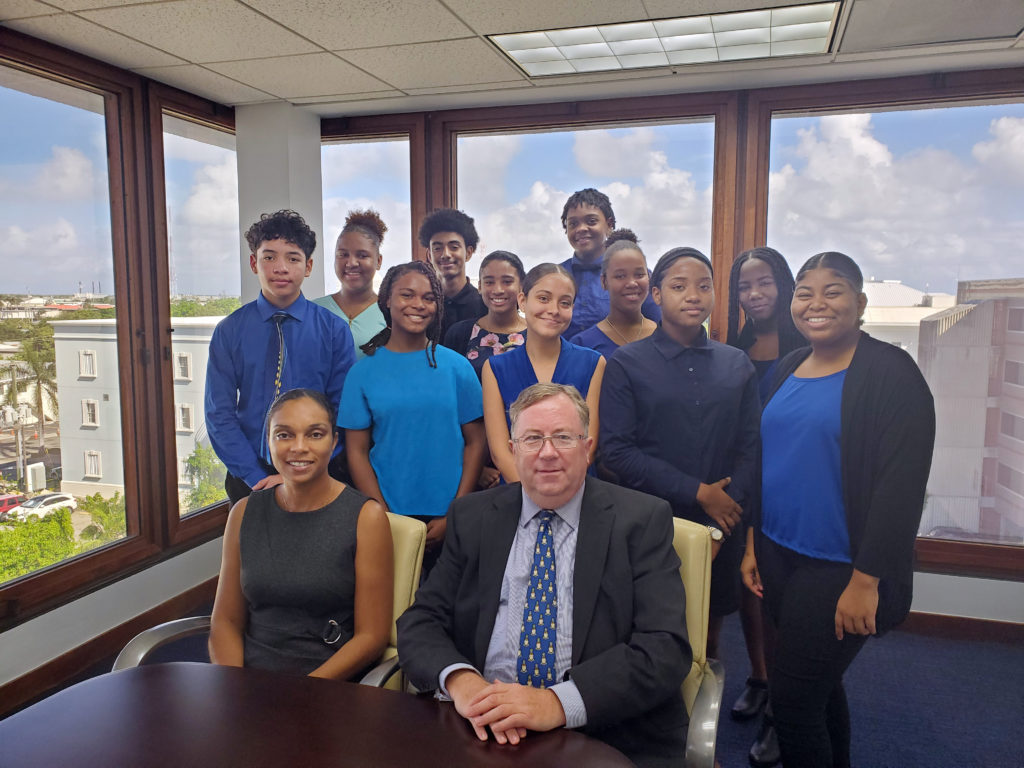
Seated (L-R): Natasha Whitelocke (HSM IP Head Paralegal) and Huw Moses (HSM Managing Partner). Front Row (L-R): Christopher Herrera, Paris Jackson, Jaysie Allen, Latoya Frazer and Johanna Dixon. Second Row (L-R): Annabelle Bush, Destiny Russell, Shyanne Stewart and Aliyanna Fisher. Third Row: (L-R): Christopher Myles and Kevaughn Hutchinson.
Global Restructuring Review (GRR) has just released their GRR 100 2020 Guide and HSM has made its debut on this list. GRR 100 is an annual publication that features the world’s leading law firms for cross-border restructuring and insolvency matters.
HSM’s Restructuring and Insolvency practice is led by Partner Ian Lambert and has grown significantly over the last year, especially due to the demand in service caused by COVID-19. GRR notes that Ian “has chalked up many years’ experience in the Cayman Islands and Canada”. Ian was also recognised as a “Name to Know” in the Cayman Islands by GRR 2019.
HSM’s Senior Associate Adam Crane was referenced for his arrival to HSM in 2018 from Patterson Law and notes “Adam was named one of the 15 “rising stars” in the International Institute’s ninth annual NextGen leadership programme in June 2020.”
Sarah-Jane Allison (HSM Partner) and Shula Sbarro (Associate) were also highlighted as names to know.
HSM was one of five international firms that were newly added to this list. GRR states: “In its relatively short existence, HSM has played a role in some of the most high-profile matters playing out in the Cayman Islands, including the fraud trial of Saudi conglomerate Ahmad Hamad Al-Gosaibi & Brothers (AHAB) and the Singular is liquidation.”
This recognition testifies that HSM is a recommended firm for carrying out insolvency and restructuring work with an international dimension.
HSM’s Dispute Resolution practice has once again been recommended as a leading firm (Cayman Islands) in The Legal 500 Caribbean 2021 edition. Our attorneys Ian Lambert (Partner) and Adam Crane (Senior Associate) received a special mention in their analysis.
The Legal 500 has been analysing the capabilities of law firms across the world for more than 30 years. Law firms and attorneys are ranked by thorough research processes and are highly credited if featured.
This recognition highlights HSM’s ability to successfully handle litigation and dispute matters.
Citing The Legal 500 website, they refer to HSM as a firm that “acts for a variety of stakeholders in cross-border restructuring and insolvency matters, with particular expertise in representing investment funds and banking and financial services clients.”
“Ian Lambert is a first class insolvency and restructuring lawyer. He is regularly involved in high profile and contentious engagements and he constantly delivers. He is a strong advocate.”
Who’s Who Legal (WWL) has recommended Robert Mack in their recently released 2020 Private Client Guide (Cayman Islands).
Robert Mack is the Head of Private Clients and Trusts at HSM and specialises in private and commercial trusts including purpose/STAR, reserved powers, unit, charitable and fixed interest trusts.
Robert has been featured by WWL for the past several years and this is testament to the high quality of service he delivers to his clients. Robert has been practicing Cayman Islands law exclusively since 2007. Prior to that he was an English qualified solicitor practicing in London. Robert is a long-standing Society of Trust and Estate Practitioners (STEP) Cayman Islands Council Member and is the current Deputy Secretary of that branch. Robert sits on the STEP legislative review sub-committee and the STEP Mental Capacity Special Interest Group.
WWL identifies the foremost legal practitioners in multiple areas of business law and recognition is based strictly on merit – you can’t buy entry into their publication. Recipients must be nominated for their expertise in the field by at least four independent sources, either from clients or peers.
Congratulations to our HSM Lawyer in the Cayman Islands, Robert Mack.
Work remotely in paradise? The Cayman Islands has made this a reality with their Global Citizen Concierge Programme, which allows persons with financial independence to live in the Cayman Islands for up to 24 months. It is available to anyone who can demonstrate their existing (and anticipated ongoing) employment outside of the Cayman Islands.
Key characteristics of Cayman’s Global Citizen Concierge Programme include:
- Created in October 2020.
- Available until 30 November 2023.
- Individual applicants must make a minimum household income of US$100,000 for single households.
- Applicant with an accompanying spouse/civil partner must make a minimum household income of US$150,000 for two person households.
- Applicant with a spouse/civil partner and dependent child or children must make a minimum household income of US$180,000.
- The government fee (per annum) for up to two persons is US$1,469 and an additional $500 per dependent.
- The holders of these certificates are expected to reside in the Cayman Islands for a minimum of 90 days each year.
HSM’s Immigration team is available to assist with these applications and have prepared a guide of the different options available for residency in the Cayman Islands.
Click on the icon below to download this guide.

Last updated: 22 October 2020.
This guide is intended only to provide a summary of the subject matter. It does not purport to be comprehensive or to provide legal advice. No person should act in reliance on any statement contained in this guide without first obtaining specific professional advice. Alternative solutions also exist which may better suit the requirements of a particular individual or entity.
Fatal error: Uncaught Error: Call to undefined function twentythirteen_paging_nav() in /home/clients/d17af2243e6f179e393695ba6e9ce04e/hsmnew/wp-content/themes/hsm/category.php:31 Stack trace: #0 /home/clients/d17af2243e6f179e393695ba6e9ce04e/hsmnew/wp-includes/template-loader.php(86): include() #1 /home/clients/d17af2243e6f179e393695ba6e9ce04e/hsmnew/wp-blog-header.php(19): require_once('/home/clients/d...') #2 /home/clients/d17af2243e6f179e393695ba6e9ce04e/hsmnew/index.php(17): require('/home/clients/d...') #3 {main} thrown in /home/clients/d17af2243e6f179e393695ba6e9ce04e/hsmnew/wp-content/themes/hsm/category.php on line 31