Category Archives: HSM LAW
The HSM Group (comprising of HSM Chambers, HSM Corporate Services Ltd. and HSM Intellectual Property) remain committed to their clients during the coronavirus (COVID-19) crisis. Our physical office in Grand Cayman is temporarily closed, but our team is working remotely until the shelter-in-place regulations are no longer required.
We are carefully monitoring and complying with the guidelines as set by the Cayman Islands Government. We make it our mission to keep abreast of these changes and how they may affect you, our valued clients.
Our lawyers in the Cayman Islands have curated a local guide to help advise a number of persons and businesses as to the requirements/expectations of the Law with COVID-19 in mind. Covering areas under corporate and commercial, debt solutions and recovery, employment and immigration, insolvency, insurance, private client and property.
Follow this link to download Cayman’s Legal Guide to COVID-19: https://staging.hsmoffice.com/law/caymans-legal-guide-to-covid-19-5283/.
This situation and its effects are ever-changing so we will be updating this guide as well as providing targeted articles on our website.
Our team is also proud to partner with the Cayman Islands Chamber of Commerce to provide informational webinars on some of these topics and recordings can be found at https://chambercovidupdates.ky/webinars/.
If you have any questions or need assistance, please reach out to your usual HSM contact or email us at info@hsmoffice.com.
Ultimately we are all in this together and HSM is on-hand to assist you during these unprecedented times.
The European Union has on the 18th of February, ‘blacklisted’ the Cayman Islands as a non-cooperative jurisdiction for tax purposes. This action was taken despite concerted efforts of the Cayman Islands Government to comply with every European Union initiative, including enacting more than 15 separate pieces of legislation designed to comply with EU criteria over the past two years alone.
It appears the ‘blacklisting’ arose as a result of two recent pieces of legislation, the Private Funds Law and the Mutual Funds (Amendment) Law which came into force on the 7th of February 2020, however, the passage of these laws came three days later than expected by the European Union’s Code of Conduct Group who met on the 4th of February. On the basis those two particular laws were not yet enacted into law, the European Union’s Code of Conduct Group recommended to the European Finance Minsters that the Cayman Islands be ‘blacklisted’ for failing to “…deliver on their commitment on time..” with respect to such legislation.
The Cayman Islands Government has to date issued two public statements on this matter since the ‘blacklisting’ occurred. They are fully committed to working closely with the European Union to remove the Cayman Islands from the ‘blacklist’ as soon as possible.
If you have any concerns on the above please direct your inquires to Huw Moses, HSM’s Managing Partner at hmoses@hmsoffice.com. We will continue to provide updates as and when they occur, but we do not expect this event to negatively impact our clients and are confident the jurisdiction will be removed from this list in due course.
The HSM Group is proud to once again offer a legal internship for the 2019/20 academic year in partnership with the Cayman Islands Further Education Centre (CIFEC).
Eleven interns have been recruited from the CIFEC Career Fair that was held in September 2019. The team at HSM has welcomed: Joshua Bent, Nahomy Bonilla-Zelaya, Derique Powery, Sheyla Scott, Rickhams Zuniga, Aaliyah Morris, Toshonna Kelly, Zara Hydes, Chrissy Stewart-Brown, Nyanza Henry and Amaya Jackson.
Since HSM is a full-service law firm, these students are able to gain experiences across a wide-range of practices including immigration, debt collection, intellectual property and even areas outside of law, such as finance.
Natasha Whitelocke coordinates the CIFEC Internship Programme on behalf of HSM and is also the Head IP Paralegal. Whitelocke along with HSM’s Managing Partner, Huw Moses, carefully select and pair an intern with a lawyer or expert at HSM. These personnel will monitor the student’s work and mentor their professionalism.
As part of the CIFEC curriculum, the internship runs until April 2019 and each student attends work twice a week during school hours. When the programme ends, HSM offers a select amount of summer jobs that will provide some students a deeper look into the working world. HSM currently employs six CIFEC graduates fulltime.
“We remain committed and passionate about developing Cayman’s next generation of professionals,” shares HSM Managing Partner, Huw Moses OBE. “Whether they become lawyers or not, our team will also teach them the basic skills needed to excel in any industry they choose.”
HSM has worked with the CIFEC progamme since the firm’s inception in 2012.
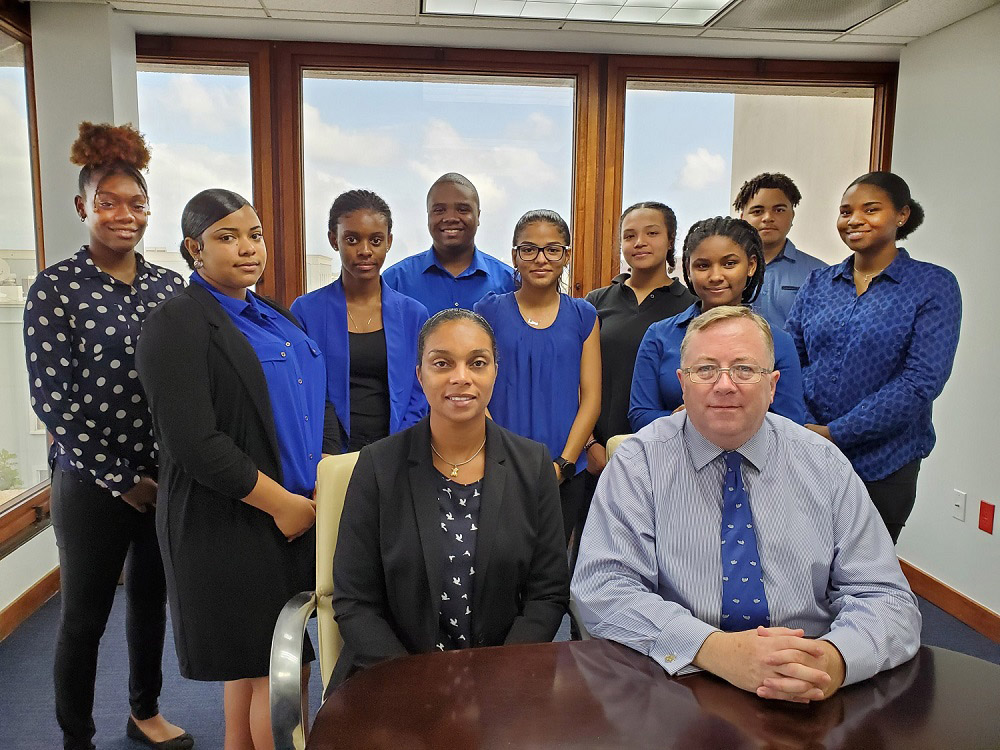
Photo (L-R): Natasha Whitelocke (HSM IP Head Paralegal) and Huw Moses (HSM Managing Partner) seated in front of HSM Interns: Aaliyah Morris, Amaya Jackson, Nyanza Henry, Joshua Bent, Nahomy Bonilla-Zelaya, Sheyla Scott, Chrissy Stewart-Brown, Derique Powery and Toshonna Kelly. Missing from photo: Rickhams Zuniga and Zara Hydes.
The HSM Group is proud to sponsor the 3rd Annual Society of Trust and Estate Practitioners (STEP) Cayman Conference, taking place at The Ritz-Carlton Grand Cayman from January 23-24.
HSM’s Head of Private Client and Trusts, Robert Mack, will be attending the conference.
Robert specialises in private and commercial trusts including purpose/STAR, reserved powers, unit, foundation companies, charitable, and fixed interest trusts. Robert is also a member of the local branch of STEP where he currently holds the position of branch Secretary.
As part of our sponsorship, HSM will have an information booth and our legal expert Samantha Bartley will be on hand to answer any questions you have. She can also put you in touch with our attorneys not only in Trusts and Private Client, but across Immigration, Labour and Employment Law, Corporate and Commercial Services, Debt Solutions and Intellectual Property.
We look forward to connecting with you at this conference.
Who’s Who Legal (WWL) has featured two HSM Lawyers in the Cayman Islands in their recently released 2019 Private Client Guide and 2020 Restructuring and Insolvency Guide.
Ian Lambert, HSM’s Partner, is recognised as a restructuring and insolvency expert.
Ian joined HSM as a Senior Associate in March 2013. He became a Partner in 2014. Ian is well-versed in numerous areas of litigation and specialises in insolvency, corporate recovery, fraud and commercial litigation.
Robert Mack, HSM’s Head of Private Clients and Trusts, is recognised as a private client expert.
Robert specialises in private and commercial trusts including purpose/STAR, reserved powers, unit, charitable and fixed interest trusts.
WWL identifies the foremost legal practitioners in multiple areas of business law and recognition is based strictly on merit – you can’t buy entry into their publication. Recipients must be nominated for their expertise in the field by at least four independent sources, either from clients or peers.
Congratulations to our HSM Lawyers in the Cayman Islands, Ian and Robert.
Purchasing property in the Cayman Islands is attractive, not only for the luxurious beaches and high standard of living but the buying process is acclaimed for its structure and variety of opportunities.
HSM’s property lawyers in the Cayman Islands breakdown the fees that buyers can expect.
There are no property taxes in the Cayman Islands but property buyers do pay stamp duty. Generally, stamp duty is payable at a rate of 7.5% on the market value of property, whether undeveloped ‘raw’ land or developed land with buildings on it. However, concessions or waivers may be available in the following circumstances:
a) First time Caymanian Purchasers
Where a purchaser is Caymanian,[1] reduced stamp duty rates may be available for the purchase of an existing residential dwelling, or raw land for the construction of a residential dwelling[2]. This concession is not automatic; an application must be made to the Minister of Finance. If approved, the following reduced rates apply for one Caymanian first-time purchaser: [3]
- (i) 0% for bare land purchases with a market value of up to CI$150,000 and for houses, apartments or other dwelling purchases with a market value of up to CI$400,000, for owner occupation; and
- (ii) 2% for bare land purchases with a market value of more than CI$150,000 but not exceeding CI$200,000 and for houses, apartments or other dwelling purchases with a Market Value of more than CI$400,000 but not exceeding CI$500,000, for owner occupation.
The following reduced rates apply for two or more[4] Caymanian first time purchasers:
- (i) 0% for bare land purchases with a market value of up to CI$300,000 and for houses, apartments or other dwelling purchases with a market value of up to CI$500,000, for owner occupation; and
- (ii) 2% for bare land purchases with a market value of more than CI$300,000 but not exceeding CI$350,000 and for houses, apartments or other dwelling purchases with a Market Value of more than CI$500,000 but not exceeding CI$600,000, for owner occupation.
The usual 7.5% applies to purchases exceeding the above limits.
b) Transfers through Natural Love and Affection
For transactions which take place through Natural Love and Affection (i.e. no consideration, financial or otherwise, passes between the parties), a fixed stamp duty rate of CI$50[5] applies. Property may pass for natural love and affection between:
- Husband and Wife;
- Parent and Child;
- Brother and Sister (as long as they share a parent); and
- Grandparent and Grandchild.
It is also possible for property to pass for natural love and affection between extended family members in a single transaction, as long as evidence of the relationship chain can be demonstrated and the parties are living. In such cases, the Stamp Duty is payable separately for each link in the relationship chain.
c) Linked Transactions/ Pre-construction/ Developments
Historically, many developers have minimized the stamp duty payable by their clients by structuring their contracts in two interdependent parts: an agreement for the sale of raw land on which the building will be constructed; and a development or construction agreement to be carried out by the developer or a related company.
Accordingly, the stamp duty is assessed on the value of the raw land only, without taking into account the value of the building the developer has agreed to construct on, provided that the agreement for sale is presented to the Lands and Survey Department for assessment before the building commences.
Changes on the horizon?
In October 2018, the Stamp Duty (Amendment) Bill 2018 (the ‘Bill’) was published. The Bill proposed that as of 1 January 2019 such transactions would be considered ‘linked property transactions’, and stamp duty would be assessed on the aggregate value of the two agreements.
What has actually changed?
However, when the Stamp Duty (Amendment) Law 2018 came into force on 19 December 2018, the draft legislation had been significantly altered with respect to ‘linked property transactions’, allowing developers with planning permission in place by 30 June 2019 a year to take advantage of the pre-existing regime for stamp duty on ‘linked property transactions’, provided they enter into their contracts before 31 December 2019. Accordingly, stamp duty will be assessed on the value of the land purchase agreement only and not on the value of the construction agreement as well.
This has allowed developers more time to prepare for the impact of the new regime and is a welcome delay for both developers and purchasers with residential development projects already underway.
What about after 31 December 2019?
The Law provides that, after 31 December 2019, in a Linked Property Transaction worth CI$300,000 or less, the stamp duty payable is 3% of the total value of the linked property transaction.[6]
In a Linked Property Transaction worth more than CI$300,000 the total 7.5% stamp duty is payable as follows:[7]
- (i) 75% of the total value of the linked transaction, payable within 45 days of the purchaser having signed an Agreement for Sale and Purchase (‘Agreement’); and
- (ii) 75% of the total value of the linked transaction, payable within 45 days of the purchaser having signed a Transfer of Land (‘Transfer’).
d) Transfers through the death of an owner, or subsequent divestment of estate
No stamp duty is payable on transactions that are effected as a result of the death of a proprietor/ owner of a land, where the land is being inherited either directly, or otherwise dealt with by way of the Administrator of the Estate.
e) Transfers between Companies and Shareholders
For transfers from a landholding company to a shareholder owning at least 45% of the shares (or vice versa), an abatement of stamp duty may also be available.[8]
f) Other
Several other categories of transfers may also be exempt from stamp duty, including:
- transfers to a receiver;[9]
- transfers executed by a cooperative society;[10] and
- certain dealings in bankruptcy.[11]
Footnotes
[1] As defined under the Immigration (Transition) Law, 2018 and only if they can provide supporting documentation.
[2] This only applies when the land or property is for the applicant’s first owner occupied dwelling.
[3] This applies to all areas except parcels located in excepted Blocks – see the Schedule to the Stamp Duty Law (2019 Revision) for a list.
[4] But no more than 10.
[5] For extended family members, the Stamp Duty fee applies separately to each ‘link’ in the relationship chain.
[6] CONVEYANCE OR TRANSFER of any immovable property within a development scheme and forming part of a linked property transaction, para (1) Schedule, Stamp Duty Law (2019 Revision)
[7] CONVEYANCE OR TRANSFER of any immovable property within a development scheme and forming part of a linked property transaction, paras. (2), (3) and (4) Schedule, Stamp Duty Law (2019 Revision)
[8] CONVEYANCE OR TRANSFER, para (3), Schedule, Stamp Duty Law (2019 Revision)
[9] CONVEYANCE OR TRANSFER, para (5), Schedule, Stamp Duty Law (2019 Revision)
[10] s.67 Cooperative Societies Law (2001 Revision)
[11] s.166 Bankruptcy Law (1997 Revision)
HSM’s Immigration team have taken a close look as to why there is a decline for work permit fees in the Cayman Islands.
It appeared to be inevitable, and may now just be coming true. Income from work permit fees is likely to fall, perhaps precipitously.
According to the Economics and Statistics Office latest Compendium of Statistics, the Cayman Islands Government received $87.3 million dollars in work permit revenue last year. There had been $88.9 million in 2017, and the number had consistently grown in each of the 8 prior years.
The drop in work permit revenue ought not to come as any surprise. What may surprise is the fact that the government revenues appear likely to fall (perhaps significantly), even if (or as) the number of work permit holders grows.
The reasons are straightforward enough. In some cases, Caymanians are advancing in their careers, and replacing expatriates who are leaving. Other expatriates find relief from high immigration fees in the Special Economic Zone. Still others (working for foreign companies with no presence in Cayman) have taken the authorities up on their kind invitation (that we simply cannot understand) to have no work permit at all, as is the case for expatriates in government service.
Those are not however the primary reasons.
With the abandonment of Term Limit Exemption Permits, and an easing of the PR system, significant and growing numbers of expatriates are inevitably proceeding to become Caymanian. The whole process (from arrival and without being married to a Caymanian) usually takes no more than 15 years. This, subject to appropriate limitations, should be celebrated. We are now at a stage that the many of our long term residents have obtained Permanent Residence and are now becoming (or will shortly become) Caymanian. A significant wave of others have acquired Permanent Residence in the past two years. Many of them were delayed in the processing of their applications and so only have a year or two to go before they (and their families) also become Caymanian.
Almost all will have met (or exceeded) the government required conditions for membership. Being Caymanian is an honour, and for those on whom it is bestowed, a privilege. It can (and should) be a source of great pride, but being Caymanian also brings with it a myriad of benefits, including an exemption from having to pay any work permit fees. That exemption applies not only to the Caymanian, but also to their spouse.
The advantage of any exemption varies by occupation. Not all work permits (or permanent residence certificates) are created equal. For teachers, the annual fee is nil; for labourers it is $550; for accountants it is $13,650; and for (equity) partners in law firms, it is $32,400. The reality is that financial services industry professionals (those responsible for the highest fees) have been granted PR in substantial number. They are wholly deserving having fulfilled the criteria for that award. They now qualify and cross the next threshold. They are becoming Caymanian. There does not appear to be corresponding levels of growth amongst executive-level work permit holders (with the pace of their predecessors becoming Caymanian, retiring, or leaving) now outpacing the supply of new accountants, bankers, and lawyers from overseas.
Certainly, the number of work permit holders will likely continue to grow, but at current work permit fees it takes 59 labourers (or 108 Produce Clerk’s or 216 baby sitters) to generate the equivalent revenue in work permit fees, as a single law firm partner. With the ongoing apartment construction boom (fueled in part by a recent change in the stamp duty treatment of pre-construction purchases) there will be heavy construction activity for the next two years. The number total of work permits may well continue to grow, all while the average price paid for each work permit appears likely to continue to decrease.
The likelihood is for substantially decreasing work permit revenues. These will likely be offset by import duties on materials and furnishings required for the new buildings, but when all the construction is complete, that too will diminish. At that stage large numbers of construction workers may be without work and will return to their home jurisdictions. At the same time, we will celebrate the latest wave of PR recipients becoming Caymanian. The monies generated in work permit fees, and the number of work permits, will then fall in unison, perhaps significantly. We can only hope that this prospect is recognized, and being planned for.
All is far from lost. There are alternative revenue sources and options mitigate the consequences, but these will need to be actioned very soon, and likely must include welcoming new residents to our shores.
HSM’s Dispute Resolution practice and attorneys Ian Lambert (Partner) and William Helfrecht (Partner) have made their debut on The Legal 500 Caribbean 2020.
The Legal 500 has been analysing the capabilities of law firms across the world for more than 30 years. Law firms and attorneys are ranked by thorough research processes and are highly credited if featured.
This recognition highlights HSM’s ability to successfully handle litigation and dispute matters.
Citing The Legal 500 website, they refer to HSM as a firm that “provides practical and useful advice on insolvency and litigation matters in a cost-effective manner.”
“Ian Lambert is experienced in complex commercial and contract disputes, insolvency and bankruptcy claims, asset recovery and fraud issues, and trust litigation; and William Helfrecht is noted for disputes relating to trusts, professional negligence work, company law and land issues.”
The HSM Group has welcomed Kathryn Rowe to their growing law practice.
Kathryn joins as a Senior Associate and will focus on employment related matters. With over 17 years of legal experience, Kathryn has a wide-range of skills in the areas of litigation, employment, immigration, data protection and regulatory matters.
Kathryn has handled contentious and non-contentious employment work, representing and advising both public and private sector employers and employees. She has provided HR advice to clients, including contract and document preparation through to disciplinary and grievance matters, immigration issues, redundancy, discrimination and other contractual issues.
Kathryn was appointed as Chairperson of the Labour Tribunal in 2015 and still holds this position.
Managing Partner, Huw Moses, OBE notes: “Kathryn is a valued addition to our employment team. She has a great mix of local and international experience, which will undoubtedly benefit our clients.”
HSM’s Immigration team explain why the population numbers don’t add up in the Cayman Islands.
Much has been stated in the press of Cayman’s growing population. The Economics and Statistics Office’s Compendium of Vital Statistics estimates the year-end population (as at December 2018) as being 65,813 persons. Of those, an estimated 29,108 are expatriates, and 36,705 Caymanian.
Notwithstanding the statistics (which relate to population), the actual total number of persons physically resident in Cayman may in fact be substantially higher. As reported in the Cayman Compass on 16 May, 2019 (using actual numbers provided by the Department of Immigration) there were 27,263 expatriates holding valid work permits or under government contract as at 6 February 2019 (some 5 weeks after the date of the ESO estimate).
That 27,263 does not include any Permanent Residents or the holders of RERC’s as the spouses of Caymanians, nor the dependents of work permit holders and government contracted workers.
Information received from the Department of Immigration and reviewed by us indicates that there were, last year, approximately 3,000 approved dependents of work permit holders and government contracted workers, and of the order of 5,000 other persons resident by virtue of some form or other of a certificate of residence (whether in their own right, as a dependant, or as the spouse of a Caymanian).
If we allow for some expatriates who are institutionalized (whether in prison, seeking asylum, or in hospital), throw in persons with student visas (there were 300 in that category alone last year), Cabinet permissions, Snow Birds spending more than 6 months a year in their beachfront condos, and some over stayers), it appears clear that there are more than 36,000 non-Caymanians “living” in Cayman.
If we add back in the reported 36,705 Caymanians, the number of residents may have already passed 72,000 in the last year. It is perhaps helpful to note that ICTA has reported there being 103,274 local cell phones in 2018. Certainly, some persons have more than one cell phone, but thousands (including young children) have none.
Informal indications (ranging from traffic to the availability of rental properties and the increasing height of Mount Trashmore) are that the population (and number of residents) has continued to grow this year.
Part of the reason for the disparity in numbers provided by the ESO, and those provided by The Department of Immigration (now WORC), is the methodology used by each. Persons who intend to leave the Cayman Islands within 6 months are simply not counted by the ESO, but are counted by WORC.
Accordingly, although persons are in fact resident for immigration purposes, they do not necessarily form part of the population for statistical purposes. That is understood to be entirely consistent with international standards. Those standards may not always be relevant to our domestic considerations, in particular given the very large transient workforce and the reality that (at least historically) when work permit holders leave, they tend to be replaced immediately by another work permit holder.
The result is that whilst statistically we had a population of 65,813 at the end of last year, the number of people living here was greater. We may now already have as many as 75,000 residents using our roads, sewerage systems, garbage facilities and other infrastructure.
If true, we have no need to wait 10 years to find out 100,000 people physically in Cayman looks (and feels) like.
This winter, a good cruise ship day, coupled with high hotel and condo occupancy (we had 6,720 rooms available at the end of last year) will (at least momentarily) push the total number of people physically present in the Islands above 100,000.
Even then, the number of residents will of course be less, and the population smaller still. The detail will depend on who is asked, on what day and why, and the statistics.
Fatal error: Uncaught Error: Call to undefined function twentythirteen_paging_nav() in /home/clients/d17af2243e6f179e393695ba6e9ce04e/hsmnew/wp-content/themes/hsm/category.php:31 Stack trace: #0 /home/clients/d17af2243e6f179e393695ba6e9ce04e/hsmnew/wp-includes/template-loader.php(86): include() #1 /home/clients/d17af2243e6f179e393695ba6e9ce04e/hsmnew/wp-blog-header.php(19): require_once('/home/clients/d...') #2 /home/clients/d17af2243e6f179e393695ba6e9ce04e/hsmnew/index.php(17): require('/home/clients/d...') #3 {main} thrown in /home/clients/d17af2243e6f179e393695ba6e9ce04e/hsmnew/wp-content/themes/hsm/category.php on line 31