Category Archives: HSM LAW
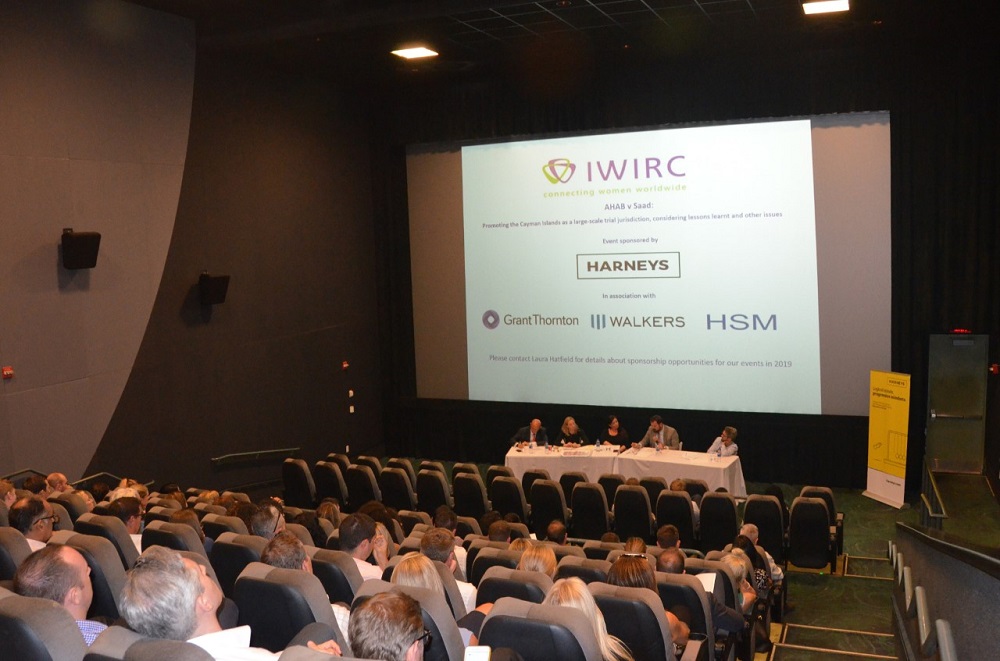
HSM Partner Ian Lambert promotes the Cayman Islands as a large-scale trial jurisdiction with International Women’s Insolvency & Restructuring Confederation (IWIRC) Cayman.
On November 26, Ian participated in a panel discussion on lessons learned and other issues for Cayman’s longest and most expensive case, AHAB v Saad.
Panelists also included Shelley White (Walkers), Hugh Dickson (Grant Thornton), Grainne King (Harneys) and William Peake (Harneys).
Their lively discussion and recount of this case showcased how the Cayman Islands’ legal framework is able to handle complex litigation and insolvency matters.
Our Head of Private Client and Trusts, Robert Mack, takes a look at Foundation Companies in the Cayman Islands and how they differ to trusts in the private client context.
In late 2017, Foundation Companies in the Cayman Islands were unveiled to the world. The Foundation Company (“FC”) was designed to act as a corporate wealth and succession planning vehicle; in some cases, it could be a viable alternative to a trust.
There are also new and unexpected uses for FCs, such as acting as a platform for emerging cryptocurrencies and special purpose vehicles in commercial transactions.
The first thing to understand about FCs is that they are merely a variant of a Cayman Islands company and are distinct in nature from civil law foundations found in places such as Panama, Lichtenstein, and certain offshore financial centers such as Jersey. FCs also have a separate legal personality, directors, officers, plus a registered office. So what sets them apart from other Cayman Islands companies? A few key distinctions are as follows:
- FCs are not designed to distribute profits to members, but rather they are meant to carry out particular purposes in accordance with its constitution. In the trust-substitute context, a key purpose is usually to hold valuable assets in order to provide a financial benefit to a defined class of beneficiaries;
- FCs do not have to issue shares, and can, therefore, be ownerless or ‘orphan’ vehicles;
- The purposes of an FC can be entrenched, so no person or court can alter them unless the founder of the FC permits it.
It is also important to understand just how FCs differ from trusts:
- Trusts do not have a separate legal personality. The term ‘trust’ merely describes the relationship which arises when assets/property are held by one person (i.e., a trustee) for the benefit of other persons or purposes (i.e., beneficial objects);
- Trustees are the legal owners of the trust assets;
- The terms of a trust can, in certain circumstances, be changed without the consent or approval of the settlor;
- Unless a Cayman Islands trust is a private purpose or charitable trust, it has a maximum duration of 150 years; FC’s, on the other hand, are perpetual;
- The courts of the Cayman Islands have broader scope to interfere in the administration of trusts than FCs.
Perhaps the biggest ‘leap of faith’ any person wishing to set up a trust must face is the fact that once they part with their valuable assets, it is the trustee who becomes the legal owner of those assets and it is the trustee who makes all the decisions about the management of those assets going forward[1]. This loss of control, while often beneficial from a planning perspective, is often a step too far for some clients, even though it is possible for a settlor of a Cayman Islands trust to reserve to himself or others, certain key administrative powers such as a power to control distributions of capital and income[2].
On the other hand, FCs allow a client to achieve effective control over the FC assets, whether directly (i.e., by taking up a role as a director or officer of the FC), or indirectly (i.e., by appointing trusted individuals as directors or officers of the FC).
While the vast majority of settlors will appoint a professional trustee to administer their trusts[3], an FC may be staffed by the client, family members, or trusted advisors[4]. This could result in minimising administrative expenses if professional directors and officers are not involved[5]. In contrast, for example, private purpose trusts (known as STAR trusts in the Cayman Islands) require that at least one of the trustees is a regulated Cayman Islands trust corporation, and such professional trustee will look to charge market rate for their services.
Foundation Companies in the Cayman Islands offers clients a new and exciting way for clients to structure their affairs with a more familiar corporate entity, and in addition the FC enables clients to be as hand-on or hands-off on the administration of the FC as they wish to be without the risk of tainting the structure[6]. For the client wary of trusts, the FC is an excellent alternative and worthy of consideration.
Cayman Financial Review
This article can also be seen in Cayman Financial Review – Q4 2018 issue.
Footnotes
[1] Subject to the terms of the trust instrument and the law generally. It is possible in some circumstances for a client to act as the trustee of his or her own trust, however, that is often inadvisable for a whole range of reasons which are outside of the scope of this article.
[2] Often times it is impractical or inadvisable for a Settlor to reserve such powers as it may have an adverse tax consequence in his or her place of tax residence.
[3] Due to the complexity of trust administration, tax efficiency, and Cayman Islands legislation which prescribe that professional trustees must appointed for certain types of trusts (ie. STAR trusts).
[4] The only requirement is that the Secretary of an FC must be a ‘qualified person’ being a person who is licensed to provide company management services in the Cayman Islands.
[5] An annual government maintenance fee of approximately US$853 is payable for each year the FC is registered however. Trusts to not attract any such annual fees.
[6] If too many trustee powers are usurped, or if the trustee/settlor relationship becomes corrupted there is a risk the trust may be deemed to be a ‘sham trust’.
HSM’s newest Senior Associate Adam Crane has been called to the Cayman Islands Bar on November 6, 2018.
Adam’s admission was moved by HSM Partner Ian Lambert, who summarised his qualifications for Justice Richard Williams. Adam hails from Nova Scotia, Canada and has substantive experience in commercial litigation, insolvency, restructuring and financial recovery matters.
Adam will focus on a wide range of civil litigation, acting for insolvency practitioners, banks, strata corporations and leading businesses based both in the Cayman Islands and overseas.
Managing Partner, Huw Moses, OBE notes: “Adam’s international experience is a real asset to our firm and we look forward to extending his services to our valued clients.”

L-R: HSM Partner, Ian Lambert; HSM Senior Associate, Adam Crane and Justice Richard Williams.
HSM’s Immigration team explores The Immigration (Amendment) Law, 2018 (“the Amendment Law”) that came into effect on 13 August 2018, and following this passage, new opportunities present themselves for persons who are married to a Caymanian and hold (or are seeking) Residency and Employment Rights Certificates as the spouse of a Caymanian.
According to documentation recently received from the Department of Immigration there are approximately 350 expatriates holding Residency and Employment Rights Certificates (RERC’s) as the spouse of a Caymanian. We expect this number will increase.
Unlike the RERC’s awarded to Permanent Residents, the RERC’s awarded to the spouse of a Caymanian were not previously permanent in nature. They only lasted for 7 years and the holder either had to seek the Right to be Caymanian (on the basis of 7 years’ marriage to a Caymanian) or seek to renew their RERC prior to its expiry.
Until the spouse of a Caymanian became Caymanian, they could not be said to be free from any immigration restriction on the period they are permitted to remain in the Islands given the 7 year period of validity of their RERC. This meant that they were unable to be naturalised or obtain a Cayman Islands passport during that 7 year period.
Cayman Islands Passports are only available to persons who hold British Overseas Territories Citizenship (“BOTC”) by virtue of a connection with the Cayman Islands. The process for being, or becoming, a BOTC of the Cayman Islands is set out in and governed by the British Nationality Act. That Act has at all relevant times required applicants for Naturalisation to have been resident in the Territory for a minimum of twelve months’ “free from Immigration Restriction for the period for which they may remain” prior to becoming eligible to apply for Naturalisation.
In contrast, the spouse of a Permanent Resident was able to seek Naturalisation a year after marrying a PR holding expatriate, and thereafter obtain a Cayman Passport. The result was that a spouse of a Caymanian was until very recently with the passing of the Amendment Law treated far less favourably. They would have to be married to a Caymanian for 7 years’, apply for Caymanian status on the grounds of 7 years’ marriage, obtain that status, and hold it for 12 months’ before being eligible to apply for naturalisation and thereafter, a Cayman Passport.
The Government has acted to ensure that a spouse of a Caymanian is subject to the same rules when seeking naturalisation and a Cayman Passport as the expatriate spouse of an expatriate PR holder. This change is welcomed and the authorities should be congratulated for making it.
The relevant amendment which came into effect on 13 August, has removed the 7 year expiry date on every RERC issued to a spouse of a Caymanian, in effect making their RERC Certificate indefinite in nature.
With no expiry date to their Certificate, a spouse of a Caymanian holding an RERC may now, provided they have held an RERC for no less than 12 months’ and have been legally and ordinarily resident in Cayman for no less than 5 years’, apply for Naturalisation on the Grounds of Residence. If they are married to a Caymanian, who is also a BOTC by virtue of a connection to the Cayman Islands and have been married and resident for 3 years’, an application for Naturalisation on the Grounds of Marriage to a BOTC can now be made.
This will greatly expedite the ability of a spouse of a Caymanian to seek and obtain Cayman Islands Passports and further, for them to thereafter seek registration as full British Citizens which, if granted, would enable them to hold full British Citizenship in addition to being British Overseas Territories Citizens.
Once the spouse of a Caymanian has been naturalised as a BOTC, they will be eligible to seek to become Caymanian on the basis of Residence some 5 years’ later or 15 years’ after first becoming Resident in the Cayman Islands, whichever is less. This is the mechanism by which most long term residents may become
Caymanian and is entirely consistent with the original intention of what started as the Caymanian Protection Law, that in order to be eligible to become Caymanian, applicants must first be British Subjects.
The ability of a spouse of a Caymanian to seek to become Caymanian relying on 7 years’ of marriage to a Caymanian (rather than on the basis of Naturalisation/Residence set out above) continues; although not least given issues that may arise following any breakdown of the marriage, prospective applicants for Caymanian Status may prefer (all other considerations being equal) to follow the Naturalisation/Residence route to becoming Caymanian rather than seeking status based on marriage.
Holders of RERC’s as a spouse of a Caymanian continue to enjoy unfettered access to the labour market and to be free to engage in any category of gainful occupation without having to pay annual fees.
The Government has elected to not require a spouse of a Caymanian to undertake any annual reporting requirements but given perceptions as to marriages of convenience and the potential for such spouses to be living apart, such provisions may need to be introduced in the future.
This article can also be seen in The Journal – November 2018 issue.
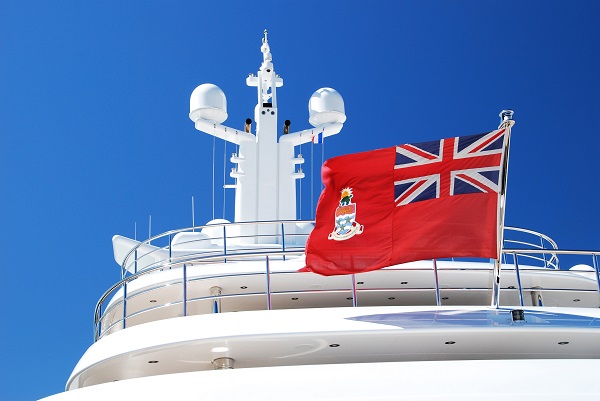
The Cayman Islands is recognised as one of the most prestigious flag states internationally and is a popular and attractive base for the registration of foreign owned vessels.
The Cayman Islands, consisting of Grand Cayman, Cayman Brac and Little Cayman, are a British overseas territory located in the western Caribbean Sea. Cayman is a major world offshore centre, which, in conjunction with its comprehensive maritime legislation, allows flexibility and safety for vessel owners in a tax neutral environment.
Cayman is a category 1 British Registry, affording Cayman registered vessels all the privileges that accompany the British Flag, along with full international recognition.
Additionally, a wide range of ownership structures is available to facilitate flagging a vessel in Cayman, and it is not always necessary for a Cayman Islands flagged vessel to be owned by a Cayman Islands individual or entity. Moreover, there are few restrictions on crew nationality for Cayman flagged vessels.
A full range of vessel registration options are offered by the Cayman Islands Shipping Registry (from bareboat charters to full registration).
HSM advises on all aspects of the vessel registration process in the Cayman Islands and maintains excellent relationships with the Cayman Islands Shipping Registry and is listed as a maritime services provider/partner.
For more details on our vessel registration services, visit hsmoffice.com/law/vessel-registration.
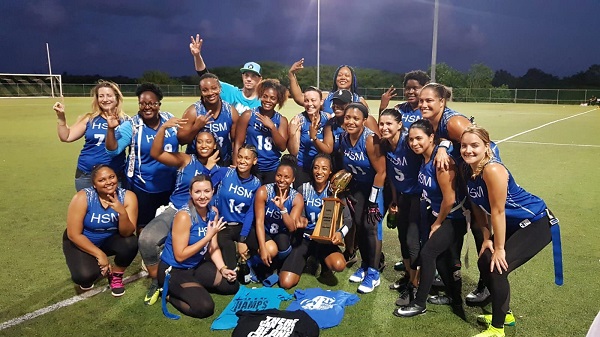
The HSM Vipers are an unstoppable force winning the Cayman Islands Flag Football Association Women’s League three years in a row.
This year’s finals took place on Saturday, October 20 at the Ed Bush Field in West Bay.
The HSM Vipers went against The Greenhouse Lynx. The game went into overtime and tied at 0-0, however; HSM prevailed at 7-6.
The HSM Vipers were awarded the overall trophy for their participation and performance during the tournament. Our own Jennifer Cotarelo-Choice, Intellectual Property Paralegal, was named MVP of the Women’s Championship Game and MVP of the Women’s League.
HSM is proud to support local sports like the Cayman Islands Flag Football League. Our team winning three years in a row is testament to their dedication, teamwork and perseverance. HSM congratulates all the teams involved and looks forward to next year’s league.

Jennifer Cotarelo-Choice (right) receiving the MVP award.
The HSM Group is excited to once again offer a legal internship for the 2018/19 academic year in partnership with the Cayman Islands Further Education Centre (CIFEC). This year marks their largest group with 16 placements.
The students were recruited at the CIFEC Career Fair which took place in September 2018. As part of the CIFEC curriculum, each student attends work twice a week during school hours.
HSM’s internship programme begins October 2018 and runs until April 2019. The students have been paired with a mentor and will gain experience in areas such as immigration, corporate services, debt collection, intellectual property and even areas outside of law, such as finance and marketing.
Joining the team are: Kymani Rose, Jada Dixon, Iesha McIntosh, Paula Brown, Oneila Ewers, Shante Ramoon, Jordyn Thompson, Amelia Lamie, Abigail Campbell, Shaquana Welcome, Chadrick Thomas, Shantel Miller, Yanina Montero, Nia Carter, Izarah Brown and Chelsea Frederick.
Upon completion of this programme, some students may have the opportunity to return to HSM for a summer placement during normal office hours. If a student has proven a match for an open position with the company, they may be offered a fulltime job. HSM currently employs six CIFEC graduates fulltime.
“We are passionate about sharing our expertise to Cayman’s next generation of leaders and are proud to be able to offer more opportunities this year,” shares HSM Managing Partner, Huw Moses OBE. “It is inspiring for us to watch these students learn and grow professionally.”
HSM has worked with the CIFEC progamme since their inception in 2012. The firm’s continued involvement in the CIFEC internship showcases their unwavering commitment to the local community by providing work experience opportunities to ambitious young professionals.
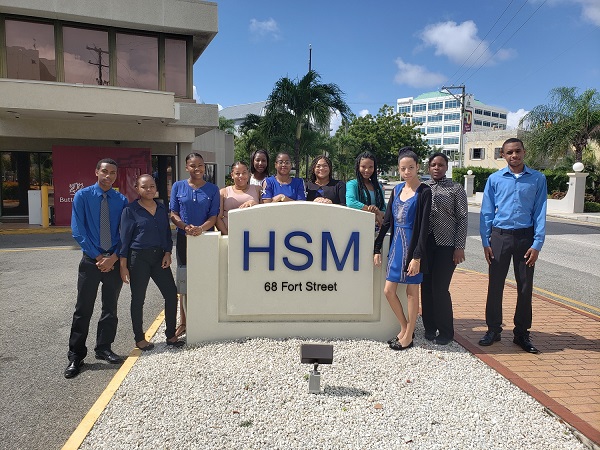
Photo (L-R): Kymani Rose, Jada Dixon, Iesha McIntosh, Paula Brown, Oneila Ewers, Shante Ramoon, Jordyn Thompson, Amelia Lamie, Abigail Campbell, Shaquana Welcome and Chadrick Thomas.
The HSM Group is thrilled to welcome Senior Associate, Adam Crane. Adam’s practice focuses primarily on areas of commercial litigation, insolvency, restructuring and financial recovery matters.
Adam joins HSM with over seven years of experience in commercial litigation, insolvency, restructuring and financial recovery. Having worked with a top Canadian law firm where he was Partner and the Chair of the Financial Recovery and Insolvency Group.
“Adam brings valuable litigation experience to the firm and we look forward to enhancing our legal services with his expertise,” shares Ian Lambert, Partner at HSM.

The Immigration (Amendment) Law, 2018 (“the Amendment Law”) came into effect on 13 August 2018, and with it, new opportunities potentially present themselves for various categories of people in the Cayman Islands to obtain the Right to be Caymanian. This article explores two such changes.
- Non-Caymanians who were born in the Cayman Islands between 27 March, 1977 and 1 January, 1983; who a British Overseas territories Citizens (“BOTC”) by virtue of their birth in the Islands; and have resided here since birth.
A frequently held misconception is that if you hold a Cayman Islands passport you are Caymanian. Many Caymanians have Cayman Islands Passports, however, many do not. Those who do not hold a Cayman Islands passport are no less Caymanian than those who do hold one. Equally, many holders of Cayman Islands Passports are not Caymanian and are only in the Cayman Islands as a result of having a different type of permission to remain, i.e. Permanent Residence. There are however those people who have Cayman Islands passports (and have been British Overseas Citizens of the Cayman Islands since birth) but have no right to be in the Cayman Islands. It is for some of these people that the Law is intended to provide remedy.
Since these individuals have held Cayman Islands passports since birth and have often lived nowhere else, they often considered themselves to be Caymanian and the wider society has often treated them as Caymanian even though they are not. Prior to the recent change in the Law, the Law had provided that in order for these individuals to become Caymanian on the basis of their birth in the Islands to non-Caymanian parents in the period between 27 March, 1977 and 1 January, 1983, they had to make an application to the Chief Immigration Officer prior to 21 December 2007 for the grant of Caymanian status.
As the development of the Islands has continued, it has become apparent that a number of persons in this category had failed to make application within the prescribed timeframe and had accordingly “fallen through the cracks.” Short of a Cabinet status grant or becoming Caymanian through marriage to a Caymanian, there was no mechanism available for these individuals to acquire status. The immigration authorities in particular, in exercising their border control function, did not seem to take note of these non-Caymanians as they have been travelling on Cayman Islands Passports. The issue seems to have largely become apparent when private sector employers, exercising the required diligence to ensure they were not employing non-Caymanians without appropriate permissions, determined certain persons were not in fact Caymanian. Both employment and being employed without immigration permission are strict liability offences under the Immigration Law. It is no defence to say “I thought they were Caymanian” or indeed for a non-Caymanian in employment without immigration permission to say “I thought I was Caymanian.”
Accordingly, these individuals are one category (there are several, including another referenced below) of what have become referred to as “Ghost Caymanians” (persons who think they are Caymanian, and/or otherwise are treated as being Caymanian, but in fact and in law, are not).
The Cayman Islands Government should be congratulated for providing a mechanism for such persons who may have previously missed the window to apply to become Caymanian, to do so now, by removing the deadline, previously written into the law, by which they had to have applied.
In order to now satisfy the requirements of the law the individual must satisfy the Chief Immigration Officer that they were born in the Islands between the relevant dates, are a BOTC on the basis of their birth in the Islands (whether or not they actually hold (or have ever held) a Cayman passport is not relevant, although most will), and have resided here since birth (absences for education and medical care are excused).
Absent “exceptional circumstances” the Chief Immigration Officer is required to grant the applications.
No form appears to have yet been generated for the making of these applications, and no fees appear to be prescribed by the regulations.
There is no known guidance or directions as to what may constitute “exceptional circumstances.” It however appears clear that the nature of the residence in the Islands since birth need not have been “lawful” in order for the requirement to be satisfied. Breaches of the Immigration Law would therefore seem not to be enough for the Chief Immigration Officer to deny an application.
It should be noted that the youngest of such prospective applicants is now approaching 35 years’ old. Many will have established families, businesses, and have worked in the Islands (unlawfully, and without a work permit) for many years. Making the required application will necessarily result in an admission to the very authority charged with enforcing the law, that the applicant is not presently (and never has been) a Caymanian. Serious consequences could potentially therefore follow for themselves and their family members. For example, if they are currently employed without a work permit, the employer (if they become aware) could terminate the employment of that individual, and the individual themselves and/or their employer may be liable to the Department of Immigration for significant unpaid work permit fees. If the persons have been erroneously allowed to register to vote during a period while they were not Caymanian, consequences would seem inevitably to have to follow vis-a-vis the Elections Office, and should the persons hold Trade and Business Licences (particularly with no Caymanian participation) the Department of Commerce and Industry would seem compelled to take note.
It is unclear what mechanisms the Government and Department of Immigration have or propose to implement to deal with these potential “fall out” issues and unfortunately they were not addressed in the Amendment Law. It is hoped that a pragmatic approach will be taken and all consequential issues arising from a successful application are addressed (without any adverse effects) at the same time Caymanian Status is granted to the applicant. That being said, the relevant authorities do not appear to have been given the required statutory authority they need to take such an approach. If they act without power there is a risk that the steps taken are illegal and void or voidable, despite their intent to act fairly and reasonably when tackling the “fall out” issues.
It is also unclear as to what the Government proposes to do should persons not make the available application and accordingly “choose” to continue as “Ghosts.” Requiring persons to regularise themselves or face serious consequence (“Ghostbusting”) does not seem to be an imminent prospect and therefore the current situation could conceivably continue.
- Persons who were Caymanian by Entitlement as children but who have failed to apply for continuation following its automatic loss on their 18th birthday prior to reaching the age of 24;
Persons who are Caymanian by Entitlement, contrary to popular misconception, are not “born Caymanians”. Rather persons who are Caymanian by Entitlement fall into a distinct category in that they are persons who, in the Determination of the Chief Immigration Officer, are the (non-Caymanian) child of a Caymanian, are under the age of 18, and who have been legally and ordinarily resident in the Islands for a minimum period of 12 months’. There are fees payable and prescribed forms for the making of such applications.
Generally speaking, persons who are “born Caymanian” will be born (whether in or outside of Cayman presently makes no difference) on a date when a parent is Caymanian and settled in the Islands. The Immigration Law defines them as persons who are Caymanian as of Right and no application need be made in order for them to become Caymanian (although acknowledgement applications are strongly recommended so that such persons can for all purposes freely demonstrate that they are Caymanian).
Caymanians by Entitlement will therefore (generally, although not exclusively) be children whose parents became Caymanian after they were born. The right to be Caymanian held by such children can be revoked
at any time prior to their reaching the age of 18 if they cease to be legally and ordinarily resident in the Islands at any time after reaching the age of 11. In any event, all persons who are Caymanian by Entitlement lose that status (and cease to be Caymanian) automatically on their 18th birthday.
Section 22(9) of the Immigration Law however has always provided a mechanism for them to continue to be Caymanian. That section always provided that anyone who is Caymanian by Entitlement can, after their 17th birthday, apply for “continuation.” They must simply demonstrate that they are (or if over 18, were) Caymanian by Entitlement, and to have been legally and ordinarily resident for at least five of the seven years’ immediately preceding the date of application.
The section goes on to provide that absent compelling reasons the Board shall grant any application made by a qualified applicant and that the grant would take effect on the applicant’s 18th birthday (if they applied when they were 17+) or upon the date of grant if the application was made after the age of 18 (and therefore on a day when the person was already not Caymanian).
In any event, before 13 August 2018, any application had to be made prior to the applicant turning 24. The Amendment Law simply removed that restriction. The applications can now be made at any time after a person who is (or was having lost it at 18) Caymanian by Entitlement and over the age of 17.
An application form exists for the purpose of making applications of this nature. The application fee is CI$250; with an additional CI$1,000 due on grant.
Many persons appear to have failed to apply for any continuation of their status. They were no longer Caymanian but did not necessarily know or understand this to be the case. Accordingly they formed a new category of Ghost Caymanian, and appear to exist in substantial number. This change in the Immigration Law allows this category of Ghost Caymanians to seek to once again become Caymanian.
They have most often been treated as being Caymanian with their true immigration status only identified by scrupulous HR Departments, the Department of Immigration processing applications for their children or spouses to be Caymanian on the basis of their relationship to them, or (for example) a relevant Government Department processing a request by them to be excused stamp duty as a first time Caymanian buyer of qualifying real estate.
When the issue was first brought to the attention of such persons, they were not able to rectify their position if they were already 24. The removal of that restriction in principle removes the barrier to application but without any additional amendments to the legislation, the writer doubts that many, if any, will be eligible to become Caymanian again on this basis, without them first obtaining and holding (for an extended period) lawful permission to be in the Cayman Islands.
The fundamental issue is that these Ghost Caymanians must be able to demonstrate that they have been legally and ordinarily resident in the Cayman Islands for five out of the seven years’ prior to making the application. Unlike the other amendment described above, mere residence is not enough. For the Residence to have been “Legal and Ordinary” as required, any individual seeking to take advantage of this section will need to have held a formal immigration permission for at least 5 years’ of the 7 years’ before their application.
If they are over 24 (and have remained resident since childhood) then in most instances their residence will have been unlawful since they ceased to be Caymanian at 18. It may not be possible to qualify in the near term, and the persons who this change purports to seek to assist may have to seek and hold alternative immigration permissions (work permits (notwithstanding apparent term limit barriers), student visas, or Governor/Cabinet permissions under sections 40 or 63 of the Immigration Law), for at least 5 years’.
These issues exist as barriers quite aside from the effects of the breaches of the Immigration Law (and potentially other Laws) that necessarily arise when a Ghost Caymanian raises their head above any proverbial parapet, in making an application.
Even then there will continue to be issues for other categories of Ghost Caymanian including most numerously those who seem never to have been the subject of formal applications to become Caymanian by Entitlement (impossible after reaching the age of 18) and yet have lived here since early childhood, have Caymanian parents, and know no other home.
Conclusion
Unless and until the authorities provide clarity on these issues (and potentially necessary but straightforward further legislative amendment is forthcoming) caution may need to be exercised by persons seeking to take advantage of these changes. A clear statement of amnesty for past and present transgressions by persons qualified to make these applications would be particularly welcomed, as would a direction from Cabinet (exercising its power under s. 63 of the Immigration Law) that any person who has resided in the Cayman Islands since any automatic loss of their status on their 18th birthday be deemed to have been Legally and Ordinarily resident in the intervening period prior to making an application for continuation under s. 22(9). Further legislative intervention in any event appears necessary to provide solutions for other categories of “Ghost”.
This article can also be seen in The Journal – October 2018 issue.
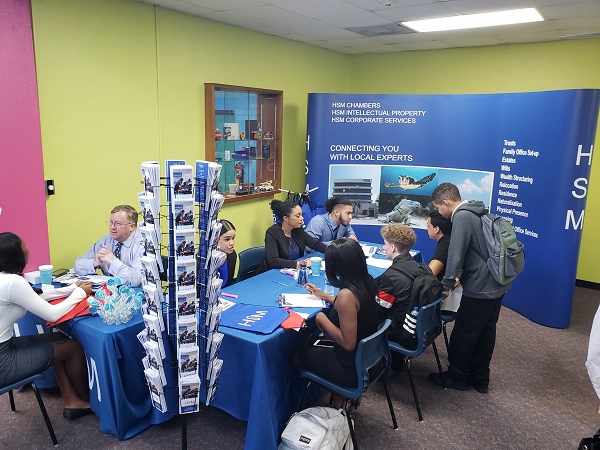
HSM is thrilled to have once again participated in the annual Cayman Islands Further Education Centre (CIFEC) Career Fair, which took place on 21 September 2018.
The fair allows the opportunity for students to present their résumé and learn more about the different industries in the Cayman Islands. Over 200 students attended this year’s fair.
HSM set up a booth at the CIFEC Library to introduce themselves as Cayman’s fastest growing law firm and seeks to recruit at least 13 students to their 2018/19 internship programme.
Managing Partner, Huw Moses and IP Head Paralegal, Natasha Whitelocke were on hand to speak with students about a career in the legal profession, especially in the fields of Intellectual Property, Immigration, Debt Collection and Corporate Services.
Gabriel Morla and Shantel Ritch, two HSM IP staff members and prior CIFEC students were also there to speak with the potential student recruits. They shared their experiences in the programme and what it is like to be employed full-time.
HSM has worked with the CIFEC progamme since 2012. The firm’s continued involvement in the CIFEC internship showcases their unwavering commitment to the local community by providing work experience opportunities to ambitious young professionals.
Fatal error: Uncaught Error: Call to undefined function twentythirteen_paging_nav() in /home/clients/d17af2243e6f179e393695ba6e9ce04e/hsmnew/wp-content/themes/hsm/category.php:31 Stack trace: #0 /home/clients/d17af2243e6f179e393695ba6e9ce04e/hsmnew/wp-includes/template-loader.php(86): include() #1 /home/clients/d17af2243e6f179e393695ba6e9ce04e/hsmnew/wp-blog-header.php(19): require_once('/home/clients/d...') #2 /home/clients/d17af2243e6f179e393695ba6e9ce04e/hsmnew/index.php(17): require('/home/clients/d...') #3 {main} thrown in /home/clients/d17af2243e6f179e393695ba6e9ce04e/hsmnew/wp-content/themes/hsm/category.php on line 31