Category Archives: HSM LAW
The HSM Group is proud to continue its internship programme in partnership with the Cayman Islands Further Education Centre (CIFEC) by offering 13 placements for the 2023/24 academic year.
As part of the CIFEC curriculum, the internship began in October 2023 and concludes in April 2024. Each student attends work twice a week during school hours and has been carefully paired with a lawyer or expert at HSM.
HSM’s team of interns include: Robert Chung, Janiya Jackson, Javari Pearson, Omari Powell, Eva Bothwell, Aquinle ‘Bria’ Missick, Jancarlos Hernandez, Korey Berry, Angelie Bodden, Jazmynn McCoy, Cliff Weeks Jr., Alanee Morgan and Pertrice Ambersley.
The HSM Group is a full-service law firm and corporate services provider, which offers students the ability to gain experiences across a wide range of practices including property, family, debt collection, intellectual property, corporate services and even areas outside of law, such as marketing and finance.
Some students have commented on their time at HSM:
“This experience allows us to have a peek of work life in the future. It also builds practical job skills for one’s future career. This internship has helped me to learn and enhance my skills in the workplace,” shares Pertrice Ambersley.
“I have formed connections and met a lot of welcoming people. I have also learned about a day in the life of an intellectual property assistant. Working in this field helps you develop your communication skills,” shares Janiya Jackson.
“My time here has been amazing. I am learning new things and the people here are so patient as well as fun. The work is also challenging so I am never bored. I feel prepared for the future and have a better idea of what I want to do,” shares Javari Pearson.
HSM Managing Partner, Huw Moses OBE shares: “Their experiences showcase why internship programmes are so important. HSM is committed to providing a foundation for young adults to develop their careers in the Cayman Islands.”
As the programme nears competition, students may have the opportunity to attain a summer work placement. In 2023, three summer students were offered full-time positions at HSM IP.
HSM has supported the CIFEC Internship Programme since 2012 and also offers sponsorship opportunities for further education. HSM employs several CIFEC graduates full-time.

Group 1 (L-R): Omari Powell, Eva Bothwell, Alanee Morgan, Jancarlos Hernandez and Angelie Bodden.

Group 2 (L-R): Aquinle ‘Bria’ Missick, Janiya Jackson, Jazmynn McCoy, Javari Pearson and Pertrice Ambersley Missing from photos: Robert Chung, Korey Berry and Cliff Weeks. Jr.
The HSM Group is pleased to be featured by Chambers & Partners in their 2024 Global Legal Guide.
Our Intellectual property practice, HSM IP, has once again been ranked as a top tier law firm in their Global (Caribbean-Wide) Intellectual Property 2024 Guide. This marks the fifth year in a row being ranked and highlights our ability to successfully handle Intellectual Property (IP) registrations, filings and infringement matters across the Caribbean.
Citing Chambers and Partners, a commenter shared that HSM IP is a firm that is “knowledgeable about the laws in various jurisdictions and is able to walk us through them.”
HSM Chambers has also been ranked for Real Estate (Cayman Islands) with HSM Partner Linda DaCosta. Our team is praised for handling contract negotiations, conveyancing, acting for banking institutions and ensuring timely completions.
Chambers and Partners is a prestigious hub for lawyer and law firm recommendations. They diligently research and feature the world’s best lawyers and have done so since 1990, covering over 200 jurisdictions.
In the myriad varieties of insurance claims, attorneys can find themselves walking a tightrope when representing both insurance companies and insured parties concurrently. While this dual representation often provides a practical and cost-effective solution, it introduces challenges that require meticulous handling to maintain ethical standards and provide equitable representation for all parties.
- Conflicting Interests:
The fundamental challenge in dual representation lies in managing the potentially conflicting interests of insurance companies and insured parties. From the outset, care must be taken that the policy is valid and is sufficient to cover the damages claimed.
In circumstances in which coverage is disputed, or a policy may have been avoided by an insured, it is inadvisable for any single attorney or firm to act for both parties: a clear and obvious conflict of interest exists.
Prior to accepting instructions to represent both parties, a rigorous investigation is necessary to ensure that potential future conflicts are avoided. Such an issue may arise as to the sufficiency of coverage for a claim. For example, if injuries are significant enough, and threaten a claimant’s ability to work in the future, advice must be provided early to both parties as to the sufficiency of any cap on damages as described in any policy.
Similarly, an issue may arise in which an insurer exercises its discretion to settle a claim on a commercial basis, whereas the insured party remains adamant that they wish to dispute liability and run a trial. In such cases, the policy terms usually provide the insurer with a broad discretion to take whatever decision it decides is fair. If the insured party seeks to run a trial against the wishes of the insurance company they may find their insurer will refuse to cover the cost of litigation under the terms of the policy. The conflict between the commercial decisions of an insurer and access to justice for the insured is an issue which attacks the very core of the relationship between the parties.
- Information Asymmetry:
When an attorney is instructed by an insurance company to represent its interests as well as those of the insured, difficulties may arise in the exchange of information. If both parties are clients, and therefore entitled to an equal duty of disclosure and confidentiality, how may this be reconciled in a case in which the attorney discovers confidential information in the possession of the insurance company that may adversely affect the insured? Or the insured admits in private consultation to conduct that would potentially avoid the relevant policy, and which was not previously known to the insurer?
These situations are likely to result in professional embarrassment, and a duty to withdraw the representation of at least one of the parties. If the issue arises shortly prior to, or during, a trial before the court, it is likely that the attorney, and/or firm, in question would be subject to heavy criticism for failing to note the risk early in the process, and may even become subject to a wasted costs award.
It is imperative, therefore, for attorneys to ensure that immediate and full enquiry is made of all relevant parties, circumstances, and the risk of any such conflict is nipped in the bud as early as possible.
- Ethical Dilemmas:
Rigorous adherence to professional codes of ethics is paramount for legal practitioners. Potential pitfalls are most common in circumstances where duties are owed to more than one client in the same proceeding.
A single attorney or firm retained by more than one client in the same matter present can present a simpler and more cost-effective solution in cases in which the interests of both clients are aligned.
- Informed Consent and Disclosure:
Obtaining informed consent is a pivotal step in dual representation. Attorneys must provide clear and comprehensive disclosure about the potential conflicts of interest to both the insurance company and the insured party. This process involves explaining the implications, risks, and benefits associated with dual representation. The roles of the insured and insurer ought clearly to be defined in the contract of engagement, with any waivers of duties relating to information exchange explained and signed by both parties.
Informed consent is not a one-time event but an ongoing process. Attorneys must continuously update both parties about any developments that could impact their representation and obtain reaffirmation of their consent as necessary throughout the process, as necessary.
Conclusion
While dual representation in insurance claims may offer practical advantages, the complexities and potential conflicts involved demand a sophisticated approach from attorneys. Navigating conflicting interests, information asymmetry, ethical dilemmas, and informed consent requires a keen eye, anticipation of conflicts and sometimes a deft touch. Attorneys must uphold the highest ethical standards, prioritise transparency, and consistently communicate with both the insurance company and the insured party to mitigate potential conflicts and ensure proper representation.
Alex Davies in HSM’s litigation team has extensive experience dealing with insurance matters, receiving instructions from insurance companies based locally and internationally, as well as acting for insured parties in claims in conjunction with, and against, their insurance companies. Alex’s practice includes advice on policy coverage, personal injury, fatal accidents, medical negligence, and complex road traffic matters.
The HSM Group has welcomed Gavin Dixon as an Associate for their immigration practice.
Gavin is a seasoned legal professional with a distinguished career in public service. Gavin has held several positions with the Cayman Islands Government including 10 years as an Immigration Officer and subsequently as a Senior Trade Officer for the Department of Commerce & Investment.
Prior to HSM, he was Crown Counsel for a substantial period at the Office of the Director of Public Prosecutions. This advocacy experience makes him well-versed before the Cayman Courts. Gavin was called to the Cayman Islands Bar in 2016.
In his role at HSM, Gavin specialises in immigration advice for non-contentious and contentious matters, including immigration appeals.
Gavin joins HSM’s established immigration team, which includes Managing Partner, Huw Moses; Senior Associate Alastair David; Immigration Services Manager Samantha Bartley; Immigration Services Supervisors: Pete Iton and Ariella Smith; Paralegal Cory Martinson; Immigration Services Assistants: Dwyane Wright (Senior Assistant), Chandra Bodden and Ayla Ramirez-Ebanks.
“Gavin brings a deep understanding of Cayman law and has shown dedication to justice during his tenure with the Cayman Islands Government,” shares HSM Managing Partner, Huw Moses OBE. “HSM’s immigration team is positioned to give clients the greatest level of support.”

Gavin Dixon outside of HSM’s building on 68 Fort Street, George Town
The HSM Group has announced Merary Eden as the recipient of their 2024-25 Article Clerkship Programme.
Over the next 18 months, Merary will gain a variety of legal experiences across corporate, immigration, employment, private client, real estate, intellectual property and more.
Merary joined HSM in July 2022 as a paralegal for the firm’s debt collection and litigation practice. She graduated from the University of Liverpool in July 2022 with a Bachelor of Laws Degree (Honours) (Class 2 Division 1) and prior to that she attained a Master of Business Administration Degree from the University of Tampa. Merary also attained a Professional Practice Course (Commendation) from Oxford Brookes University, which is affiliated with the Truman Bodden Law School in the Cayman Islands.
Merary is particularly interested in investment funds and is also excited to gain experience in trusts, wills and estate administration. HSM Partner Sarah Allison is her principal and will provide guidance to Merary as she progresses through her articles to become an attorney.
“We are pleased to have Merary undertaking her articles with HSM,” shares HSM Managing Partner, Huw Moses OBE. “HSM is committed to fostering legal talent and we look forward to her contributions across the firm’s practices.”

Pursuant to the Financial Assistance Act, 2022 (the “Act”) passed by Parliament in October 2022, the Needs Assessment Unit “NAU”) became the Department of Finance (the “DFA”). The corresponding Financial Assistance Regulations, 2023 (the “Regulations”) and the Financial Assistance (Appeals) Regulations, 2023 (the “Appeal Regulations”) were approved by Cabinet on 10 October 2023. HSM Partner Sarah Allison covers the key updates and criteria.
The Act repeals the Poor Persons (Relief) Act (1997 Revision) and introduces a new procedure for issuing financial assistance to households which meet the eligibility criteria. The Act also establishes an Appeals Tribunal for incidental and connected purposes.
According to the Ministry of Investment, Innovation & Social Development: “the legislation forms one part of an overall reform and modernisation agenda to create meaningful and measurable changes in Government’s involvement in social development in the Cayman Islands, and more broadly to work collaboratively with community partners in overcoming existing barriers and hurdles .” [1]
Of note, the Regulations introduce a new and welcomed category of financial assistance enabling the DFA to cover up to CI$3,000 per month of a successful applicant’s accommodation costs, which now include mortgage payments. Prior to the Act, the provision of accommodation costs was limited to rental payments.
To be eligible for financial assistance, household members must be Caymanian, a spouse or civil partner of a Caymanian living with the Caymanian at the time of the application and for five years or more immediately preceding the application, or a guardian of a dependent who is Caymanian. Depending on the number of people in the household, the aggregate household income and savings must not exceed certain thresholds and the Director must be satisfied that the household’s expenses exceed the household income.
Upon receipt of an application for financial assistance, the Director of the DFA has 10 working days in which to evaluate the application and determine whether the application should be granted or refused.
The amount of financial assistance granted for accommodation shall be determined by the Director in accordance with the size and composition of the household. The duration of financial assistance for which a household will be approved to receive financial assistance will be for a period of 1 – 3 months or up to 3 years depending on whether the applicant is temporarily unemployed, has dependents, is temporarily or permanently disabled, or has an emergency. The provisions seek to align with the Cayman Islands Older Persons Policy and Disability Policy
For those eligible to apply for assistance under the Act, this legislative change will come as a welcome one in the current financial climate.
[1] https://www.gov.ky/iisd/financial-assistance-bill-2022

The HSM Group was featured recently in The Legal 500 2024 Caribbean rankings.
Our intellectual property practice, HSM IP, is a ranked firm for their cross-Caribbean expertise. Citing The Legal 500 website, they shared: “As the only specialist IP firm in the Cayman Islands, HSM IP has been notably active in advising the Cayman government on its IP legislation as well as assisting a broad range of clients with trade mark, design and patent prosecution matters across the entire Caribbean region. The group also has experience in IP infringement and enforcement work and counts Fortune 500 companies, global law firms and specialist IP practices on its client roster.” Managing Partner Huw St. J. Moses, OBE leads the team of 11 IP specialists.
Client testimonies include: “The team is extremely responsive and able to provide practical, commercial guidance where necessary.” “Kate Cleary is extremely responsive and easy to deal with.” “HSM is known for its trade mark representation in the Caribbean region. They are one of a few firms that specialise and excel in this region.”
HSM’s property work is highlighted as a Firm to Watch for Real Estate (Cayman Islands). Citing The Legal 500 website, they shared “Linda DaCosta heads up HSM’s real estate practice, which is noted for advising local and overseas purchasers, vendors, investors and developers on a mix of residential and commercial property transactions.”
HSM Partner Christian Victory is ranked as a Next Generation Partner for Investment Funds (Cayman Islands). Christian has over 20 years of legal experience and is well-respected in the industry. He is knowledgeable in all matters relating to Cayman Islands funds and investment services, including the formation and establishment of, and on-going advice to mutual funds and hedge funds, master-feeder structures and the formation of stand-alone vehicles.
The Legal 500 has been analysing the capabilities of law firms across the world for more than 30 years. Law firms and attorneys are ranked by thorough research processes and are highly credited if featured.
These features highlight HSM’s ability to successfully handle a wide range of legal matters.
Thank you to our valuable clients for recommending us.
The HSM Group is thrilled to announce that they have recruited three of their interns from the Cayman Islands Further Education Centre (CIFEC) internship programme 2022-2023.
Kayleigh Bush, Phyllis Brown and Jenae Whittaker have all joined the firm as IP Administrative Assistants for the firm’s intellectual property (IP) practice. They originally joined as CIFEC interns from October 2022 through April 2023 and further completed HSM’s 2023 Summer Internship Programme.
Since HSM is a full-service law firm, each of the students gained a variety of experiences including debt collection, compliance and property law. In their roles as IP assistants, they are responsible for coordinating new trade mark / patent applications, updating client files and supporting the office actions team.
In addition to working full-time, they are interested in pursuing further education at the University College of the Cayman Islands. Jenae is studying Business Administration; Phyllis is studying Real Estate and Kayleigh plans to study Business Administration in the spring of 2024.
HSM Managing Partner, Huw Moses OBE shares: “We are pleased to have these former CIFEC students join our team. I thoroughly recommend the CIFEC internship programme to all employers on the island, especially those genuinely interested in ensuring our young Caymanians succeed when they start their chosen careers.”
HSM has partnered with the CIFEC progamme since 2012 and recently attended the CIFEC Careers Fair on 22 September 2023, where they interviewed students for the next internship programme. HSM plans to welcome at least 10 interns this month through April 2024.

(L-R: Kayleigh Bush, Jenae Whittaker and Phyllis Brown stand in front of HSM’s building on 68 Fort Street, George Town)
A recent article extolling the real problems faced by many in demonstrating that they are in fact (and remain) Caymanian – and emphasizing that the law as written created some truly mind-bending scenarios – seems to have elicited significant comment and discussion.
Some of the commentary acknowledged what was said – and then raised the challenge: How do we fix it?
Fair enough. For fix it we must.
But solutions require us to understand the problem.
Speaking truth to power does not always work. At least not to begin with. Whether confronting an excessive fondness for rum, an abusive spouse, a dishonest preacher, or sea level rise, denial is usually the first solution that humanity reaches for. It is too often a necessary stage of the process on the road to redemption.
No matter what else we did, granting status in 2003 to thousands of largely unvetted (although frequently deserving) persons was always going to create cracks. Consistently pouring hundreds of new people into those cracks with a failing and (in many respects arbitrary and unlawfully operated) Permanent Residence scheme, effectively disregarding any question of assimilation, economic stability, or Caymanian Protection, and doing it year after year, was always going, like a freeze/thaw cycle familiar to those from colder climes, fracture the very foundation on which we all stand.
Fractured enough, the heartiest of bedrock will turn to gravel, then to sand – and thence ultimately, to dust.
The foundations – built by Mr. Benson, Captain Charles, Dr. Roy, Miss Sybil, significant numbers of Seafarers, the resilient women they left behind, (and topped off by an Arch or two (later accompanied by a Godfrey), and many others, were solid. They were a Rock. He hath founded it upon the seas and upon that Rock was modern Cayman built.
Like every society we are entitled to our own creation story. The persons named above (and hundreds of others, Caymanian and expatriate), constitute a critical part of ours.
“Caymanian” is the equivalent of a nationality. Strictly it is an immigration status and is not on any analysis, a citizenship. As described most eloquently by the late Mr. Benson Ebanks in presenting the Caymanian Protection Law to the (then) Legislative Assembly on 27 September, 1971 (in reference to the term “Caymanian”) …“… we are not really conferring a nationality on ourselves, this is impossible, we’re all citizens of the British Commonwealth that is the United Kingdom and Colonies and this is merely a label which will enable us to control certain activities within our own shores”.
Indeed – the legislation prescribed that to become Caymanian (i.e. to be granted Caymanian Status), you had to first be a British Subject. In Mr. Benson’s words “first and foremost a British Subject”. It made sense. We could hardly have had Caymanians singing God Save the Queen as our National Anthem – and not have them entitled to some passport or other issued by or on behalf of Her Majesty Queen Elizabeth. “British Subject” appeared capable of being interpreted widely – and incorporating any citizenship that owed allegiance to Her Majesty Queen Elizabeth. That was fine for Commonwealth Citizens, but of course meant that Americans could not become Caymanians – and since that was somewhat problematic for citizens of our largest trading partner (and source of tourists and cash to buy real-estate (and perhaps, pay real estate commissions)) we amended our Caymanian Protection Law in 1984 to allow Americans (and citizens of Ireland, any British Dependent Territory, Australia, The Bahamas, Barbados, Belize, Canada, Jamaica, New Zealand, and Trinidad and Tobago) to apply to become Caymanian.
This coincided (or at least followed shortly after) the UK tightening the rules around British Subjects – with the creation of the concept of British Citizenship occurring with the coming into force of the British Nationality Act on 1 January 1983. That Act confirmed six types of British Nationality – with British Citizenship being the only one granting an automatic right of abode in the United Kingdom.
For some years following, standard language in letters from the Department of Immigration confirming persons to be Caymanian, provided:
“If you hold or acquire a passport giving you nationality as a British Subject Citizen of the United Kingdom and Colonies or British Citizen of the British Dependent Territories you may have an endorsement placed therein indicating that you are also a person of Caymanian Status. The endorsement can be obtained by presenting your passport at this office together with this letter.
I regret to advise you that such an endorsement cannot be placed in the passports of other countries and if you wish to travel on a non-British passport it is suggested that for your convenience you carry this letter together with your passport to facilitate travel to and from the Cayman Islands.”
British Dependent Territories Citizenship was renamed British Overseas Territories Citizenship in 2002. Persons who were already British Dependent Territories Citizens on 21 May, 2002, automatically became BOTH British Overseas Territories Citizens AND British Citizens, on that date.
By the time of the 2003 (in)famous Cabinet status grants (to many clearly deserving and some clearly not) we lost track of the whole suggestion that you had to be any one of the six types of British Nationality (or what was formally described as an “eligible person”) to become Caymanian. No regard was had to the citizenship of the 2,850 direct recipients (nor does it seem, was appropriate regard given to a great many of their dependents).
The result was that thousands of persons became Caymanian, almost overnight, without anyone asking: are they (at some level) British? Many were not. The immediate consequence was that for the first time, many people who were not entitled to British Overseas Territory (Cayman) (or British) Passports, and in any event, owed no allegiance to the Queen, became Caymanian.
Sorry Mr. Benson.
History is history and it is often not good. Hindsight would prefer that we had approached the response to a period of mistreatment and failure to fairly consider applicants, differently. The Cabinet Status grants were mis-described as a necessary solution following years of an unlawful moratorium on the processing of status applications. They were NOT necessary. Alternatives existed, and in fact were used. The Gazette naming the Cabinet status recipients also reveals that the Caymanian Status and Permanent Residency Board granted status to some 102 other persons in the same period. It appears that one group were fully vetted whilst the other, frankly, were not. (Yes, I know hundreds lined up at the RCIP for their police records, but by then the deed had been done. The status’ had already been granted with no regard to what the RCIP knew (or said) about an individual).
The fact that so many became Caymanian without having some level of British Citizenship did not matter until election time – when it was realized that many hundreds of persons who had recently been made Caymanian could not register to vote. This is because the then Elections Law (by then) required almost all voters not born in Cayman to have BOT Citizenship (whether by connection to the Cayman Islands, or to anywhere else) to register.
Some of the newly minted Caymanians seeking to apply for Naturalisation to become BOTC’s by virtue of their “connection” with the Cayman Islands were being stymied in their attempts to be naturalised on the basis that they had not yet lived in Cayman for the prescribed 5 years, not been settled for at least 1 year, or (in some cases) had criminal records pre-dating their grant of status. I was the recipient of a number of frustrated calls. There was nothing I could do to help the callers (and did not hesitate to tell them so).
Some may ask, what was the point in granting status to someone, if they could not thank you at the polls?
The solution was elegant. Change the Constitution in a manner that defined who could vote – without any separate need to debate and amend the Elections Law. In doing so any Caymanian (over the age of 18) could vote even if they did not have British Overseas Territory Citizenship and were thus ineligible to hold a Cayman Passport.
Then the next big issue arose: What about the children?
Hundreds of persons who did not qualify to be dependents on work permit holders were nevertheless allowed into Cayman as one of their parents had become Caymanian. Many were permitted to attend a quickly overburdened government school system (itself already recovering from Hurricane Ivan) – and after a year in Cayman were often acknowledged to be Caymanian by Entitlement (on the basis they were under the age of 18, the child of a Caymanian, and had been legally and ordinarily resident in the Islands for at least a year). You read that correctly. One year of residence is all it took.
Of course, all these children (as with all persons who are Caymanian by Entitlement) would have to leave Cayman or apply for continuation of their status on turning 18. Some made the required application – and were (quite properly) refused on the basis that they had not (by then) lived (legally and ordinarily) in Cayman for 5 of the 7 years preceding their 18th birthday. They were sometimes required to leave.
Others stayed, but did not apply for continuation. Many of those (former Caymanians “by Entitlement”) appear to have simply been able to continue living and working here and have become among our “Ghost Caymanians.”
Notwithstanding that this issue has been well known for many years, “Ghost Caymanians” are still a problem – although we are seeing increased efforts to require Caymanians to demonstrate/evidence that they are Caymanian. Of course, the National ID scheme will provide an inflection point for those whose “undocumented” presence has been tolerated (potentially even assisted) for so long. There will undoubtedly have to be yet more (in effect) freely distributed permissions. This time (I would beg) start off with Permanent Residence rather than heading straight to the most sacred of permissions, the Right to be Caymanian. Let’s hope we don’t find too many Ghosts registered to vote (or owning more than 40% of local businesses, or holding a scholarship, or working without a work permit, or being the “Caymanian” Spouse of an RERC holder).
If we are in a hole. Rule number 1: STOP DIGGING! Enforce the law – AND the principles underpinning it. The society we inherit and construct must fit the foundation laid for it. If it does not, it will surely fall out of balance, and ultimately topple. It is only by not consistently following our own laws (again, and again) that we seem to find ourselves in many of our quagmires.
First, we need an accurate list of all the people living here who are already Caymanian. Incredibly, we do not. If we did, it wouldn’t be taking weeks for many Caymanians to seek and obtain formal acknowledgement of that fact, sometimes decades after they are born in or moved to Cayman – and we would not have the Department of WORC deferring a number of applications for “further evidence” that referees are Caymanian.
Second, we need to ensure that every agency and department of both the public and private sectors stop being allowed to exercise their own discretion/preference as to who is Caymanian relative to who is not. Aside from those caught in the Schrodinger Paradox, you are either Caymanian or not. The distinctions are clear.
Third, we need to clarify and rationalize the path to becoming Caymanian, and make accommodation for those that have fallen into any cracks.
Fourth, we need to seal the cracks!
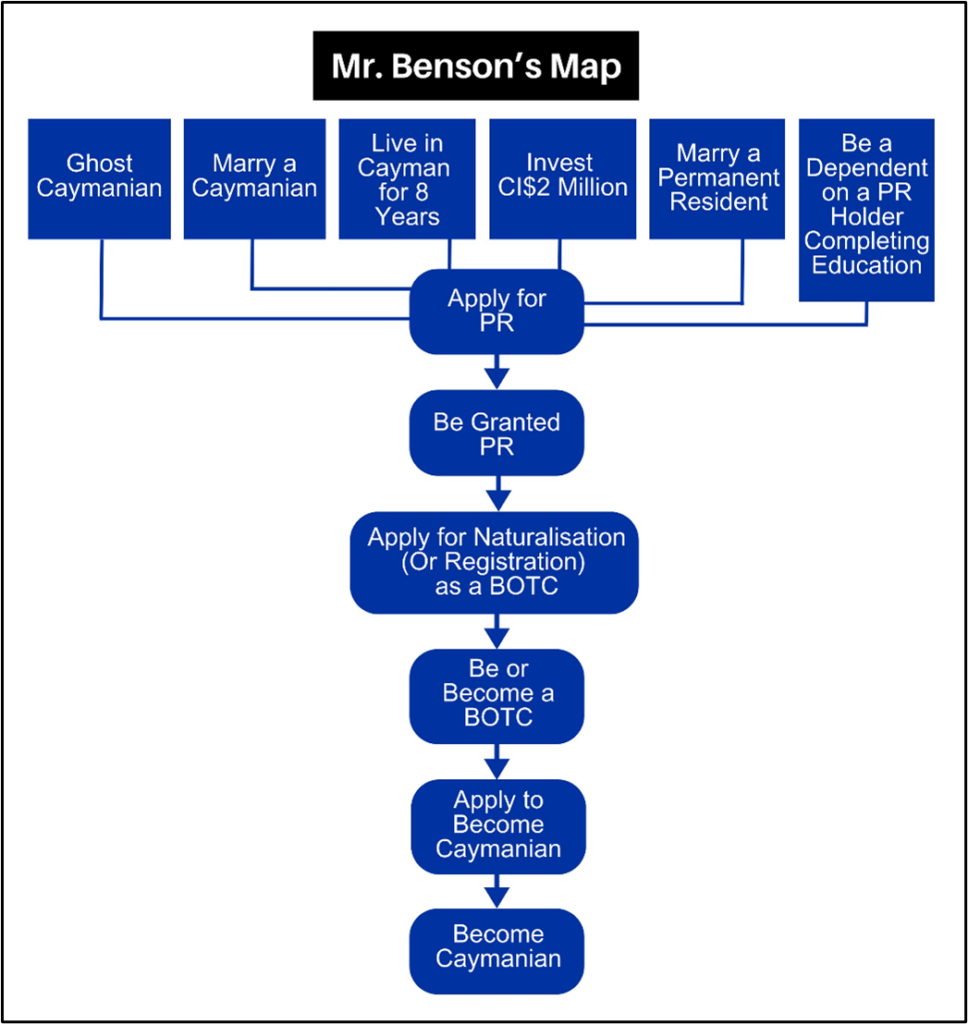
For persons who are not born Caymanian and who do not become Caymanian as children, we now have two distinct routes to become Caymanian (not including Cabinet Status grants or claims to be Caymanian based on descent).
They require Marriage to a Caymanian for 7 years (but amazingly none of those years need be in Cayman), OR 5 years of Residence (including at least one year as a Permanent Resident) followed by Naturalisation or Registration as a BOTC, and THEN a further 5 years of residence post Naturalisation or Registration. The reality is that for most the Naturalisation option requires at least 15 years in Cayman, given that application for PR cannot be made in most cases unless the applicant has been legally and ordinarily resident in the Islands for 8 years.
The British Nationality Act (under which persons are vetted to become a BOTC) is thorough – and (for example) will generally not permit persons of bad character or for whom the Cayman Islands are not a person’s genuine home, to advance to BOT Citizenship. It can be a very useful filter.
We do not have to reinvent the wheel. Permanent Residence is in effect available to all who marry Caymanians, all who marry Permanent Residents, all who pass through the 8 year Points-System, all who are the dependent children of a Permanent Resident (and who are in Cayman as approved dependents for at least 7 years before turning 18) and all who invest more than CI$2 million in developed real estate and pay CI$100,000 to the Government.
If we simply required all applicants for the Right to be Caymanian to first be Naturalised or Registered as BOTC’s, we would free ourselves from the problem of having thousands of Caymanians unable to hold a Cayman Passport, have additional vetting and security as to who we are making Caymanian, and significantly simplify our immigration (and border control) systems. Imagine how easy it could be to simply have a stamp in everyone’s passport denoting their immigration status?
The idea of being a BOTC on the path to becoming Caymanian is not a new idea or even my own. It was expressed (and invoked) by Mr. Benson Ebanks more than 50 years ago. It was sound advice then – and we should not be hesitating to follow it now.
Were we to do so we would again have a solid foundation to take whatever next steps the Caymanian people deem appropriate.
The HSM Group has welcomed Christian Victory, a bolster addition to their legal team and who has joined as Partner, Head of Corporate and Commercial.
Christian has over 20 years of legal experience and is well-respected in the industry having been ranked by The Legal 500 (Next Generation Partner) and IFLR 1000 (Rising Star). In 2010 he located to the Cayman Islands and moved up the ranks to become a Partner at another major international law firm.
In his role at HSM, Christian leads a qualified team and overseas all aspects of corporate and commercial law. He regularly advises on entity formations, corporate restructuring, local business licensing, mergers and acquisitions as well as assists with governance, regulatory and reporting requirements.
Christian plays a pivotal role in ensuring corporate compliance. He has a proven track record of successfully navigating complex legal matters and is knowledgeable regarding economic substance, beneficial ownership and anti-money laundering requirements.
He is well-versed in all matters relating to Cayman Islands funds and investment services, including the formation and establishment of, and on-going advice to mutual funds and hedge funds, master-feeder structures and the formation of stand-alone vehicles. He also has experience in banking and finance, general lending and debt issuance.
Christian’s career began in Ireland where he worked at William Fry Solicitors in Dublin for eight years and was an associate in their asset management and investment funds department. He then worked in the British Virgin Islands as an associate specialising in Corporate and Commercial. His global experience provides cutting-edge advice to his clients.
His practice at HSM is built on integrity, commitment and results. Working closely with HSM Corporate Services Ltd., he is able to provide a comprehensive service through our team’s ability to offer registered offices and other regulatory requirements.
“We are thrilled to have Christian join the partnership,” shares HSM Managing Partner, Huw Moses OBE. “I look forward to working with him as we continue to grow HSM’s offering of legal services.”

HSM Partner Christian Victory in front of HSM’s building on 68 Fort Street, George Town.
Fatal error: Uncaught Error: Call to undefined function twentythirteen_paging_nav() in /home/clients/d17af2243e6f179e393695ba6e9ce04e/hsmnew/wp-content/themes/hsm/category.php:31 Stack trace: #0 /home/clients/d17af2243e6f179e393695ba6e9ce04e/hsmnew/wp-includes/template-loader.php(86): include() #1 /home/clients/d17af2243e6f179e393695ba6e9ce04e/hsmnew/wp-blog-header.php(19): require_once('/home/clients/d...') #2 /home/clients/d17af2243e6f179e393695ba6e9ce04e/hsmnew/index.php(17): require('/home/clients/d...') #3 {main} thrown in /home/clients/d17af2243e6f179e393695ba6e9ce04e/hsmnew/wp-content/themes/hsm/category.php on line 31