Tag Archives: Cayman Immigration
Over the past 24 months, HSM Chambers have dealt with two cases involving individuals who obtained the Right to be Caymanian through marriage. In both cases, the Caymanian spouse subsequently passed away before three years had elapsed from the grant of that status. In both matters, the marriages were subsisting at the time of death.
Despite there being no automatic requirement to revoke the Right to be Caymanian in such circumstances, the Caymanian Status and Permanent Residency Board wrote to both surviving spouses advising that they were in danger of losing their Caymanian status. In one of those cases, the Board ultimately revoked that status, notwithstanding the fact that the individual has a Caymanian child.
It is true that the Board possesses the legal power to revoke status in these circumstances. The real question, however, is not whether they can act in this manner, but whether they should.
When a surviving spouse is already grieving the death of their partner, does “Cayman Kind” require that they immediately face the additional fear of losing their immigration status and their future in the Islands? Or is there a more humane and measured approach available?
Surely there is room for the Board to make careful and compassionate enquiries before issuing threatening correspondence. For example:
• Was the marriage subsisting at the time the Caymanian spouse died?
• Was the couple living together in the Cayman Islands at the time of death?
• Has the surviving spouse been convicted of any offences since the grant of status?
These are all relevant considerations.
Indeed, if the answers establish that the marriage was genuine and subsisting, that the couple were living together at the time of death, and that the surviving spouse has maintained good character, then that individual would likely satisfy the criteria under Section 28(7) of the Caymanian Protection Act as the surviving spouse of a Caymanian.
If, on those facts, the individual would likely qualify to be granted the Right to be Caymanian as a surviving spouse anyway, one must ask: what purpose is truly served by revoking the status in the first place?
It cannot be that the individual must apply for and subsequently be granted the Right to be Caymanian as the surviving spouse of a Caymanian and pay the required fees of CI$1,250. Surely, the Board is not imposing their own death tax on Caymanians?
The law grants discretion for a reason. Discretion allows public bodies to distinguish between abuse of the system and genuine human tragedy. It allows authorities to temper legal power with common sense and compassion.
There are more appropriate ways to address such cases.
A simple preliminary enquiry, conducted sensitively and privately, could avoid unnecessary distress for families already enduring loss. Instead, formal notices threatening revocation risk compounding grief with fear and uncertainty.
If the response provided raises more questions than it answers or if it shows that the marriage has broken down, then at this time the Board could issue a minded to revoke letter but is there a requirement to issue such a stress-inducing threatening letter beforehand?
“Cayman Kind” is often described as reflecting the values of compassion, dignity, and community. Those values should not disappear when immigration discretion is exercised.
No one suggests that the Board should ignore cases of fraud or sham marriages or even cases whether the marriage has broken down within 3 years of the grant. But where a marriage was genuine, subsisting, and ended only because of death, there is surely a strong argument that compassion, not confrontation, should guide the process.
The issue is not simply legality.
It is humanity as much as it is one of law.
In a press release dated 15 April 2026, the Ministry of Caymanian Employment and Immigration announced:
”The Immigration (Transition) (Amendment and Validation) Act, 2025 introduces updated rules for work permit holders changing jobs, effective 1 May 2026.
Work permit holders can still change jobs. However:
• First-time work permit holders granted a permit on or after 1 May 2026 must remain with their sponsoring employer for at least 2 years
• If a worker leaves before completing this period without a valid reason, they will be required to leave the Cayman Islands for 1 year before applying for another permit
The Director of WORC may allow a job change in prescribed circumstances, including:
• Unpaid or uncompensated overtime
• Discrimination or retaliation
• Harassment, including sexual harassment or bullying
• Any other situation the Director of WORC deems justifies an exemption
Domestic Helpers: A special exception applies—workers may be able to change employers within the same role without leaving the Islands”.
While the above does provide insight into the operation of the “new” Section 64, it does pose more questions than answers it provides.
“First-Time Work Permit Holders”: A Concept Not Found in the Act
The press release states that:
“First-time work permit holders granted a permit on or after 1 May 2026 must remain with their sponsoring employer for at least 2 years.”
This formulation introduces a concept — “first-time work permit holders” — which does not appear anywhere in the new Section 64. The statutory language is notably broader. Subsection (1) applies to:
“A person who is the holder of a work permit…”
There is no distinction drawn between:
- first-time permit holders;
- repeat permit holders; or
- individuals already present and working in the Cayman Islands.
Equally, the press release states that the new Section 64 applies only to permits granted post 1 May 2026. If this is correct, what does that mean for existing work permit holders?
The Position of Existing Work Permit Holders
The starting point in the legislation is clear:
- Section 64 has been repealed and replaced in its entirety; and
- The new Section 64 contains no express limitation to future permits.
It does not preserve the former Section 64, nor does it disapply the new Section 64.
Accordingly, on a strict reading of the statute:
- existing work permit holders remain “persons who are the holder of a work permit”; and
- if they cease employment within two years of the grant of their permit after 1 May 2026, they would appear to fall within subsection (3), triggering the one-year departure requirement (absent an exemption).
This degree of freedom which the press release would seemingly point to, does not appear to align with the intention of the Act.
This disconnect creates legal uncertainty for both employers and employees, who may reasonably rely on the Government’s public guidance, but whose rights and obligations are ultimately determined by the legislation itself.
“Prescribed Circumstances” Without Regulations
The press release also attempts to give content to the “prescribed circumstances” under subsection (5), listing examples such as unpaid overtime, discrimination, and harassment.
While these examples are helpful from a policy perspective, they are not — at present — legally operative. It is suspected that new Regulations will be published but as of today’s date, no such Regulations exist.
The statute is explicit: exemptions depend on “prescribed circumstances”, which must be set out in regulations. In the absence of such regulations:
- there are no formally prescribed circumstances; and
- the exemption mechanism under subsections (4)–(5) remains incomplete.
- an employee who has been released from their work permit.
- An employee who claims to have been unfairly dismissed.
- An employee who has been made redundant.
Conclusion: A Need for Clarification
The press release provides a useful indication of policy intent, but it does not resolve the underlying statutory ambiguities. In particular:
- the concept of “first-time work permit holders” has no clear legislative basis;
- the position of existing work permit holders remains uncertain; and
- the exemption regime cannot function fully in the absence of regulations.
Given the significant consequences of Section 64 — including mandatory departure from the Islands — it is essential that these issues are clarified, either through regulations, formal guidance, or further legislative amendment.
Until then, there remains a real risk that the law, as enacted, may operate more broadly and more rigidly than the Government’s public statements suggest.
On Friday, 27 March 2026, the Government announced that the “Immigration Law changes will take effect on Friday, 1 May 2026”. It appears that the Act which was passed in December 2025 and amended, prior to coming into force on 25 March 2026, will be the Law of the Cayman Islands as of 1 May 2026. It appears that all the amended sections will come into force on 1 May 2026. This means that it is likely that a further set of Regulations will have to be published between now and 1 May 2026. These Regulations are needed to prescribe in what circumstances a work permit holder can change employer during the first two years of Employment. The new Section 64 of the Act which comes into force on 1 May 2026 sets out that only those work permit holders who satisfy the prescribed circumstances will be able to change employers during the first two years of employment. In the absence of prescribed circumstances, a work permit holder who leaves their employment during the first two years of employment will have to leave the Cayman Islands for a year if they wish to obtain a new work permit.
The absence of Regulations, means that as of 1 May 2026, work permit holders may be subject to the full effect of Section 64 and the mandatory departure requirement, while being unable in any meaningful way to access the exemption regime intended to mitigate its harshness. In effect, subsection (4)–(5) risks being rendered temporarily inoperable, as these were the subsections which provided the exemption from the requirement to leave the Cayman Islands and which the prescription would relate. This raises not only issues of fairness and proportionality, but also legal uncertainty for both employees and employers, who are left without clear guidance as to how applications will be assessed in the interim. Unless and until the relevant regulations are introduced, the new Section 64 may operate in a manner that is more rigid than the legislature may have intended.
Despite the need for Regulations in regard to Section 64, it is not clear why these Regulations are yet to be published. The Government have published new Regulations in respect to Fees in 2026, but not substantive Regulations in regards to this section 64. Why this is, is not clear but it is hoped that Regulations will be published. Since the Immigration (Transition) (Amendment and Validation) Act, 2025 was passed last year, the issue of Section 64 and the uncertainty surrounding it, has been the area in which the most advice has been provided to clients. The fact we are now a month a way from this law coming into force and are none the wiser is neither fair nor appropriate to employees or employers.
As the government prepares for a commencement date of 1 March 2026 for the Immigration (Transition) (Amendment and Validation) Act 2025 (“the Amendment Act”), it is becoming increasingly obvious that there will be a large number of individuals adversely affected by the changes.
Perhaps most surprisingly, either by design or implication the Government has introduced a two-tier Permanent Residence system, in which a number of individuals including children will be adversely affected.
The recent Amendment Act introduces new transitional provisions under what is to become Section 83A of the Caymanian Protection Act, designed to address the status of permanent residents (PRs) under the revised immigration framework. The Transitional Provisions protect a limited group of Permanent Residents. This group will be able to apply for the Right to be Caymanian after 15 years of residence (provided they are Naturalised / Registered as a BOTC) or 5 years after Registration / Naturalisation (“Tier 1”). A close review indicates that they may inadvertently exclude several longstanding categories of lawful permanent residents, which will mean that they are not protected (“Tier 2”).
What is not clear is why the Government has decided to include some groups of Permanent Residents and not include other Permanent Residents, hence what appears to be a two tier system.
Which Permanent Residents are Protected – Tier 1
Section 83A(4) and (5) of the Amendment Act provides that the new timeline to apply for the Right to be Caymanian (RTBC) will not apply to the following categories of individuals provided they hold the relevant permission on the day of grant:
- Individuals granted permanent residence after at least eight years’ lawful and ordinary residence;
- Spouses or civil partners of Caymanians or PR holders holding a Residency and Employment Rights Certificate (RERC) by virtue of marriage or civil partnership;
- Holders of a Certificate of Permanent Residence for Persons of Independent Means (PIM); and
- Spouses, civil partners, and dependents of PIM certificate holders. Provided they are British Overseas Territories Citizens
These categories form a closed list, leaving a gap for long-term residents who do not fall neatly within the above categories.
Which Permanent Residents are not protected – Tier 2
The provisions exclude several long-term lawful permanent residents, including:
- RERC holders granted under section 39 of the current Immigration Act;
- Children registered as BOTCs under sections 15(1) or 15(4) of the British Nationality Act, who are BOTCs by entitlement and have independent permanent residence under section 36(4);
- Adult dependent relatives listed on another person’s RERC (e.g., parents);
- Spouses of PR holders who are listed as dependents but do not hold an RERC of their own; and
- Refugees granted indefinite leave to remain under the Customs and Border Control Act.
Perhaps the strangest categories to exclude are the children of Permanent Residents who have either been registered by entitlement or hold an RERC in their own right pursuant to Section 39 of the current Act. These children’s immigration permissions are arguably stronger than the children of Certificate holders as a Person of Independent Means but their ability to apply for Caymanian Status after 15 years is not preserved. These individuals with the strongest ties to the Cayman Islands and most integrated are being excluded from the protections of the transitional provisions for a reason which is not clear.
It should be noted that these changes to the Transitional Provisions have changed since they were first made public on the publication of the proposed Bill in October 2025. The original relevant section stated:
(4) Section 10(a) and (b) of the principal Act as amended by the Immigration (Transition) (Amendment and Validation) Act, 2025 shall not apply to a person in respect of whom a certificate, permission or exemption —
(a) is issued under —
(i) the principal Act;
(ii) the repealed Immigration Act (2015 Revision); or
(iii) any prior immigration law saved by the repealed Immigration Act (2015 Revision); and (b) is in force at the date of the commencement of the Immigration (Transition) (Amendment and Validation) Act, 2025,
and such a person may apply in accordance with the relevant Act under which the person’s certificate, permission or exemption is issued for the grant of the right to be Caymanian under section 28(3) or (4) of the principal Act or under any other earlier analogous provision.
This section as originally drafted “grandfathered” in a wide group of people. On 8 December 2025, the Government published amendments to the Bill, and the new law (coming into effect on 1 March 2026) states:
(4) Section 28(3) and (4) of the principal Act as amended by section 10(a) and (b) of the Immigration (Transition) (Amendment and Validation) Act, 2025 shall not apply to a person referred to in subsection (5) —
(a) who has been granted the right to reside permanently in the Islands, or whose Certificate has been issued, under —
(i) the principal Act;
(ii) the repealed Immigration Act (2015 Revision); or (iii) any prior immigration law saved by the repealed Immigration Act (2015 Revision); and
(b) whose right to reside permanently in the Islands or whose Certificate is in force at the date of the commencement of section 10(a) and (b) of the Immigration (Transition) (Amendment and Validation) Act, 2025.
(5) For the purposes of subsection (4), the persons are as follows —
(a) a person who has been granted the right to reside permanently in the Islands after having been legally and ordinarily resident in the Islands for a period of at least eight years other than a person referred to in section 37(1)(a), (b), (c), or (d) of the principal Act;
(b) a spouse or civil partner of a Caymanian or permanent resident who is the holder of a Residency and Employment Rights Certificate by virtue of marriage to, or civil partnership with, the Caymanian or permanent resident;
(c) a person who is the holder of a Certificate of Permanent Residence for Persons of Independent Means; and
(d) a spouse or civil partner, and any dependants, of the holder of a Certificate of Permanent Residence for Persons of Independent Means who is the holder of a Certificate of Permanent Residence for Dependants of Persons of Independent Means.
The above section is far more restrictive than the proposed provisions of October 2025. What is most concerning is that from the most recent Cayman Compass Article on this point, dated 16 January 2026, the effect of the transitional provisions was potentially not fully understood by the Ministry.
In an attempt to seek further guidance on the issues, HSM Chambers have recently written to the Director of WORC and the Ministry requesting clarity as to what is to happen to those Permanent Residents who fall within the “second tier” of the Permanent Residence system.
In our view, the commencement of this new legislation should be delayed until the Government can give due consideration to the “Tier 2” issues if the possibility of litigation is to be avoided.
In October 2025, the Government proposed a change to the Immigration (Transition) Act (2022 Revision) (“the Current Law”) by publishing the Immigration (Transition) (Amendment and Validation) Bill 2025 (“the Bill”). In a 58-page document the Government set out the numerous changes they wished to bring into the Current Law, which has now been renamed the Caymanian Protection Act (“CPA”) and requested views on these changes.
HSM Chambers submitted a detailed response to the changes in which we set out:
- What we thought was good about the Bill.
- What we thought should be amended in the Bill.
- What we thought should be included in the Bill.
On 8 December 2025, the Minister for Caymanian Employment and Immigration tabled a number of changes to the Bill and these changes have been incorporated into the recently passed Bill, known as the CPA. It is now far more restrictive than previously drafted and will form (and we understand do form) part of the CPA. A commencement date has not yet been officially announced but it is expected that the CPA will become law in the New Year.
HSM Chambers’ position remains that there are issues with the CPA which have not yet been addressed. These issues are varied and detailed and include whether or not a proper consultation can be said to have taken place in the absence of the Regulations that will accompany the CPA when it becomes effective.
In the absence of the Regulations, for example, the following matters remain unclear:
- What prescribed financial standing will be required to satisfy the Board that an applicant for the Right to be Caymanian (“RTBC”) can support their dependents. It is presumed that this figure will be an income of at least $5,000 per month, with an additional $1,000 income required for each additional dependent, if the same threshold proposed for work permit holders is adopted.
- Whether the prescribed financial standing will take into account child dependents who are Caymanian or have their own immigration permission. Currently, it appears that where an expatriate applies for an immigration permission and they have a Caymanian child, by way of example, that child is not considered a “dependent” when a review of the individuals salary takes place to see if they have sufficient income to support other non-Caymanian children. It is not clear whether this situation will change.
- What the prescribed circumstances will be to permit an individual to change their employer within the first two years of the grant of the work permit.
- Whether there are to be any changes to the thresholds for Certificates of Permanent Residence as a Person of Independent Means, or Residency Certificate as a Person of Independent means.
Likewise, there remain issues with a number of the changes, perhaps most notably for those spouses who are “stay at home parents” who are married to a RERC holder but do not hold a RERC in their own right and are instead listed as dependents on their spouse’s RERC.
For reasons that are unclear, the Government appears to intend that these individuals would, in circumstances where their marriage breaks down or their RERC-holding spouse dies, be unable to apply for an RERC in their own right and therefore would potentially be required to leave the Cayman Islands.
Another issue which remains, post the changes proposed on 8 December 2025 is the punitive elements of the CPA, which seeks to penalize individuals who marry a person with a different term limit from themselves. Those individuals will now acquire the term limit of the party with the least time left in the Cayman Islands.
At present under the current legislation, those individuals can either retain their own term limit or elect to acquire the term limit of the spouse with the most time left. This will now change. It is not clear why approximately 1,000 individuals who currently hold work permits linked to their spouse, or whose spouse is linked to their permit, are to be treated in such a harsh manner.
The proposed changes could operate to penalize those who choose to marry, rather than those who remain unmarried.
Noticeable changes
Reduction in those Protected by the Transitional Provisions
In the Bill as originally published, it was clear that those people who had applied for Permanent Residence (PR) and were awaiting the decision of their application would be protected by the Transitional Provisions relating to eligibility to apply for the Right to be Caymanian. Specifically, such individuals would have been entitled to apply after 15 years of residence (provided they were naturalised), rather than after 20 years as now set out in the CPA.
The Cayman Islands Government amended the Bill, now the CPA, to ensure that it is only those individuals who are actually granted PR at the time the CPA comes into force will be entitled to apply for the Right to be Caymanian after 15 years of residence (and being naturalised).
This amendment will adversely affect at least 600 people who are currently working pursuant to a Permission to Continue Working with pending PR applications if decisions are not given before the CPA comes into effect.
Identity Cards
The Bill published in October 2025, was wholly silent as to Identity Cards. While it is correct that Section 71 of the Current Law allows for the issuance of an Identification Card, the Amendments proposed on 8 December 2025, appeared to make it more likely that an Identification Card, at least for Work Permit holders, will be required, and the associated costs will have to be paid in advance of the grant of the Work Permit.
The proposed Amendments (and which we believe form part of the CPA), make reference to Identification Cards in two separate provisions. Since 2022, there have been rumours of a National Identification Card, and it appears that we are moving one step closer to them being introduced, if the proposed amendments do form part of the CPA.
If it is the case that Identification Cards are introduced for work permit holders, then those Work Permit holders can expect to be arrested and fined if they do not produce upon request an Identification Card or within 48 hours of the request made by a Police Officer, an Officer of WORC (but not Customs and Border Control) and an Officer of the Department of Labour and Pensions. It should be noted that it appears that a request to produce the ID Card can be made without a reasonable suspicion that a violation of the Immigration law, or any law has occurred, and can be made without cause by the relevant officer. This appears a little draconian.
Whether the CPA will result in a wide rollout of the Identification Cards is not known. However, it does appear that the Identification Card and the associated costs, will be a further cost to employers or expatriates wishing to live in the Cayman Islands. This is in addition to the anticipated increase of almost 700% in the driver license fees for expatriates due to take effect in the New Year.
It is also notable that where a business applies for a work permit and pays the costs of the Identification Card in advance, but the Work Permit is ultimately not granted, there appears to be no provision for the recovery of the Identification Card fees in the CPA.
Conclusion
HSM Chambers reiterates its concerns raised during the consultation period. There are still fundamental flaws in the CPA which have not been corrected and will create uncertainty and difficulties. A meaningful consultation process should still take place, allowing stakeholders the opportunity to comment on the changes alongside the yet unseen regulations with the benefit of full and complete information.
With the publishing on Friday (17 October 2025) of the proposed new Immigration Bill, numerous clients have sought advice/reassurance that they will not be adversely affected by any proposed changes. Like with any change in legislation, there will be those who will be more affected than others but in the main it appears that the proposed changes will not be as severe as some had feared.
The previous Government published a white paper of proposed legislative changes in January of this year and while there are changes to those proposals, there are similarities. The Immigration (Transition) (Amendment and Validation) Bill 2025 was gazetted on Friday, 17 October 2025 and is open for public for consultation until 14 November 2025.
There will be for instance:
- No proposed term limit of 10 years.
- No proposed two-year rollover.
- There will be no blanket ban on work permit holders changing their employment.
It is however proposed that:
- The time that an individual can obtain the Right to be Caymanian (“Caymanian Status”) by Naturalisation be extended to 20 years resident in the Cayman Islands or 10 years post naturalisation.
- Residency and Employment Rights Certificates (“RERC”) whether obtained through marriage to a Caymanian or a PR holder will not be Permanent Residency and will be time barred.
- Certain Immigration certificates obtained by marriage can be revoked on the basis of reasonable suspicion, which is a lower standard of proof than the balance of probabilities.
And these were proposed under the previous Government.
What is noticeable however is that the transitional provisions make it clear that:
- Those individuals who currently have a pending PR / Residency and Employment Rights Certificate (“RERC”) application will be assessed and awarded PR if successful under the current Act.
- Those people who have started on the path to obtaining Cayman Status, i.e.
- Those people who have applied for a RERC and currently have a Permission to Continue Work.
- Those people who have a RERC granted under the current or earlier law.
Will be able to apply for the Right to be Caymanian as the law currently stands. Therefore, if you have been granted an RERC or if you have applied for one, you will be able to obtain Cayman Status after being naturalised if you have been resident in the Cayman Islands for 15 years as opposed to the proposed 20 years.
It is therefore vital that those people who can apply for an RERC now should apply before the change in the Law so that they can take advantage of the transitional provisions.
One of the greatest issues with the current (and the previous) consultation is that the “meat” of the changes will no doubt be found in the Regulations which accompany the Act. It is clear that the current proposed changes envisage changes to the Regulations. However, those Regulations have not been provided for public consultation. This is an issue, and it is not clear why these proposed Regulations have not been published.
While, a view might be that Regulations are not often consulted upon, in an Immigration context, and when those Regulations will be so important it is believed that they should be published in this case.
In a press release dated 3 July 2025, Workforce Opportunities & Residency Cayman (WORC) reminded Residency and Employment Rights Certificate (RERC) holders who obtained their Permanent Residence on the basis of the Points system or being married to a Permanent Resident and those individuals who obtained residence on the basis of their independent means to submit annual declarations.
WORC reminded those groups that not only was it a criminal offence not to provide an annual declaration but also it could lead to the revocation of their Immigration permission.
As there are no policies in regard to the revocation of Immigration permissions it is therefore difficult to know in what context this would happen. It is however suspected that the Department would only seek to revoke an Immigration permission on failure to submit the appropriate paperwork if there was a connected offence, i.e. the individual had changed job titles (without permission) or a dependent had not declared at an earlier stage.
That being said, it is open to the Director or the Caymanian Status and Permanent Residency Board to revoke an immigration permission based solely upon the failure to provide an annual update.
Prior to revoking an immigration permission the Department or the relevant board would send a “Minded to Revoke” letter to the individual in question. In those circumstances, HSM Partner Alastair David recommends that the individual in question seeks immediate legal advice so that they can understand the situation that they find themselves in and what would be the appropriate next steps.
On 3 February 2025, the Privy Council in London considered a Declaration of Incompatibility made by the Cayman Islands Court of Appeal in respect to Section 37 (3) of the Immigration (Transition) Act (2021 Revision).
This section of the Act is the one that grants or rejects an individual’s application for Permanent Residence in the Cayman Islands.
The Court of Appeal declared Section 37 (3) of the Immigration (Transition) Act (2021 Revision) incompatible with Section 9 of the Bill of Rights on the basis that there was no ability to consider an applicant’s constitutional rights and carry out a proportionality exercise in the award of Permanent Residence. It is this decision that is being appealed by the Attorney General of the Cayman Islands.
HSM Partner, Mr. Alastair David, originally highlighted the issue that the aforementioned Act is incompatible with the constitution namely Section 9 of the Bill of Rights, which provides rights to family life and/or private life to residents in the Cayman Islands.
This is as far as we are aware, the first time, the Privy Council have been asked to review a decision of the Cayman Islands Court of Appeal which relates solely to an Immigration matter arising in the Cayman Islands.
The Cayman Islands Permanent Residence system is a points based system, which awards Permanent Residence to those individuals who obtain 110 points or more upon a consideration of their application. There is not a separate human rights consideration or a proportionality consideration and in the event that an individual’s application is rejected and they have no other way of remaining in the Cayman Islands, they are expected to leave for at least a year.
The Privy Council were asked to consider various aspects of the Immigration system and the Permanent Residence system and in particular Section 53 (1)(b) of the Immigration (Transition) Act (2021 Revision) which the Cayman Islands Government says provides an alternative means to reside in the Cayman Islands. This alternative permits the Cabinet of the Cayman Islands to grant permissions to individuals to remain outside of the Work Permit regime, but there are very few policies or guidance in regards to this system, and in HSM’s experience an application of this nature can take up to a year to be considered.
Both the original Claimant’s, Mr. Buray and Mr. D’Souza, did not take part in the matter before the Privy Council, however HSM Chambers represented Miss Jones-Hunter who had been granted permission to act as an intervenor. Miss Jones-Hunter’s case was presented by Mr. Manjit Singh Gill KC of No 5 Chambers, who was instructed by HSM’s Mr. Alastair David.
The Attorney General of the Cayman Islands was represented by Tom Hickman KC and he led Will Bordell, both of whom are from Blackstone Chambers.
The judgment is expected in the next few months.
A recent article extolling the real problems faced by many in demonstrating that they are in fact (and remain) Caymanian – and emphasizing that the law as written created some truly mind-bending scenarios – seems to have elicited significant comment and discussion.
Some of the commentary acknowledged what was said – and then raised the challenge: How do we fix it?
Fair enough. For fix it we must.
But solutions require us to understand the problem.
Speaking truth to power does not always work. At least not to begin with. Whether confronting an excessive fondness for rum, an abusive spouse, a dishonest preacher, or sea level rise, denial is usually the first solution that humanity reaches for. It is too often a necessary stage of the process on the road to redemption.
No matter what else we did, granting status in 2003 to thousands of largely unvetted (although frequently deserving) persons was always going to create cracks. Consistently pouring hundreds of new people into those cracks with a failing and (in many respects arbitrary and unlawfully operated) Permanent Residence scheme, effectively disregarding any question of assimilation, economic stability, or Caymanian Protection, and doing it year after year, was always going, like a freeze/thaw cycle familiar to those from colder climes, fracture the very foundation on which we all stand.
Fractured enough, the heartiest of bedrock will turn to gravel, then to sand – and thence ultimately, to dust.
The foundations – built by Mr. Benson, Captain Charles, Dr. Roy, Miss Sybil, significant numbers of Seafarers, the resilient women they left behind, (and topped off by an Arch or two (later accompanied by a Godfrey), and many others, were solid. They were a Rock. He hath founded it upon the seas and upon that Rock was modern Cayman built.
Like every society we are entitled to our own creation story. The persons named above (and hundreds of others, Caymanian and expatriate), constitute a critical part of ours.
“Caymanian” is the equivalent of a nationality. Strictly it is an immigration status and is not on any analysis, a citizenship. As described most eloquently by the late Mr. Benson Ebanks in presenting the Caymanian Protection Law to the (then) Legislative Assembly on 27 September, 1971 (in reference to the term “Caymanian”) …“… we are not really conferring a nationality on ourselves, this is impossible, we’re all citizens of the British Commonwealth that is the United Kingdom and Colonies and this is merely a label which will enable us to control certain activities within our own shores”.
Indeed – the legislation prescribed that to become Caymanian (i.e. to be granted Caymanian Status), you had to first be a British Subject. In Mr. Benson’s words “first and foremost a British Subject”. It made sense. We could hardly have had Caymanians singing God Save the Queen as our National Anthem – and not have them entitled to some passport or other issued by or on behalf of Her Majesty Queen Elizabeth. “British Subject” appeared capable of being interpreted widely – and incorporating any citizenship that owed allegiance to Her Majesty Queen Elizabeth. That was fine for Commonwealth Citizens, but of course meant that Americans could not become Caymanians – and since that was somewhat problematic for citizens of our largest trading partner (and source of tourists and cash to buy real-estate (and perhaps, pay real estate commissions)) we amended our Caymanian Protection Law in 1984 to allow Americans (and citizens of Ireland, any British Dependent Territory, Australia, The Bahamas, Barbados, Belize, Canada, Jamaica, New Zealand, and Trinidad and Tobago) to apply to become Caymanian.
This coincided (or at least followed shortly after) the UK tightening the rules around British Subjects – with the creation of the concept of British Citizenship occurring with the coming into force of the British Nationality Act on 1 January 1983. That Act confirmed six types of British Nationality – with British Citizenship being the only one granting an automatic right of abode in the United Kingdom.
For some years following, standard language in letters from the Department of Immigration confirming persons to be Caymanian, provided:
“If you hold or acquire a passport giving you nationality as a British Subject Citizen of the United Kingdom and Colonies or British Citizen of the British Dependent Territories you may have an endorsement placed therein indicating that you are also a person of Caymanian Status. The endorsement can be obtained by presenting your passport at this office together with this letter.
I regret to advise you that such an endorsement cannot be placed in the passports of other countries and if you wish to travel on a non-British passport it is suggested that for your convenience you carry this letter together with your passport to facilitate travel to and from the Cayman Islands.”
British Dependent Territories Citizenship was renamed British Overseas Territories Citizenship in 2002. Persons who were already British Dependent Territories Citizens on 21 May, 2002, automatically became BOTH British Overseas Territories Citizens AND British Citizens, on that date.
By the time of the 2003 (in)famous Cabinet status grants (to many clearly deserving and some clearly not) we lost track of the whole suggestion that you had to be any one of the six types of British Nationality (or what was formally described as an “eligible person”) to become Caymanian. No regard was had to the citizenship of the 2,850 direct recipients (nor does it seem, was appropriate regard given to a great many of their dependents).
The result was that thousands of persons became Caymanian, almost overnight, without anyone asking: are they (at some level) British? Many were not. The immediate consequence was that for the first time, many people who were not entitled to British Overseas Territory (Cayman) (or British) Passports, and in any event, owed no allegiance to the Queen, became Caymanian.
Sorry Mr. Benson.
History is history and it is often not good. Hindsight would prefer that we had approached the response to a period of mistreatment and failure to fairly consider applicants, differently. The Cabinet Status grants were mis-described as a necessary solution following years of an unlawful moratorium on the processing of status applications. They were NOT necessary. Alternatives existed, and in fact were used. The Gazette naming the Cabinet status recipients also reveals that the Caymanian Status and Permanent Residency Board granted status to some 102 other persons in the same period. It appears that one group were fully vetted whilst the other, frankly, were not. (Yes, I know hundreds lined up at the RCIP for their police records, but by then the deed had been done. The status’ had already been granted with no regard to what the RCIP knew (or said) about an individual).
The fact that so many became Caymanian without having some level of British Citizenship did not matter until election time – when it was realized that many hundreds of persons who had recently been made Caymanian could not register to vote. This is because the then Elections Law (by then) required almost all voters not born in Cayman to have BOT Citizenship (whether by connection to the Cayman Islands, or to anywhere else) to register.
Some of the newly minted Caymanians seeking to apply for Naturalisation to become BOTC’s by virtue of their “connection” with the Cayman Islands were being stymied in their attempts to be naturalised on the basis that they had not yet lived in Cayman for the prescribed 5 years, not been settled for at least 1 year, or (in some cases) had criminal records pre-dating their grant of status. I was the recipient of a number of frustrated calls. There was nothing I could do to help the callers (and did not hesitate to tell them so).
Some may ask, what was the point in granting status to someone, if they could not thank you at the polls?
The solution was elegant. Change the Constitution in a manner that defined who could vote – without any separate need to debate and amend the Elections Law. In doing so any Caymanian (over the age of 18) could vote even if they did not have British Overseas Territory Citizenship and were thus ineligible to hold a Cayman Passport.
Then the next big issue arose: What about the children?
Hundreds of persons who did not qualify to be dependents on work permit holders were nevertheless allowed into Cayman as one of their parents had become Caymanian. Many were permitted to attend a quickly overburdened government school system (itself already recovering from Hurricane Ivan) – and after a year in Cayman were often acknowledged to be Caymanian by Entitlement (on the basis they were under the age of 18, the child of a Caymanian, and had been legally and ordinarily resident in the Islands for at least a year). You read that correctly. One year of residence is all it took.
Of course, all these children (as with all persons who are Caymanian by Entitlement) would have to leave Cayman or apply for continuation of their status on turning 18. Some made the required application – and were (quite properly) refused on the basis that they had not (by then) lived (legally and ordinarily) in Cayman for 5 of the 7 years preceding their 18th birthday. They were sometimes required to leave.
Others stayed, but did not apply for continuation. Many of those (former Caymanians “by Entitlement”) appear to have simply been able to continue living and working here and have become among our “Ghost Caymanians.”
Notwithstanding that this issue has been well known for many years, “Ghost Caymanians” are still a problem – although we are seeing increased efforts to require Caymanians to demonstrate/evidence that they are Caymanian. Of course, the National ID scheme will provide an inflection point for those whose “undocumented” presence has been tolerated (potentially even assisted) for so long. There will undoubtedly have to be yet more (in effect) freely distributed permissions. This time (I would beg) start off with Permanent Residence rather than heading straight to the most sacred of permissions, the Right to be Caymanian. Let’s hope we don’t find too many Ghosts registered to vote (or owning more than 40% of local businesses, or holding a scholarship, or working without a work permit, or being the “Caymanian” Spouse of an RERC holder).
If we are in a hole. Rule number 1: STOP DIGGING! Enforce the law – AND the principles underpinning it. The society we inherit and construct must fit the foundation laid for it. If it does not, it will surely fall out of balance, and ultimately topple. It is only by not consistently following our own laws (again, and again) that we seem to find ourselves in many of our quagmires.
First, we need an accurate list of all the people living here who are already Caymanian. Incredibly, we do not. If we did, it wouldn’t be taking weeks for many Caymanians to seek and obtain formal acknowledgement of that fact, sometimes decades after they are born in or moved to Cayman – and we would not have the Department of WORC deferring a number of applications for “further evidence” that referees are Caymanian.
Second, we need to ensure that every agency and department of both the public and private sectors stop being allowed to exercise their own discretion/preference as to who is Caymanian relative to who is not. Aside from those caught in the Schrodinger Paradox, you are either Caymanian or not. The distinctions are clear.
Third, we need to clarify and rationalize the path to becoming Caymanian, and make accommodation for those that have fallen into any cracks.
Fourth, we need to seal the cracks!
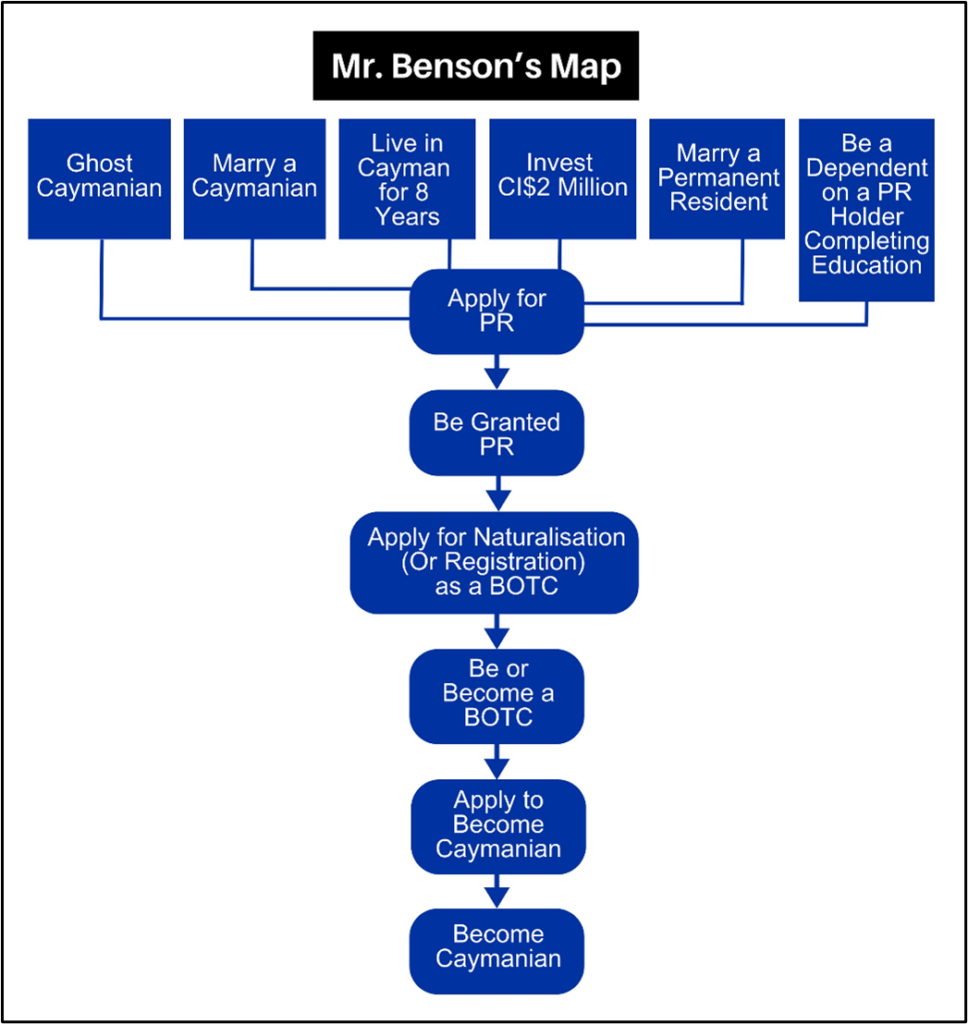
For persons who are not born Caymanian and who do not become Caymanian as children, we now have two distinct routes to become Caymanian (not including Cabinet Status grants or claims to be Caymanian based on descent).
They require Marriage to a Caymanian for 7 years (but amazingly none of those years need be in Cayman), OR 5 years of Residence (including at least one year as a Permanent Resident) followed by Naturalisation or Registration as a BOTC, and THEN a further 5 years of residence post Naturalisation or Registration. The reality is that for most the Naturalisation option requires at least 15 years in Cayman, given that application for PR cannot be made in most cases unless the applicant has been legally and ordinarily resident in the Islands for 8 years.
The British Nationality Act (under which persons are vetted to become a BOTC) is thorough – and (for example) will generally not permit persons of bad character or for whom the Cayman Islands are not a person’s genuine home, to advance to BOT Citizenship. It can be a very useful filter.
We do not have to reinvent the wheel. Permanent Residence is in effect available to all who marry Caymanians, all who marry Permanent Residents, all who pass through the 8 year Points-System, all who are the dependent children of a Permanent Resident (and who are in Cayman as approved dependents for at least 7 years before turning 18) and all who invest more than CI$2 million in developed real estate and pay CI$100,000 to the Government.
If we simply required all applicants for the Right to be Caymanian to first be Naturalised or Registered as BOTC’s, we would free ourselves from the problem of having thousands of Caymanians unable to hold a Cayman Passport, have additional vetting and security as to who we are making Caymanian, and significantly simplify our immigration (and border control) systems. Imagine how easy it could be to simply have a stamp in everyone’s passport denoting their immigration status?
The idea of being a BOTC on the path to becoming Caymanian is not a new idea or even my own. It was expressed (and invoked) by Mr. Benson Ebanks more than 50 years ago. It was sound advice then – and we should not be hesitating to follow it now.
Were we to do so we would again have a solid foundation to take whatever next steps the Caymanian people deem appropriate.
HSM Chambers are delighted to see that the requirement for various expatriates to have and provide proof to the Department of WORC of undertaking a vaccine course to prevent / suppress COVID-19 (SARS-CoV-2), before being granted an Immigration permission has been withdrawn effective as of 7 June 2023.
On 22 May 2023, HSM Chambers put the Department of WORC on notice that unless HSM Chambers were provided with confirmation, within 14 days, that the mandate would be withdrawn, we were instructed by a client to challenge that mandate and the legality of it. The challenge to the mandate would be predicated on the basis that it breached our client’s Section 9 Rights as protected by the Bill of Rights.
HSM Chambers were clear in our client’s position that as of 1 May 2023 when the World Health Organisation declared the global emergency over, the requirement to be vaccinated to obtain an Immigration permission could no longer be justified (if it ever could) due to the fact that:
- Tourists could and had been staying in the Cayman Islands unvaccinated.
- The terms of the mandate were unequal in that it did not apply to all expatriate workers nor Caymanians.
On 6 June 2023, HSM Chambers were notified that:
- The requirement to be vaccinated against SARS-CoV-2 would be lifted.
- That it was not accepted that the mandate amounted to a breach of the Bill of Rights.
- That consideration was being given to the lifting of the vaccine requirement prior to the receipt of our letter.
Hopefully, such drastic measures will not have to be reintroduced again. However, in the event that they are, it is hoped that any mandate is reasonable, proportionate and applies equally to all residents and persons seeking to enter the Cayman Islands.
Fatal error: Uncaught Error: Call to undefined function twentythirteen_paging_nav() in /home/clients/d17af2243e6f179e393695ba6e9ce04e/hsmnew/wp-content/themes/hsm/tag.php:33 Stack trace: #0 /home/clients/d17af2243e6f179e393695ba6e9ce04e/hsmnew/wp-includes/template-loader.php(86): include() #1 /home/clients/d17af2243e6f179e393695ba6e9ce04e/hsmnew/wp-blog-header.php(19): require_once('/home/clients/d...') #2 /home/clients/d17af2243e6f179e393695ba6e9ce04e/hsmnew/index.php(17): require('/home/clients/d...') #3 {main} thrown in /home/clients/d17af2243e6f179e393695ba6e9ce04e/hsmnew/wp-content/themes/hsm/tag.php on line 33