Tag Archives: Cayman Islands Lawyer
The HSM Group is thrilled to welcome Shelly Perryman-Pollard to their law firm. Shelly joins HSM Partners Kerrie Cox and Linda DaCosta in their family law practice and will help people navigate through divorce and separation, financial considerations, custody matters, property settlement and more.
Shelly comes to HSM as an Associate with 12 years of legal experience in the family field. Shelly attained her Bachelor of Laws Degree (Hons) from the University of London in 2006. She is an experienced litigator and received a certificate of Enrolment to the Supreme Court of Judicature Trinidad and Tobago in 2009.
Shelly has substantial experience in contested matters before the Courts whilst always having an eye on the possibility of achieving a settlement with the attendant saving of legal costs.
Family affairs encapsulate many areas and to complement these services, HSM’s team of experts can also advise on immigration issues, family trusts, wills and estate administration.
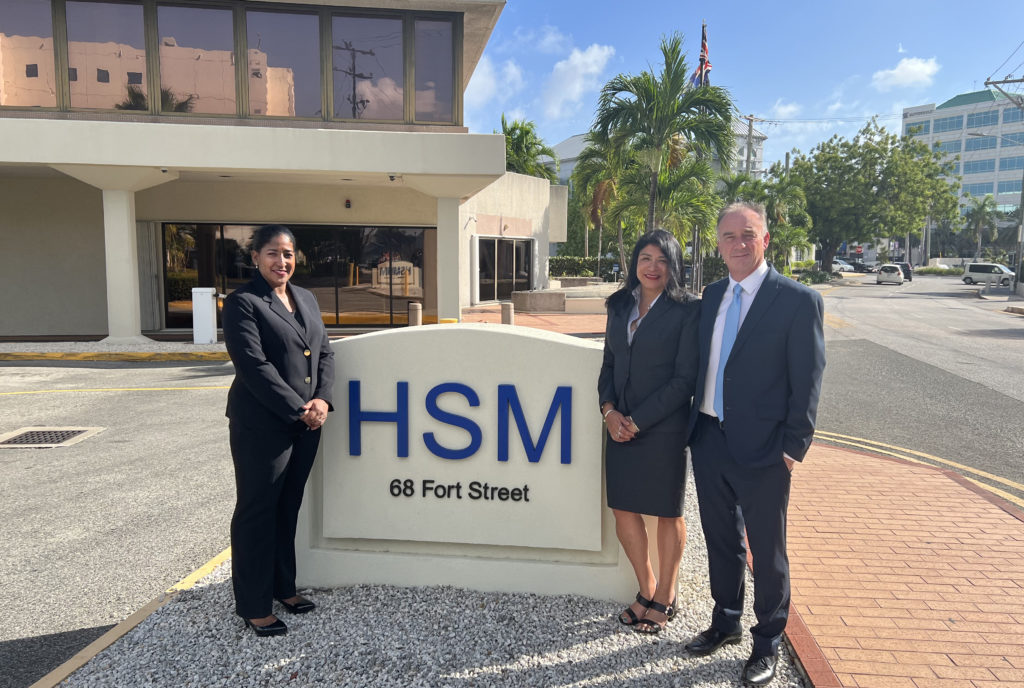
Photo (L-R): Shelly Perryman-Pollard (HSM Associate), Linda DaCosta (HSM Partner) and Kerrie Cox (HSM Partner)
HSM’s newest lawyer Stephanie Mills became a qualified attorney-at-law in the Cayman Islands on 17 November.
Stephanie’s admission was moved by HSM Partner, Sarah Allison, who summarised her qualifications for Justice Richard Williams.
During her admission, Stephanie expressed her gratitude to the Court as well as her family and friends, and is thrilled to put her experience to use in her homeland.
Stephanie has over five years of experience in the legal field and prior to joining HSM, she practiced as a paralegal and subsequently as a solicitor at a UK law firm before returning to the Cayman Islands. Whilst working in the UK she was exposed to a wide range of practice areas and gained considerable experience in residential conveyancing matters.
Stephanie successfully completed her Legal Practice Course at Manchester Metropolitan University in 2015 and received a Bachelor of Laws (Hons) degree from the Truman Bodden Law School in 2014. During her studies she represented the Cayman Islands Law School in the Caribbean Law Clinic in Florida and their team received an ovation from the judges. Stephanie was admitted as a solicitor of the Superior Courts of England & Wales in 2020.
Stephanie is a part of HSM’s Litigation team and specialises in Debt Solutions and Recovery by providing assistance to a variety of banks and leading businesses enforcing secured/unsecured loan agreements, credit facilities and contracts for the supply of goods/services.
Managing Partner, Huw Moses, OBE notes, “We are proud to witness this significant milestone in Stephanie’s career and are delighted to see our firm grow with the addition of another qualified Caymanian professional. Congratulations Stephanie.”
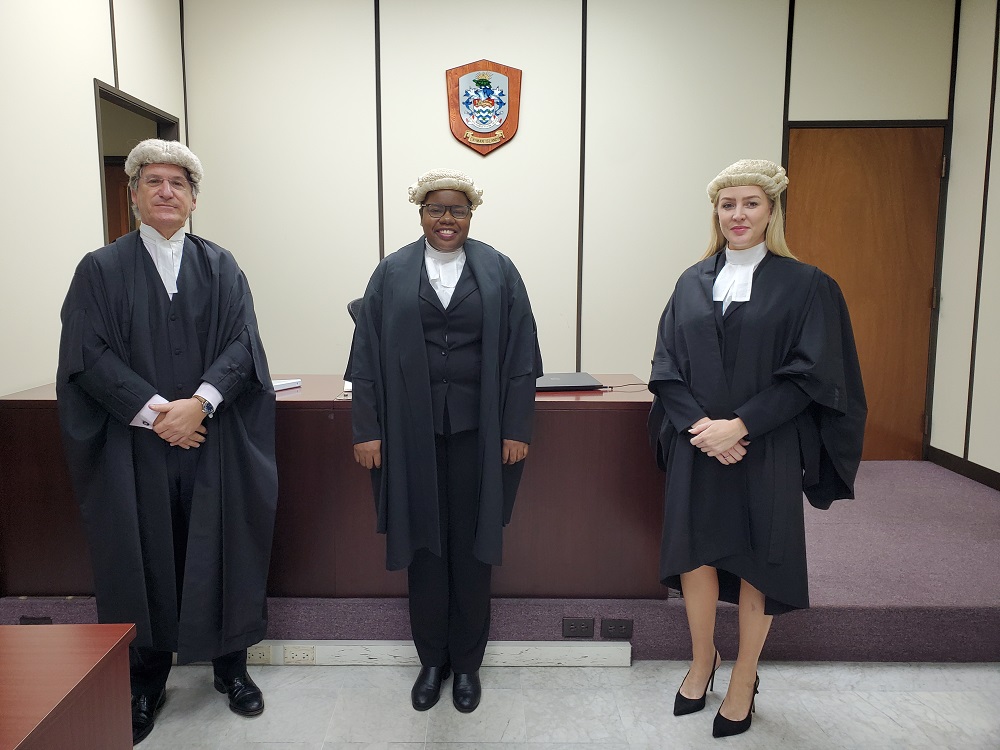
Photo (L-R): Justice Williams, Stephanie Mills (HSM Associate) and Sarah Allison (HSM Partner)
The HSM Group has welcomed Travis Ritch to their growing law practice.
Travis has over 10 years of legal experience with a wide-range of skills in the practice areas of Litigation, Public and Administrative Law, Company, Insolvency, and Employment Law. Prior to beginning his career, Travis graduated from King’s College, London (LLB) and was previously educated in the Cayman Islands, Massachusetts, USA and Ontario, Canada.
In 2011, Travis was called to the bar in England and Wales after completing the Bar Professional Training Course at City Law School. He was subsequently called to the bar in the Cayman Islands in 2015 and joins HSM having previously practiced with Ritch & Conolly.
Travis has worked on a number of high-profile insolvency and litigation matters in the Cayman Islands. Travis has been a trusted adviser to several statutory authorities. Since 2016 he has served as Deputy Chairman of the Planning Appeals Tribunal.
HSM Managing Partner, Huw Moses, OBE notes: “Travis is a valued addition to our team. With extensive experience and having grown up in the Cayman Islands, he brings a deep understanding of the local legal landscape. We look forward to strengthening our firm with him.”

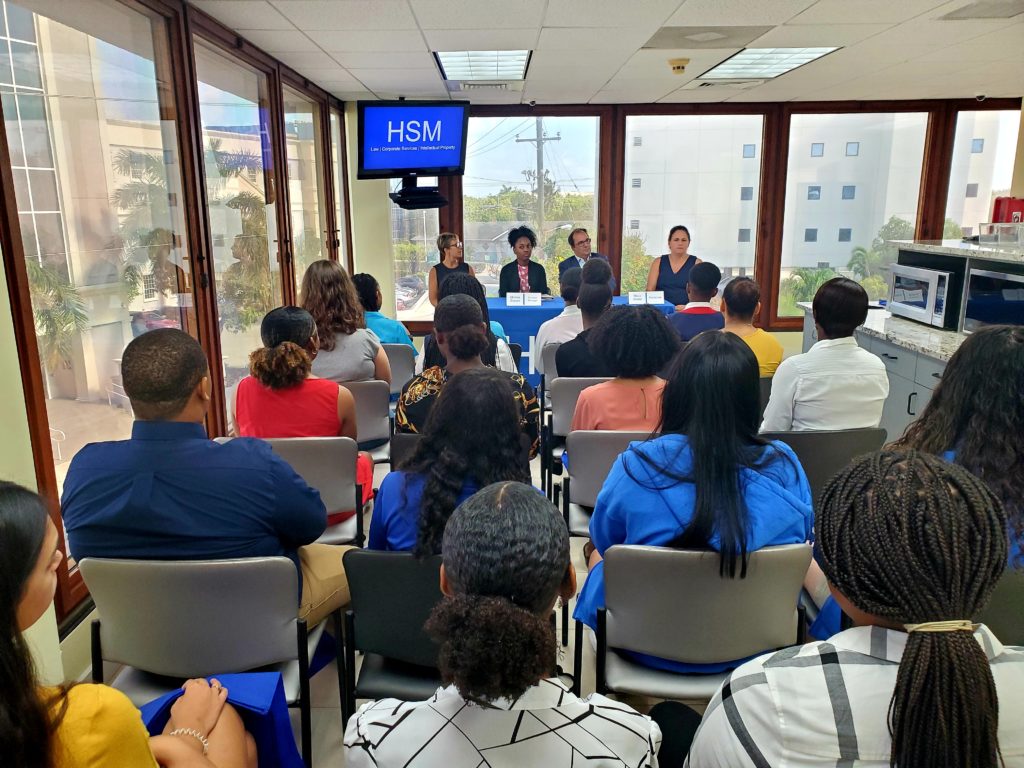
The HSM Group opened their doors to welcome 18 students from the Cayman Islands Chamber of Commerce Mentoring Cayman Programme on 25 February 2021.
The students were given a tour of the HSM offices by HSM’s Managing Partner, Huw Moses and Chief Executive Officer, Donna Farrow.
Afterwards they were given a presentation on the legal industry and career details, which included a panel of HSM staff across various sectors and the students got the opportunity to ask questions.
HSM is a full-service law firm in the Cayman Islands that offers a wealth of employment opportunities, including immigration, intellectual property, litigation, property, private client, corporate services and more. They also have areas outside of law such as finance, secretarial and marketing.
Chamber’s Mentoring Cayman Programme offers experiences for professionals to mentor students on the verge of graduating. It also serves as an introduction to the many career paths available on island.
“Our company is always looking for ways to support young adults,” shares Huw. “We are proud to offer them insight into the working world and help mold them professionally.”
In addition to this initiative, HSM is a proud supporter of the Cayman Islands Further Education Centre (CIFEC) Internship Programme since 2012 and offers sponsorship opportunities for further education. HSM also employs seven former CIFEC graduates fulltime.
HSM’s Employment and Immigration lawyers are advising a number of persons and businesses as to the requirements and expectations of the Cayman Islands Law during COVID-19, in particular where businesses may be required to make staff redundant.
Redundancy is defined in Cayman Islands Law as “a situation in which, by virtue of a lack of customers or of orders, retrenchment, the installation of labour-saving machinery an employer’s going out of business, force majeure or any other reason, tasks which a person was last employed to perform no longer exist.”
Cayman Islands Labour Law
A redundancy is a form of “fair dismissal” provided it is carried out in accordance with the Labour Law. The Law provides for preference in employment. If a group of persons carrying out a specific role within an organization are to be made redundant, the Law requires that preference be given according to immigration status. It follows that work permit holders are expected to be made redundant before permanent residents, permanent residents are expected to be made redundant before the spouse of a Caymanian holding a Residency and Employment Rights Certificate, and Caymanians are expected, by Law, to be the last to face redundancy. This is entirely academic if a business is closing down. All persons (without regard to immigration status) will likely be made redundant together. That is perfectly lawful.
Given that a redundancy constitutes a form of termination, it triggers a series of entitlements.
These include severance pay, notice pay, and accrued (but untaken) vacation pay.
Severance Pay is calculated as being one week’s pay, at the latest “basic wage”, for each completed year of service. “Basic wage” means the ordinary wage due to an employee under his or her contract of employment. It does not include such matters as future anticipated gratuities and commissions. Accordingly, for many, the basic wage will be CI$6.00 (or such other higher number set out in their contract of employment. Where no formal contract exists, the amount can be determined by reference to the conduct of the employer and employee – i.e. what is the basic wage that has in fact been paid.
Notice pay is determined by reference to the contract of employment. Where no notice period is prescribed it is deemed to be the interval between pay days.
Accordingly (by way of example) an employee who is made redundant on 31 March and who:
- has been employed by that employer for 3 years and 2 months
- earns CI$6.00 per hour at basic wage for a 40 hour week (CI$12,480 per annum); and
- has a 10 day annual vacation entitlement and has taken none this year;
would generally expect to be entitled to payment on redundancy of:
- 3 weeks severance of CI$720
- One month’s notice pay of CI$1,040 (assuming the employee is not asked to work during their notice period); and
- 2.5 days accrued but untaken vacation pay of CI$120.
A person in this situation would accordingly expect payment on redundancy of CI$1,880. Such payment is payable immediately on termination.
National Pensions Law
There is generally no entitlement to access pension monies prior to retirement. However, severance payments made on redundancy are not pensionable, but accrued untaken vacation pay, and any payment due in lieu of notice, are considered to be pensionable under the National Pensions Law. Also it should be noted that any additional voluntary contributions made by the employee can be withdrawn due to unemployment.
Health Insurance Law
All residents in the Cayman Islands are required to have “adequate” health insurance. As a general rule the obligation to ensure that health insurance is in place rests with employers. Upon termination of employment employers are generally required to ensure that health insurance is maintained for 3 months following the termination of employment. Employers are however entitled to charge those premiums to the employee. The employer’s obligation to maintain health insurance ends upon the person becoming employed elsewhere, being covered by an alternative qualifying policy of insurance, upon the expiry of 3 months, or upon the person leaving the Cayman Islands (whichever happens first). It follows that it may be of direct economic benefit for persons who held work permits, but who have been made redundant (or otherwise terminated), to leave the Islands as soon as practicable.
Immigration Law
Regulation 9 of the Immigration Regulations provides that where a person on a work permit is no longer employed, any work permit ceases to be valid, and the employer must forthwith notify the Department of Workforce Opportunities & Residency Cayman. Redundant employees who were on a work permit to be in Cayman have no right to remain once their employment ends. In normal circumstances that means that persons are expected to register as tourists and remain in accordance with permissions extended by WORC/Customs and Border Control. Customs and Border Control have announced that where a permission to work in Cayman ends before 22 March persons can simply proceed to leave before the anticipated 22 March, 2020 closure, without first having to “regularize” their permission to be in the Islands.
As matters stand, no expatriate can work in the Cayman Islands without express permission or exemption from requirements. It will not be impossible for an expatriate made redundant to seek and obtain alternative employment without first having to leave, and if normal rules continue to apply, Caymanians, Spouses of Caymanians and Permanent Residents will be given preference for any opportunity.
Rent
The obligation to pay rent will be based on the terms of any applicable lease. In normal circumstances appropriate notice will need to be given, and deposits may be forfeited if notice is not given or there is damage to the rented unit. Some leases may provide for the lease to end upon the termination of a work permit.
Repatriation
Unless provided for by contract, there is no obligation on an employer to ensure that an expatriate employee is able to return to their home country. It is worthy to note that employers have paid substantial “repatriation fees” to the Cayman Islands Government in the expectation that those funds could be applied towards the costs associated with workers getting to their homeland. For some, returning home is not a reasonable possibility. It requires closed third party borders to be crossed, even if flights are available. They may be stuck in Cayman, perhaps for an extended period. The Government has recognized this and it, employers, and the community will have to come together (maintaining social distancing) to ensure that everyone’s basic needs can be met.
We are ultimately, all in this together.

This article is intended only to provide a summary of the subject matter. It does not purport to be comprehensive or to provide legal advice. No person should act in reliance on any statement contained in this article without first obtaining specific professional advice. Alternative solutions also exist which may better suit the requirements of a particular individual or entity.
Key Contacts

Alastair David
Senior Associate
adavid@hsmoffice.com

Hilary Brooks
Senior Associate
hbrooks@hsmoffice.com
HSM is proud to welcome Associate Oscar DaCosta to their law firm in the Cayman Islands.
Oscar has worked with several local law firms across Grand Cayman and has gained a wide-range of experiences in Litigation, Employment, Banking/Commercial and Property Law.
Oscar obtained an LLB (Hons) Degree from the University of Liverpool (Truman Bodden Law School) in 2014 and also received a Commendation in the Professional Practice Course in 2017. Oscar is also an Accredited Civil and Commercial Mediator by the ADR Group – Civil Mediation Council (CMC) in London.
Addressing the court, Oscar shared his passion for the law and his desire to make a positive impact in the community.
Oscar is a qualified lawyer in the Cayman Islands and will be assisting HSM’s property team with development transactions, acquisitions and disposals as well as landlord/tenant matters across residential and commercial properties.
Managing Partner, Huw Moses, OBE notes, “We are thrilled to have Oscar on our team and with Cayman’s enticing property market, we are equipped to provide a high quality of service to this industry.”

(L-R): Oscar DaCosta (HSM Associate) and Justice Margaret Ramsay-Hale
Purchasing property in the Cayman Islands is attractive, not only for the luxurious beaches and high standard of living but the buying process is acclaimed for its structure and variety of opportunities.
HSM’s property lawyers in the Cayman Islands breakdown the fees that buyers can expect.
There are no property taxes in the Cayman Islands but property buyers do pay stamp duty. Generally, stamp duty is payable at a rate of 7.5% on the market value of property, whether undeveloped ‘raw’ land or developed land with buildings on it. However, concessions or waivers may be available in the following circumstances:
a) First time Caymanian Purchasers
Where a purchaser is Caymanian,[1] reduced stamp duty rates may be available for the purchase of an existing residential dwelling, or raw land for the construction of a residential dwelling[2]. This concession is not automatic; an application must be made to the Minister of Finance. If approved, the following reduced rates apply for one Caymanian first-time purchaser: [3]
- (i) 0% for bare land purchases with a market value of up to CI$150,000 and for houses, apartments or other dwelling purchases with a market value of up to CI$400,000, for owner occupation; and
- (ii) 2% for bare land purchases with a market value of more than CI$150,000 but not exceeding CI$200,000 and for houses, apartments or other dwelling purchases with a Market Value of more than CI$400,000 but not exceeding CI$500,000, for owner occupation.
The following reduced rates apply for two or more[4] Caymanian first time purchasers:
- (i) 0% for bare land purchases with a market value of up to CI$300,000 and for houses, apartments or other dwelling purchases with a market value of up to CI$500,000, for owner occupation; and
- (ii) 2% for bare land purchases with a market value of more than CI$300,000 but not exceeding CI$350,000 and for houses, apartments or other dwelling purchases with a Market Value of more than CI$500,000 but not exceeding CI$600,000, for owner occupation.
The usual 7.5% applies to purchases exceeding the above limits.
b) Transfers through Natural Love and Affection
For transactions which take place through Natural Love and Affection (i.e. no consideration, financial or otherwise, passes between the parties), a fixed stamp duty rate of CI$50[5] applies. Property may pass for natural love and affection between:
- Husband and Wife;
- Parent and Child;
- Brother and Sister (as long as they share a parent); and
- Grandparent and Grandchild.
It is also possible for property to pass for natural love and affection between extended family members in a single transaction, as long as evidence of the relationship chain can be demonstrated and the parties are living. In such cases, the Stamp Duty is payable separately for each link in the relationship chain.
c) Linked Transactions/ Pre-construction/ Developments
Historically, many developers have minimized the stamp duty payable by their clients by structuring their contracts in two interdependent parts: an agreement for the sale of raw land on which the building will be constructed; and a development or construction agreement to be carried out by the developer or a related company.
Accordingly, the stamp duty is assessed on the value of the raw land only, without taking into account the value of the building the developer has agreed to construct on, provided that the agreement for sale is presented to the Lands and Survey Department for assessment before the building commences.
Changes on the horizon?
In October 2018, the Stamp Duty (Amendment) Bill 2018 (the ‘Bill’) was published. The Bill proposed that as of 1 January 2019 such transactions would be considered ‘linked property transactions’, and stamp duty would be assessed on the aggregate value of the two agreements.
What has actually changed?
However, when the Stamp Duty (Amendment) Law 2018 came into force on 19 December 2018, the draft legislation had been significantly altered with respect to ‘linked property transactions’, allowing developers with planning permission in place by 30 June 2019 a year to take advantage of the pre-existing regime for stamp duty on ‘linked property transactions’, provided they enter into their contracts before 31 December 2019. Accordingly, stamp duty will be assessed on the value of the land purchase agreement only and not on the value of the construction agreement as well.
This has allowed developers more time to prepare for the impact of the new regime and is a welcome delay for both developers and purchasers with residential development projects already underway.
What about after 31 December 2019?
The Law provides that, after 31 December 2019, in a Linked Property Transaction worth CI$300,000 or less, the stamp duty payable is 3% of the total value of the linked property transaction.[6]
In a Linked Property Transaction worth more than CI$300,000 the total 7.5% stamp duty is payable as follows:[7]
- (i) 75% of the total value of the linked transaction, payable within 45 days of the purchaser having signed an Agreement for Sale and Purchase (‘Agreement’); and
- (ii) 75% of the total value of the linked transaction, payable within 45 days of the purchaser having signed a Transfer of Land (‘Transfer’).
d) Transfers through the death of an owner, or subsequent divestment of estate
No stamp duty is payable on transactions that are effected as a result of the death of a proprietor/ owner of a land, where the land is being inherited either directly, or otherwise dealt with by way of the Administrator of the Estate.
e) Transfers between Companies and Shareholders
For transfers from a landholding company to a shareholder owning at least 45% of the shares (or vice versa), an abatement of stamp duty may also be available.[8]
f) Other
Several other categories of transfers may also be exempt from stamp duty, including:
- transfers to a receiver;[9]
- transfers executed by a cooperative society;[10] and
- certain dealings in bankruptcy.[11]
Footnotes
[1] As defined under the Immigration (Transition) Law, 2018 and only if they can provide supporting documentation.
[2] This only applies when the land or property is for the applicant’s first owner occupied dwelling.
[3] This applies to all areas except parcels located in excepted Blocks – see the Schedule to the Stamp Duty Law (2019 Revision) for a list.
[4] But no more than 10.
[5] For extended family members, the Stamp Duty fee applies separately to each ‘link’ in the relationship chain.
[6] CONVEYANCE OR TRANSFER of any immovable property within a development scheme and forming part of a linked property transaction, para (1) Schedule, Stamp Duty Law (2019 Revision)
[7] CONVEYANCE OR TRANSFER of any immovable property within a development scheme and forming part of a linked property transaction, paras. (2), (3) and (4) Schedule, Stamp Duty Law (2019 Revision)
[8] CONVEYANCE OR TRANSFER, para (3), Schedule, Stamp Duty Law (2019 Revision)
[9] CONVEYANCE OR TRANSFER, para (5), Schedule, Stamp Duty Law (2019 Revision)
[10] s.67 Cooperative Societies Law (2001 Revision)
[11] s.166 Bankruptcy Law (1997 Revision)
HSM’s Immigration team have taken a close look as to why there is a decline for work permit fees in the Cayman Islands.
It appeared to be inevitable, and may now just be coming true. Income from work permit fees is likely to fall, perhaps precipitously.
According to the Economics and Statistics Office latest Compendium of Statistics, the Cayman Islands Government received $87.3 million dollars in work permit revenue last year. There had been $88.9 million in 2017, and the number had consistently grown in each of the 8 prior years.
The drop in work permit revenue ought not to come as any surprise. What may surprise is the fact that the government revenues appear likely to fall (perhaps significantly), even if (or as) the number of work permit holders grows.
The reasons are straightforward enough. In some cases, Caymanians are advancing in their careers, and replacing expatriates who are leaving. Other expatriates find relief from high immigration fees in the Special Economic Zone. Still others (working for foreign companies with no presence in Cayman) have taken the authorities up on their kind invitation (that we simply cannot understand) to have no work permit at all, as is the case for expatriates in government service.
Those are not however the primary reasons.
With the abandonment of Term Limit Exemption Permits, and an easing of the PR system, significant and growing numbers of expatriates are inevitably proceeding to become Caymanian. The whole process (from arrival and without being married to a Caymanian) usually takes no more than 15 years. This, subject to appropriate limitations, should be celebrated. We are now at a stage that the many of our long term residents have obtained Permanent Residence and are now becoming (or will shortly become) Caymanian. A significant wave of others have acquired Permanent Residence in the past two years. Many of them were delayed in the processing of their applications and so only have a year or two to go before they (and their families) also become Caymanian.
Almost all will have met (or exceeded) the government required conditions for membership. Being Caymanian is an honour, and for those on whom it is bestowed, a privilege. It can (and should) be a source of great pride, but being Caymanian also brings with it a myriad of benefits, including an exemption from having to pay any work permit fees. That exemption applies not only to the Caymanian, but also to their spouse.
The advantage of any exemption varies by occupation. Not all work permits (or permanent residence certificates) are created equal. For teachers, the annual fee is nil; for labourers it is $550; for accountants it is $13,650; and for (equity) partners in law firms, it is $32,400. The reality is that financial services industry professionals (those responsible for the highest fees) have been granted PR in substantial number. They are wholly deserving having fulfilled the criteria for that award. They now qualify and cross the next threshold. They are becoming Caymanian. There does not appear to be corresponding levels of growth amongst executive-level work permit holders (with the pace of their predecessors becoming Caymanian, retiring, or leaving) now outpacing the supply of new accountants, bankers, and lawyers from overseas.
Certainly, the number of work permit holders will likely continue to grow, but at current work permit fees it takes 59 labourers (or 108 Produce Clerk’s or 216 baby sitters) to generate the equivalent revenue in work permit fees, as a single law firm partner. With the ongoing apartment construction boom (fueled in part by a recent change in the stamp duty treatment of pre-construction purchases) there will be heavy construction activity for the next two years. The number total of work permits may well continue to grow, all while the average price paid for each work permit appears likely to continue to decrease.
The likelihood is for substantially decreasing work permit revenues. These will likely be offset by import duties on materials and furnishings required for the new buildings, but when all the construction is complete, that too will diminish. At that stage large numbers of construction workers may be without work and will return to their home jurisdictions. At the same time, we will celebrate the latest wave of PR recipients becoming Caymanian. The monies generated in work permit fees, and the number of work permits, will then fall in unison, perhaps significantly. We can only hope that this prospect is recognized, and being planned for.
All is far from lost. There are alternative revenue sources and options mitigate the consequences, but these will need to be actioned very soon, and likely must include welcoming new residents to our shores.
HSM’s Dispute Resolution practice and attorneys Ian Lambert (Partner) and William Helfrecht (Partner) have made their debut on The Legal 500 Caribbean 2020.
The Legal 500 has been analysing the capabilities of law firms across the world for more than 30 years. Law firms and attorneys are ranked by thorough research processes and are highly credited if featured.
This recognition highlights HSM’s ability to successfully handle litigation and dispute matters.
Citing The Legal 500 website, they refer to HSM as a firm that “provides practical and useful advice on insolvency and litigation matters in a cost-effective manner.”
“Ian Lambert is experienced in complex commercial and contract disputes, insolvency and bankruptcy claims, asset recovery and fraud issues, and trust litigation; and William Helfrecht is noted for disputes relating to trusts, professional negligence work, company law and land issues.”
The HSM Group has welcomed Kathryn Rowe to their growing law practice.
Kathryn joins as a Senior Associate and will focus on employment related matters. With over 17 years of legal experience, Kathryn has a wide-range of skills in the areas of litigation, employment, immigration, data protection and regulatory matters.
Kathryn has handled contentious and non-contentious employment work, representing and advising both public and private sector employers and employees. She has provided HR advice to clients, including contract and document preparation through to disciplinary and grievance matters, immigration issues, redundancy, discrimination and other contractual issues.
Kathryn was appointed as Chairperson of the Labour Tribunal in 2015 and still holds this position.
Managing Partner, Huw Moses, OBE notes: “Kathryn is a valued addition to our employment team. She has a great mix of local and international experience, which will undoubtedly benefit our clients.”
Fatal error: Uncaught Error: Call to undefined function twentythirteen_paging_nav() in /home/clients/d17af2243e6f179e393695ba6e9ce04e/hsmnew/wp-content/themes/hsm/tag.php:33 Stack trace: #0 /home/clients/d17af2243e6f179e393695ba6e9ce04e/hsmnew/wp-includes/template-loader.php(86): include() #1 /home/clients/d17af2243e6f179e393695ba6e9ce04e/hsmnew/wp-blog-header.php(19): require_once('/home/clients/d...') #2 /home/clients/d17af2243e6f179e393695ba6e9ce04e/hsmnew/index.php(17): require('/home/clients/d...') #3 {main} thrown in /home/clients/d17af2243e6f179e393695ba6e9ce04e/hsmnew/wp-content/themes/hsm/tag.php on line 33