Category Archives: HSM LAW
An Overview of Attorney General of the Cayman Islands and another (Respondents) v. Shelliann Bush (Appellant) [2025] UKPC 39. The Judicial Committee of the Privy Council has confirmed that employees of charitable organisations in the Cayman Islands have no statutory right to protection against unfair dismissal, and that this exclusion does not breach the Cayman Islands’ Bill of Rights.
Background
The appellant, Ms Shelliann Bush, had been employed at The Pines Retirement Home (a charitable organisation) until November 2021, when she was dismissed for failing to comply with a newly introduced vaccination requirement, in response to the COVID-19 pandemic.
Seeking compensation under the Labour Act (2021 Revision) (Act), she was informed by the Department of Labour and Pensions that the Act does not apply to charitable organisations, by virtue of section 3(b).
The appellant brought constitutional proceedings, arguing that this exclusion denied her rights under section 7 (fair trial), section 9 (private and family life), and section 16 (non-discrimination) of the Bill of Rights.
Proceedings Below
At first instance (Grand Court), the Honourable Justice Walters (Actg) held that section 3(b) imposed a procedural bar which violated section 7 and gave rise to discriminatory treatment. However, the Cayman Islands Court of Appeal reversed that decision. It held that by virtue of section 3(b), employees of charities have no substantive civil rights to claim unfair dismissal. Without such a right, section 7 was not engaged.
The Privy Council’s Reasoning
Lord Lloyd-Jones, giving the advice of the Board, upheld the Court of Appeal’s approach.
Section 7: No substantive right to unfair dismissal
Section 7 of the Bill of Rights, like Article 6 of the European Convention on Human Rights, is a procedural guarantee. It does not create substantive rights where none exist in domestic law.
The Board drew on R (Kehoe) v Secretary of State for Work and Pensions [2006] 1 AC 42; and Matthews v Ministry of Defence [2003] 1 AC 1163, both of which emphasised that Article 6 is concerned with access to courts for determination of existing rights, not the creation of new rights.
Whilst the Labour Act does confer a statutory right not to be unfairly dismissed, section 3(b) expressly excludes charitable organisations. This exclusion prevents such rights from arising at all, rather than imposing a procedural bar on their enforcement.
International law arguments rejected
The appellant sought to rely on international labour standards and on dicta from R (Wright) v Secretary of State for Health [2009] 1 AC 739, and the concurring opinion of Judge Pinto de Albuquerque in K.M.C. v Hungary (App No 19554/11), 19 November 2012 (ECHR), to argue that there exists a universal civil right not to be unfairly dismissed. The Board, however, rejected this submission, noting that unfair dismissal is a statutory construct which varies across jurisdictions and is not mandated by international law.
Section 16 read with section 7 or 9
The appellant further argued that section 16 prohibited discriminatory exclusion from the statutory scheme. The Board held that since section 7 was not engaged, section 16 could not be read with it.
As to section 9, the Board accepted that employment-related disputes may in some circumstances fall within the notion of ‘private life’ for example, Denisov v Ukraine (App No 76639/11), 25 September 2018, ECHR Grand Chamber and Novakovic v Croatia [2021] ELR 169), which illustrate that Article 8 can apply where dismissal has severe consequences for private life or professional reputation.
However, the Board followed its own recent guidance in Royal Cayman Islands Police Association v Commissioner of Police [2022] ICR 117, holding that the unfair dismissal regime was designed to regulate employment relations, not to safeguard private life. The link to section 9 was therefore ‘too tenuous’ to engage section 16.
Conclusions
- The decision of the Privy Council reaffirms a sharp doctrinal distinction: Wrongful dismissal remains available under the common law where the contract of employment is breached, but its remedies are limited (usually to notice pay).
- Unfair dismissal is purely statutory. If Parliament has withheld it from a category of employees, courts cannot supply it through constitutional interpretation. More broadly, the case illustrates the limits of the Bill of Rights in expanding employment protections.
- Section 7 cannot create substantive rights, and section 16 discrimination claims require a sufficiently close connection with the core values of the relevant right.
The ruling is therefore significant both for employment law (leaving employees of charities reliant solely on contractual remedies) and for constitutional law, in affirming a restrained approach to the ambit of rights under the Cayman Islands Constitution.
In the UK and around the world, a large amount of case law has developed around how to assess whether an individual is an employee or not. Companies such as Uber and Pimlico Plumbers have fought lengthy court battles to avoid declarations that their staff are employees or workers due to tax issues and other statutory benefits that employees and workers are entitled to.
In the Cayman Islands, it is equally important to know whether a business or even an individual has entered into a contract for service or a contract of service. A contract of service would indicate an employee / employer relationship, a contract for service would indicate something else.
The determination of what is and what is not a contract of/for service is very fact specific and the authorities can look behind any written document to see how the services were performed.
Generally, in the Cayman Islands, the Immigration Act requires that an expatriate has an immigration permission to work in the Cayman Islands, i.e. be an employee, of a business or of an individual. If that expatriate has no immigration permission to work as an employee for the individual or the business, then the employer and the employee are breaking the law and can be prosecuted.
In the event that Workforce Opportunities & Residency Cayman (WORC) have a suspicion that an individual or business is in breach of the law, an investigation can take place.
The Department of WORC have the power, if they so wish, to issue an administrative fine to the individual and the business if they believe that a breach of the Immigration Act has occurred. These fines can be up to five times the cost of an annual work permit fee and as a result these fines can be very punitive.
If a business accepts that they have broken the law and accept an administrative fine they will be placed on the “WORC Offenders Register”, although this Register is not publicly available. The Department has published a policy in regards to the effect of this and it appears that if you find yourself on this Register your applications will be subject to additional scrutiny, may be delayed and administrative fines will be increased in the event of repeated breaches.
An individual who has been working without an immigration permission who accepts an administrative fine, could experience trouble obtaining future work permits or a future Permanent Residence application might be put in jeopardy.
If the offer of a fine is declined, WORC submit the file to the office of the Director of Public Prosecution (“DPP”) to determine whether or not a prosecution should take place.
Recently a business in the Cayman Islands found themselves under investigation for employing a “social media influencer”. This is not the first time that social media influencers have caused issues for businesses in the Cayman Islands. Businesses and influencers have been fined in the past for operating in the Cayman Islands without the appropriate immigration permissions.
What was different in the most recent investigation was that the business had been wise enough to enter into a formal written agreement with the influencer which was far more consistent with a “contract for service” as opposed to a “employment contract”. Equally, the way in which the business and the social media influencer operated was far more consistent with a contract for service than an employment contract.
As part of the investigation, the business was permitted to provide the contract to WORC and also make submissions as to why they had not broken the law. Despite this and the acceptance from WORC that the social media influencer was not “under a contract of employment” an administrative fine was proposed by WORC because they considered that the influencer “should not have been providing services to (your) client nor receiving compensation in any form without the appropriate work authorization”.
The business found themselves in a very difficult position. On the one hand they could accept the administrative fine, which while fairly punitive could be absorbed or on the other hand they could maintain that they had done nothing wrong and risk a prosecution. Not only did the business risk a higher fine, but they also, if the prosecution took place would face the risk of much higher legal fees.
In this case, the business “stuck to their guns”. They maintained they had done nothing wrong and asked for the matter to be transferred to the DPP for a legal ruling. That ruling has come back and there is to be no prosecution.
What can people learn from this?
If there is any doubt as to whether or not the contractual relationship is one which could lead to a finding of a contract of employment, the parties should take immediate legal advice.
It is primarily the responsibility of the business and the expatriates who are entering into a contractual relationship to ensure that the appropriate permissions have been obtained. A business or an individual should never find themselves in a position that they cannot point to a contractual document of some nature which sets out the nature of the relationship between them and the expatriate.
The contractual document should clearly set out the provisions which enable the reader to conclude that the document is not an employment contract if that is the real intent i.e. no reference to a “salary” or benefits, which would be consistent with an employment relationship.
In the recent matter, the evidence was very strong that the contractual relationship was not one of a contract of service and equally the concession by WORC that the influencer was not working under a “contract of employment” helped strengthen the business’ position. Due to the fact that the business had “protected” themselves by having a written agreement, which accurately described the relationship between the parties, the business could take the “gamble” and ask for the matter to be referred to the DPP with a degree of certainty that no prosecution would take place.
But in the absence of a written document which accurately reflects the position of the parties, the business might not have wished to take the gamble and paid the fine.
While it was disappointing that WORC took the position that an offence pursuant to Section 68(5) of the Immigration (Transition) Act (2022 Revision) (“the Act”) had been made out, it is hoped that they will now have received clarity in regards to the law.
Section 68(5) of the Act is clear and it states:
(5) A person who employs another in contravention of this Act or in contravention of any condition or limitation contained in a permit commits an offence and is liable on summary conviction in respect of a first offence to a fine of twenty thousand dollars and to imprisonment for one year and in respect of a second or subsequent offence to a fine of thirty thousand dollars and to imprisonment for two years.
An employment relationship has to exist between the parties for the offence to be established. In normal circumstances, a contract for service will not fall foul of Section 68(5) of the Act. Care must be taken when drafting a contract for service to ensure it is clear that no employment relationship is created. Merely saying in the document, “this is not a contract of employment” is not enough. Legal advice may well be worth obtaining to avoid the risk of an administrative fine or worse.
In October 2025, the Government proposed a change to the Immigration (Transition) Act (2022 Revision) (“the Current Law”) by publishing the Immigration (Transition) (Amendment and Validation) Bill 2025 (“the Bill”). In a 58-page document the Government set out the numerous changes they wished to bring into the Current Law, which has now been renamed the Caymanian Protection Act (“CPA”) and requested views on these changes.
HSM Chambers submitted a detailed response to the changes in which we set out:
- What we thought was good about the Bill.
- What we thought should be amended in the Bill.
- What we thought should be included in the Bill.
On 8 December 2025, the Minister for Caymanian Employment and Immigration tabled a number of changes to the Bill and these changes have been incorporated into the recently passed Bill, known as the CPA. It is now far more restrictive than previously drafted and will form (and we understand do form) part of the CPA. A commencement date has not yet been officially announced but it is expected that the CPA will become law in the New Year.
HSM Chambers’ position remains that there are issues with the CPA which have not yet been addressed. These issues are varied and detailed and include whether or not a proper consultation can be said to have taken place in the absence of the Regulations that will accompany the CPA when it becomes effective.
In the absence of the Regulations, for example, the following matters remain unclear:
- What prescribed financial standing will be required to satisfy the Board that an applicant for the Right to be Caymanian (“RTBC”) can support their dependents. It is presumed that this figure will be an income of at least $5,000 per month, with an additional $1,000 income required for each additional dependent, if the same threshold proposed for work permit holders is adopted.
- Whether the prescribed financial standing will take into account child dependents who are Caymanian or have their own immigration permission. Currently, it appears that where an expatriate applies for an immigration permission and they have a Caymanian child, by way of example, that child is not considered a “dependent” when a review of the individuals salary takes place to see if they have sufficient income to support other non-Caymanian children. It is not clear whether this situation will change.
- What the prescribed circumstances will be to permit an individual to change their employer within the first two years of the grant of the work permit.
- Whether there are to be any changes to the thresholds for Certificates of Permanent Residence as a Person of Independent Means, or Residency Certificate as a Person of Independent means.
Likewise, there remain issues with a number of the changes, perhaps most notably for those spouses who are “stay at home parents” who are married to a RERC holder but do not hold a RERC in their own right and are instead listed as dependents on their spouse’s RERC.
For reasons that are unclear, the Government appears to intend that these individuals would, in circumstances where their marriage breaks down or their RERC-holding spouse dies, be unable to apply for an RERC in their own right and therefore would potentially be required to leave the Cayman Islands.
Another issue which remains, post the changes proposed on 8 December 2025 is the punitive elements of the CPA, which seeks to penalize individuals who marry a person with a different term limit from themselves. Those individuals will now acquire the term limit of the party with the least time left in the Cayman Islands.
At present under the current legislation, those individuals can either retain their own term limit or elect to acquire the term limit of the spouse with the most time left. This will now change. It is not clear why approximately 1,000 individuals who currently hold work permits linked to their spouse, or whose spouse is linked to their permit, are to be treated in such a harsh manner.
The proposed changes could operate to penalize those who choose to marry, rather than those who remain unmarried.
Noticeable changes
Reduction in those Protected by the Transitional Provisions
In the Bill as originally published, it was clear that those people who had applied for Permanent Residence (PR) and were awaiting the decision of their application would be protected by the Transitional Provisions relating to eligibility to apply for the Right to be Caymanian. Specifically, such individuals would have been entitled to apply after 15 years of residence (provided they were naturalised), rather than after 20 years as now set out in the CPA.
The Cayman Islands Government amended the Bill, now the CPA, to ensure that it is only those individuals who are actually granted PR at the time the CPA comes into force will be entitled to apply for the Right to be Caymanian after 15 years of residence (and being naturalised).
This amendment will adversely affect at least 600 people who are currently working pursuant to a Permission to Continue Working with pending PR applications if decisions are not given before the CPA comes into effect.
Identity Cards
The Bill published in October 2025, was wholly silent as to Identity Cards. While it is correct that Section 71 of the Current Law allows for the issuance of an Identification Card, the Amendments proposed on 8 December 2025, appeared to make it more likely that an Identification Card, at least for Work Permit holders, will be required, and the associated costs will have to be paid in advance of the grant of the Work Permit.
The proposed Amendments (and which we believe form part of the CPA), make reference to Identification Cards in two separate provisions. Since 2022, there have been rumours of a National Identification Card, and it appears that we are moving one step closer to them being introduced, if the proposed amendments do form part of the CPA.
If it is the case that Identification Cards are introduced for work permit holders, then those Work Permit holders can expect to be arrested and fined if they do not produce upon request an Identification Card or within 48 hours of the request made by a Police Officer, an Officer of WORC (but not Customs and Border Control) and an Officer of the Department of Labour and Pensions. It should be noted that it appears that a request to produce the ID Card can be made without a reasonable suspicion that a violation of the Immigration law, or any law has occurred, and can be made without cause by the relevant officer. This appears a little draconian.
Whether the CPA will result in a wide rollout of the Identification Cards is not known. However, it does appear that the Identification Card and the associated costs, will be a further cost to employers or expatriates wishing to live in the Cayman Islands. This is in addition to the anticipated increase of almost 700% in the driver license fees for expatriates due to take effect in the New Year.
It is also notable that where a business applies for a work permit and pays the costs of the Identification Card in advance, but the Work Permit is ultimately not granted, there appears to be no provision for the recovery of the Identification Card fees in the CPA.
Conclusion
HSM Chambers reiterates its concerns raised during the consultation period. There are still fundamental flaws in the CPA which have not been corrected and will create uncertainty and difficulties. A meaningful consultation process should still take place, allowing stakeholders the opportunity to comment on the changes alongside the yet unseen regulations with the benefit of full and complete information.
The concept of ‘domicile’ is an ancient but highly relevant set of legal rules which, in a nutshell, seeks to determine where an individual’s true home is during the course of their lifetime.
As a broad statement of principal, if an adult freely chooses to reside permanently in a particular country and they in fact do reside there, they will also usually be regarded as being domiciled there.
Why is this important? It is because law of domicile governs which system of law applies to the assets/property of a person when they die. HSM Partner, Robert Mack, covers everything you need to know in this article.
This may come as a shock to people who have freely chosen to make the Cayman Islands their adoptive home, for if they become ‘Cayman domiciled’ and they die domiciled here, it means that their worldwide assets (excluding foreign real estate) could be subject to the succession laws of the Cayman Islands.
This can be particularly complex where people originate from places where their estate would normally pass by a formula set by law where their heirs get fixed shares depending on their degree of connection to the deceased.
In contrast, the succession laws of the Cayman Islands permits a person to dispose of his or her assets as they see fit, and are not compelled to make provisions for close family members such as spouses or children if they choose not to do so despite any moral obligation to do so.
This can even become more complex where such an individual dies without leaving a valid Will, as the statutory intestacy rules of the Cayman Islands would then apply.
Even if a person has a valid Will in their previous place of domicile, any change in their domicile status may impact the validity of their foreign Will in relation to non-real estate. The reverse is also true. If a person is domiciled in the Cayman Islands and they take up residence in another country with the intention to reside there permanently, their Cayman Islands domicile is likely to be lost, and aside from Cayman Islands realty, their estate would be subject to the laws of their new place of domicile.
Tips:
- If you have moved to the Cayman Islands and it is your intention to reside here permanently, then the laws of the Cayman Islands will likely govern the devolution of your estate, with the exception of any foreign real estate you may own. You should consider doing a Cayman Will to cover your assets in the Cayman Islands, and to update any foreign Wills you may have in place.
- If you are a Cayman Islands domiciled person and you leave the Cayman Islands to reside in another country with the intention of living there permanently, then you are likely to have acquired a new domicile in that country. You should consult an estate lawyer in the new country and consider doing a fresh Will there. You should also update your Cayman Will (if any) to ensure it conforms to the law of your new domicile.
- If you have moved to the Cayman Islands and you have no intention of residing here permanently, but you own realty here, consider putting in place a Cayman Will to deal with your Cayman real estate and update your non-Cayman Islands Will.
- If you move to the Cayman Islands without the intention of residing here permanently, but at some point you do decide to reside here permanently, then your domicile may have changed at that moment and you should consider making a Cayman Islands Will and revising any non-Cayman Islands Will you may have.
Conclusion
The rules of domicile are highly complex and have been greatly simplified here. If you have moved from or to the Cayman Islands, it is worthwhile exploring the impact this decision may have on your estate planning with one of HSM’s specialist attorneys.
The HSM Group is proud to announce the launch of its 2025/26 internship programme in collaboration with the Cayman Islands Further Education Centre (CIFEC).
HSM recently welcomed 10 ambitious interns to its team: Mia-Ariel Torres Gordon, Dimitri Seymour, Jureimi Monotero, Tianna McKenzie, Sonia Kimball, Allison Coe, Maria F. De La Cruz Ramirez, Shenae Peters, Alica Allen and Diego McLaughlin.
HSM is a full-service law firm and corporate services provider, which offers students the ability to gain experiences across a wide-range of practices including immigration, debt collection, intellectual property, corporate services and even areas outside of law, such as finance and marketing.
The selection process began at the CIFEC Careers Fair held on 19 September 2025. HSM participated with a booth where students were able to engage with the team, learn about the firm’s work, and submit formal applications.
As part of the CIFEC curriculum, the internship runs from October 2025 until April 2026 and each student attends work twice a week during school hours. When the programme ends, there may be opportunities for some students to gain a summer work placement or full-time employment at HSM.
HSM Managing Partner, Huw Moses OBE shares: “Our internship programme continues to be a rewarding experience for both our team and the students. It is a privilege to help shape the future of young professionals and set the foundation for their careers.”
Commenting on their experiences so far, intern Allison Coe, shares: “I am beyond grateful for the opportunity to work with HSM. Working in the marketing department has been a smooth and insightful experience so far.”
Intern Alicia Allen, shares: “Being a part of the Intellectual Property team at HSM has been an enjoyable experience. I am learning about trade marks and patents, and how to certify them.”
Intern Diego McLaughlin, shares: “My experience at HSM has been an eye-opening experience, giving me valuable insight into the industry and what to expect from full-time work.”
HSM has supported the CIFEC Internship Programme since 2012 and also offers sponsorship opportunities for further education. HSM employs 11 CIFEC graduates full-time.
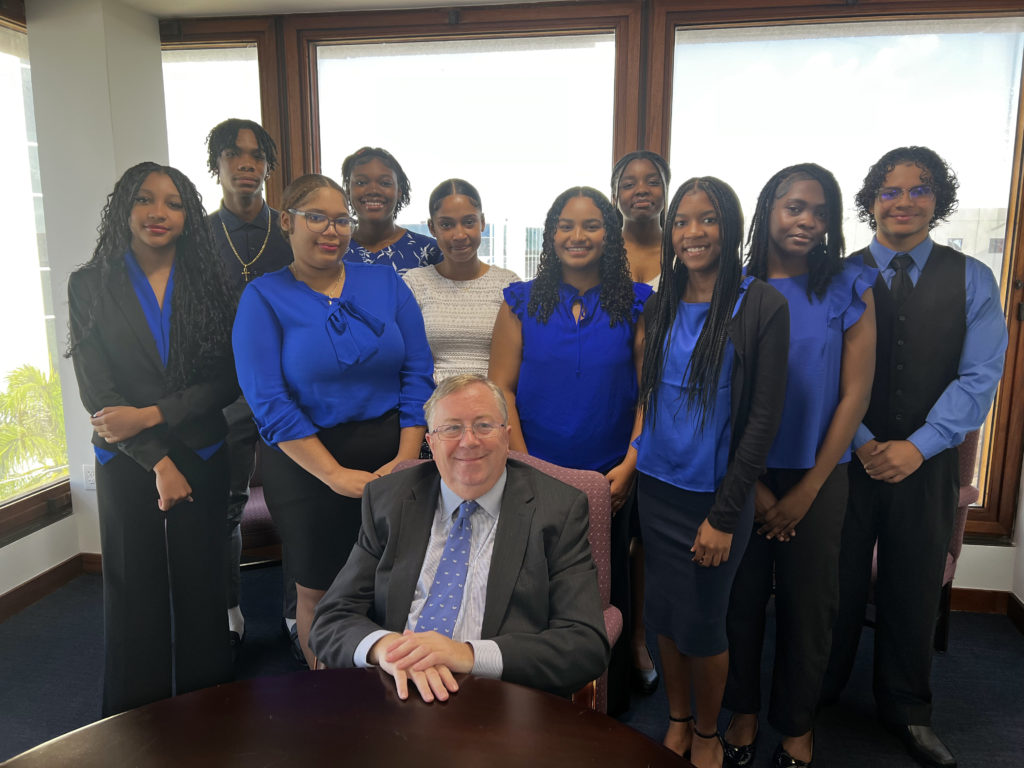
Photo: Huw Moses (HSM Managing Partner) seated in front of HSM interns. (L-R): Mia-Ariel Torres Gordon, Dimitri Seymour, Jureimi Monotero, Tianna McKenzie, Sonia Kimball, Allison Coe, Maria F. De La Cruz Ramirez, Shenae Peters, Alica Allen and Diego McLaughlin
The HSM Group was featured recently in the Legal 500 2026 Caribbean rankings.
HSM Chambers, a full-service law firm, received rankings across multiple practice areas for their expertise in the Cayman Islands and are highlighted below with some of Legal 500’s commentary:
- Real Estate: HSM’s real estate team advises local and international developers and institutions on all stages of commercial and residential projects, from land acquisitions and pre-construction contracts through to completion. The practice also handles retail, landlord and tenant, financing, planning, and strata corporation matters. Linda DaCosta brings over 25 years of Cayman property experience and notable litigation expertise.
“HSM are willing to take on difficult and challenging tasks and work around the clock to get them completed.”
“‘HSM continuously and consistently provides exceptional client service for all the real estate deals they have advised me on. The team is very responsive and provides practical solutions to any challenges faced in any transaction. Highly recommended team.”
- Corporate and Commercial: HSM advises on the incorporation and operation of Cayman corporate entities, drafting a wide range of commercial documents, including service agreements and purchase agreements. Practice head Christian Victory is experienced in entity formation, structuring, licensing, M&A, and supports clients with governance, regulatory compliance, and reporting requirements.
“HSM Chambers distinguishes itself through its deep local expertise, responsiveness, and practical, solutions-oriented approach. What sets their regulatory and corporate team apart is their ability to combine strong technical knowledge of Cayman law with a clear understanding of the commercial and operational realities faced by investment management firms.”
- Private Client: HSM’s private client and trusts team advises on both contentious and non-contentious trust and estate matters, alongside a full suite of services for high-net-worth individuals. The team frequently works in tandem with its immigration practice to assist clients relocating to the Cayman Islands. Robert Mack leads the group and is highly experienced across the full spectrum of private client and trust work, including discretionary, fixed interest, and charitable trusts.
HSM IP Ltd. provides worldwide Intellectual Property (IP) services and is once again a ranked firm for their cross-Caribbean expertise:
- Intellectual Property: HSM IP has long-standing experience managing IP portfolios for numerous Fortune 500 companies and Forbes top 10 businesses, supported by its deep regional knowledge and established presence. Offering full-service IP protection, the team advises on the entire lifecycle of intellectual property assets, ensuring comprehensive solutions for brand holders.
“We use HSM on the regular for work in the Caribbean. They do amazing work, are very communicative, understand our business, and are just good people,” as well as “‘The team are responsive, friendly, and helpful.” HSM IP Senior Manager Mrinali Menon has retained her Leading Associate ranking. Huw Moses, Mrinali Menon and Kate Cleary lead the HSM IP team and are well versed in IP strategy and management. Testimonials also highlighted Kate by sharing “Kate Cleary is always very personable, knowledgeable, and helpful.”
The Legal 500 has been analysing the capabilities of law firms across the world for more than 30 years. Law firms and attorneys are ranked by thorough research processes and are highly credited if featured.
Thank you to our valuable clients for recommending us and to the researchers at The Legal 500 for recognising our efforts.
With the publishing on Friday (17 October 2025) of the proposed new Immigration Bill, numerous clients have sought advice/reassurance that they will not be adversely affected by any proposed changes. Like with any change in legislation, there will be those who will be more affected than others but in the main it appears that the proposed changes will not be as severe as some had feared.
The previous Government published a white paper of proposed legislative changes in January of this year and while there are changes to those proposals, there are similarities. The Immigration (Transition) (Amendment and Validation) Bill 2025 was gazetted on Friday, 17 October 2025 and is open for public for consultation until 14 November 2025.
There will be for instance:
- No proposed term limit of 10 years.
- No proposed two-year rollover.
- There will be no blanket ban on work permit holders changing their employment.
It is however proposed that:
- The time that an individual can obtain the Right to be Caymanian (“Caymanian Status”) by Naturalisation be extended to 20 years resident in the Cayman Islands or 10 years post naturalisation.
- Residency and Employment Rights Certificates (“RERC”) whether obtained through marriage to a Caymanian or a PR holder will not be Permanent Residency and will be time barred.
- Certain Immigration certificates obtained by marriage can be revoked on the basis of reasonable suspicion, which is a lower standard of proof than the balance of probabilities.
And these were proposed under the previous Government.
What is noticeable however is that the transitional provisions make it clear that:
- Those individuals who currently have a pending PR / Residency and Employment Rights Certificate (“RERC”) application will be assessed and awarded PR if successful under the current Act.
- Those people who have started on the path to obtaining Cayman Status, i.e.
- Those people who have applied for a RERC and currently have a Permission to Continue Work.
- Those people who have a RERC granted under the current or earlier law.
Will be able to apply for the Right to be Caymanian as the law currently stands. Therefore, if you have been granted an RERC or if you have applied for one, you will be able to obtain Cayman Status after being naturalised if you have been resident in the Cayman Islands for 15 years as opposed to the proposed 20 years.
It is therefore vital that those people who can apply for an RERC now should apply before the change in the Law so that they can take advantage of the transitional provisions.
One of the greatest issues with the current (and the previous) consultation is that the “meat” of the changes will no doubt be found in the Regulations which accompany the Act. It is clear that the current proposed changes envisage changes to the Regulations. However, those Regulations have not been provided for public consultation. This is an issue, and it is not clear why these proposed Regulations have not been published.
While, a view might be that Regulations are not often consulted upon, in an Immigration context, and when those Regulations will be so important it is believed that they should be published in this case.
Recently there have been a number of decisions by the Deputy Governor’s Office to deny individuals applications for Naturalisation. Those decisions have fallen into two distinct categories. Firstly, those applicants who are students outside of the Cayman Islands and are yet to return to the Cayman Islands. The second decision we have seen relates to an individual who after successfully appealing against the rejection of their Permanent residency application had to wait more than 15 months to obtain his Residency and Employment Rights Certificate (RERC).
Category 1
Young adults who attend school outside of the Cayman Islands while possessing an RERC or even after extending their Right to be Caymanian on the basis of entitlement, are perhaps the most integrated into Caymanian society but that does not mean that they will be naturalised as a British Overseas Territory Citizen with a Connection to the Cayman Islands. The vast majority of the individuals will have spent their formative years in Cayman, they will have a number of Caymanian friends, they may even speak with a Caymanian accent. Equally, their home most probably will be in the Cayman Islands with their parents and perhaps their siblings.
Due to the fact that they are attending a University outside of the Cayman Islands, they will more than likely have spent more than the permitted 90 days outside of the Cayman Islands. The British Nationality Act 1981 requires an individual be a settled resident of the British Overseas Territory and further places certain conditions on the application. The applicant cannot be outside of the Cayman Islands for more than 90 days in any one calendar year (including the year prior to the application) or more than 450 days in a period of five years. However, exceptions can be made depending on the circumstances.
Unlike the majority of Immigration decisions in the Cayman Islands, where there are no published policies, there are a variety of policies published by the UK Home Office for applications for Naturalisation. However, the policy for how the Deputy Governor should exercise his discretion in regards to making an exception for absences of over 90 days in any one year (including the year prior to the application) and 450 days over a period of five years does not provide definitive guidance.
The policy states:
“The process for assessing if the statutory requirements are met will vary for territory to territory. However, for consistency, you may wish to refer to the guidance on naturalisation as a British citizen.”
Up until recently, the Deputy Governor’s Office took the view that those students who were attending higher education outside of the Cayman Islands had a reasonable explanation for why they were outside of the Cayman Islands for more than 90 days / 450 days and therefore exercised that discretion to grant the application.
This seemingly is no longer the case and we have seen a number of applications from students rejected in recent months. At no time, prior to the decisions has the Deputy Governor’s Office notify applicants or Immigration Service providers that they were going to change their approach or policy when processing these applications.
In an attempt to be consistent with the UK, the Deputy Governor’s office is seemingly applying a British policy to the Cayman Islands, despite the ability to exercise discretion, which is wholly unsuitable to the Cayman Islands.
The UK policy sets out that where an individual has absences greater than that set out in the UK policy the decision maker is able to exercise their discretion when the applicant has established their family in the UK and one of the following applies:
- at least 2 years residence (for applications under section 6(1)), or 1 year (for applications under section 6(2)), without substantial absences immediately prior to the beginning of the qualifying period – if the period of absence is greater than 730 days (for section 6(1)) or 450 days (for section 6(2)) the period of residence must be at least 3 or 2 years respectively.
- the excess absences are the result of:
-
- postings abroad in Crown service under the UK government or in service designated under section 2(3) of the British Nationality act 1981.
- accompanying a British citizen spouse or civil partner on an appointment overseas.
- the excess absences were an unavoidable consequence of the nature of the applicant’s career, such as a merchant seaman or employment with a multinational company based in the UK with frequent travel abroad.
- exceptionally compelling reasons of an occupational or compassionate nature to justify naturalisation now, such as a firm job offer where British citizenship is a statutory or mandatory requirement.
- the applicant was prevented from being in the UK because they had been removed from the UK, and the decision to remove them was later overturned.
- the applicant was incorrectly prevented from resuming permanent residence in the UK following an absence.
- the excess absences were because the applicant was unable to return to the UK because of global pandemic.
By the Deputy Governor following the above and applying it in a Cayman context, students are finding that their applications are being rejected. The fact that none of exceptions in the UK policy would apply to students is perhaps not surprising. The United Kingdom has over 260 higher education institutions and therefore there is no need to for an applicant for British Nationality to leave the UK to obtain the education they want. The Cayman Islands has far less and in many cases the Cayman Islands does not offer the courses that some people want. Despite this flaw the Deputy Governor’s office has now started to apply this narrow criteria.
Equally, the policy that is being applied to individuals who are absent for more than 100 days in the year prior to the application also means the chances for a student studying outside of the Cayman Islands and being successful in their naturalisation application are equally slim.
Whilst the Deputy Governor’s Office is saying that the student can apply when they return to the Cayman Islands, this offers little comfort to those who wish to be Naturalised as soon as possible. This is particularly true as it is unclear as to whether the individual has to wait a year and ensure that their absences fall below 90 days during that year period.
It would therefore seem that the unintended consequence of the Deputy Governor’s office is disenfranchise those Permanent Residents / RERC holders who have the strongest connections to the Cayman Islands from being naturalised.
Category 2
Last month, HSM Chambers were informed that a client who applied for Naturalisation did not meet the necessary criteria, as he had not had Permanent Residence for a year. This is a requirement of the British Nationality Act but can be waived. Since 2017, the Deputy Governor’s office, has waived this requirement when an individual has been waiting for over 15 months for a decision on their Permanent Residence application, including time spent successfully appealing the rejection, of an Permanent Residence application.
We were very surprised recently to learn that the Deputy Governor’s Officer were no longer abiding by this policy and they had unilaterally withdrawn it without consulting anyone or notifying the relevant persons. Perhaps what makes the decision even more egregious is that that UK Policy which the Department are now following (in regards to Students) states that in circumstances where “the applicant made an application for Indefinite Leave to Remain (Permanent Residence in Cayman) at least 15 months before the citizenship application, and was granted following a delay which was not their fault”, the 12 month period can be waived. It therefore appears, absent an explanation, one which has not been provided, the Deputy Governor’s Office is taking inconsistent approaches to applying the UK Policies in the Cayman Islands.
Conclusion
The current situation surrounding Naturalisation decision making is unsatisfactory. Those people with the strongest ties to the Cayman Islands are having applications rejected on the basis of a policy which does not take into account their own specific circumstances and the specific circumstances in the Cayman Islands, i.e. the limited courses available in the Cayman Islands and limited places. Equally, those people who could take advantage of a policy contained with the same document are being prevented from doing so, for reasons not clear to us. One thing is sure, if these issues continue, legal action will follow.
We would strongly urge that a clear and comprehensive policy is made available for all to see. This policy would have to be produced in agreement with the UK Home Office and take into account the special and unique circumstances of the Cayman Islands and other British Overseas Territories.
Latest Statistics
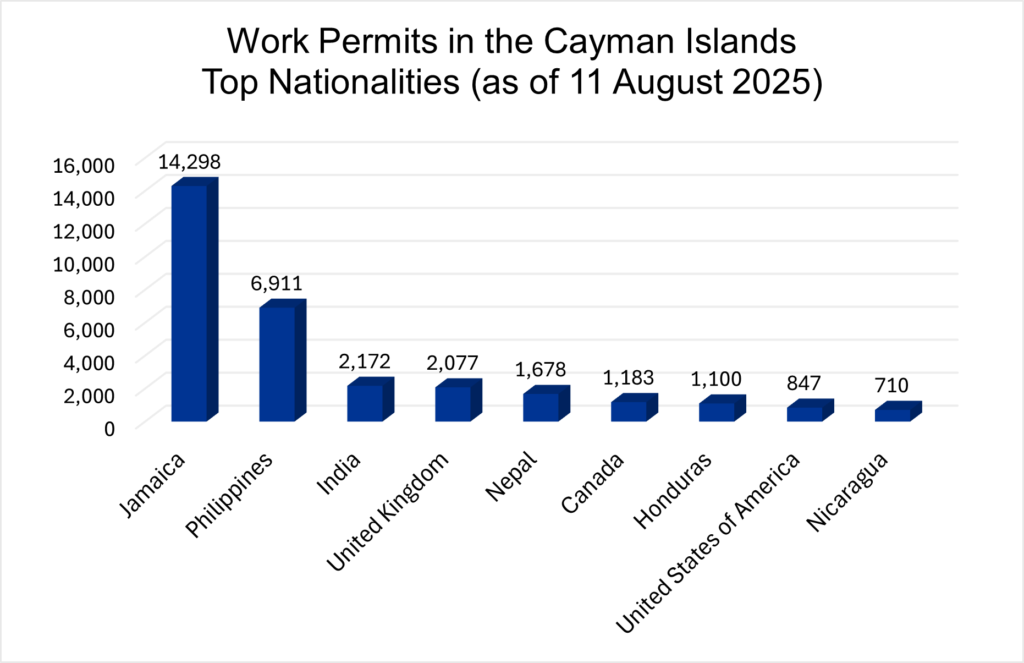
As at 11 August 2025, there are 37,262 work permits held in the Cayman Islands.
The top nationalities continue to be: Jamaica (14,298), Philippines (6,911), India (2,172), United Kingdom (2,077), Nepal (1,678), Canada (1,183), Honduras (1,100), United States of America (847) and Nicaragua (710).
Interestingly South Africa is nearing the top 10 nationalities with 686 permits.
From 1 January 2025 through 22 September 2025, the Board reviewed the following Right to be Caymanian (“RTBC”) applications:
- 221 RTBC applications on the basis of naturalisation.
- 124 RTBC applications on the basis of marriage.
Processing times from application to the notification of the result of the application continue (based on matters we are handling) remain consistent. We are currently advising clients to expect the following approximate processing times:
- Right to be Caymanian applications – 6-8 months.
- PR point based applications – 10-12 months.
- Naturalisation applications – 10 months.
- Variations to PR – up to 6 months.
- RERC as spouse of a Caymanian – up to 6 months.
- RERC as Spouse of a PR holder – up to 6 months.
- Work Permit grant – 12 weeks.
- Work Permit renewal – 12 weeks.
- Variations to work permit – between 3-6 months.
Merary Eden successfully completed her articles at HSM and is now a qualified attorney having been called to the Cayman Islands Bar on 16 September 2025.
Merary’s admission was moved by HSM Partner, Alastair David, who summarised her qualifications for Honourable Chief Justice Margaret Ramsay-Hale.
Addressing the Court, Merary shared, “HSM has been more than just a place to complete my articles. Their mentorship has developed me into the attorney you see today. I am grateful for their support.”
Merary joined HSM in July 2022 as a paralegal for the firm’s debt collection and litigation practice. She graduated from the University of Liverpool in July 2022 with a Bachelor of Laws Degree (Honours) (Class 2 Division 1) and prior to that she attained a Master of Business Administration Degree from the University of Tampa. Merary also attained a Professional Practice Course (Commendation) from Oxford Brookes University, which is affiliated with the Truman Bodden Law School in the Cayman Islands.
Merary will be joining HSM as an Associate where she will be assisting in both the Property practice alongside HSM Partner Linda DaCosta, and the Corporate and Commercial practice alongside HSM Partner Christian Victory. By working across both areas, Merary will contribute to the seamless service that supports our clients’ business and personal needs.
Managing Partner, Huw Moses, OBE notes, “We congratulate Merary on this significant milestone and are pleased to see our firm grow with the addition of another qualified Caymanian professional.”

Photo (L-R): Alastair David (HSM Partner and Merary’s Principal), Huw Moses (HSM Managing Partner), Honourable Chief Justice Margaret Ramsay-Hale, Merary Eden (HSM Associate) and Linda DaCosta (HSM Partner)
The HSM Group is proud to share its outstanding success where it achieved gold medals across multiple categories:
- Law Firm
- Immigration Law
- Estate Law
- Family Law
The Best of Cayman Islands is a vote-based contest focusing on and highlighting the best businesses, companies, groups, locations, items and services in Cayman Islands. The 2025 awards were announced on 11 September 2025.
We are honoured to be awarded in these categories,” shares HSM Managing Partner Huw Moses. “These gold medals reflect the expertise, hard work and dedication of our team as well as the trust our clients place in us.”
HSM’s recognition across multiple categories reinforces its reputation as Cayman’s go-to law firm. The HSM Group is comprised of HSM Chambers, HSM Corporate Services Ltd. and HSM IP Ltd. With expertise across all areas of law, the HSM team works collaboratively across service areas to deliver the highest level of service to clients.
This is also the third year in a row that HSM has won a gold medal for Immigration Law by Best of Cayman. Adding to this milestone, HSM’s Immigration Team recently welcomed two former interns into full-time roles, reinforcing the firm’s commitment to supporting local talent.
HSM is pleased with this recognition and extends its sincere thanks to their clients, staff and the wider community for taking the time to vote. Congratulations to the HSM Group for its commitment to delivering legal excellence and providing clients with a comprehensive service.
The HSM Group specialises in Immigration, Employment, Corporate and Commercial, Family, Property, Litigation, Restructuring, Insolvency, Private Client, Debt Solutions and Intellectual Property.
Fatal error: Uncaught Error: Call to undefined function twentythirteen_paging_nav() in /home/clients/d17af2243e6f179e393695ba6e9ce04e/hsmnew/wp-content/themes/hsm/category.php:31 Stack trace: #0 /home/clients/d17af2243e6f179e393695ba6e9ce04e/hsmnew/wp-includes/template-loader.php(86): include() #1 /home/clients/d17af2243e6f179e393695ba6e9ce04e/hsmnew/wp-blog-header.php(19): require_once('/home/clients/d...') #2 /home/clients/d17af2243e6f179e393695ba6e9ce04e/hsmnew/index.php(17): require('/home/clients/d...') #3 {main} thrown in /home/clients/d17af2243e6f179e393695ba6e9ce04e/hsmnew/wp-content/themes/hsm/category.php on line 31