Category Archives: HSM LAW
The HSM Group is proud to once again offer a legal internship for the 2024/25 academic year in partnership with the Cayman Islands Further Education Centre (CIFEC).
The team at HSM has welcomed 10 interns: Ahmoya Morrison, Nashla Evans McCoy, Shannell Pinnace Stewart, Alrick Peddie Jr, Rhynnia Rattary, Malachi Green, Samiya Wood, Jayden Nembhard, Azaria Ruiz-Bodden and Claudia Garcia Guerrero.
HSM is a full-service law firm and corporate services provider, which offers students the ability to gain experiences across a wide-range of practices including immigration, debt collection, intellectual property, corporate services and even areas outside of law, such as finance and marketing.
These students were interviewed at the CIFEC Careers Fair on 4 October 2024. HSM participated at this fair with a booth, which gave students an opportunity to learn about HSM as well as make a formal application.
As part of the CIFEC curriculum, the internship runs from October 2024 until April 2025 and each student attends work twice a week during school hours. When the programme ends, there may be opportunities for some students to attain a summer work placement or full-time employment at HSM.
HSM Managing Partner, Huw Moses OBE shares: “Our internship programme has been enjoyable and incredibly successful over the years, offering young professionals the chance to learn, contribute and set the foundation for their careers.”
HSM has supported the CIFEC Internship Programme since 2012 and also offers sponsorship opportunities for further education. HSM employs several CIFEC graduates full-time.

Photo: Huw Moses (HSM Managing Partner) seated in front of HSM interns. (L-R): Ahmoya Morrison, Nashla Evans McCoy, Shannell Pinnace Stewart, Alrick Peddie Jr, Rhynnia Rattary, Malachi Green, Samiya Wood, Jayden Nembhard, Azaria Ruiz-Bodden and Claudia Garcia Guerrero
As a result of a recent Freedom of Information request to Customs and Border Control (“CBC”) it has come to the attention of HSM Chambers that as of August 2024 there are 19,607 people who are currently subject to a Stop List held by CBC.
Stop Lists and Persona Non Grata (“PNG”)
The establishment of a Stop List is required as per Section 108 of the Customs and Border Control Act (2022 Revision) but seemingly should only apply to Prohibited Immigrants. However, from the information provided to HSM Chambers, the Stop List includes other groups of individuals which it would appear that the Law did not envisage should be included.
Of the 19,607, there are 3,412 Prohibited Immigrants but also 13,766 who have been declared Persona Non Grata (“PNG”), and even more surprisingly 60 Permanent Residents and 412 Caymanians or those who hold Caymanian Status. It is not immediately clear how a Caymanian (or a Permanent Resident) can be on the Stop List (and therefore potentially prevented from coming to the Cayman Islands). As a matter of law they cannot be Prohibited Immigrants because they are specifically excluded from this designation by the relevant legislation. We suspect that these people may have been placed on this list prior to them obtaining the relevant permissions they are now shown as having.
Amusingly (but perhaps not for their families) there are 11 deceased individuals (Immigration status unknown) who are listed in a category of their own on the Stop List, who presumably are not considering returning to the Cayman Islands in the near future (unless duppies are crossing our borders), but they presumably are prevented from being buried here or having their bodies or ashes brought here. We suspect that this is just an administrative mechanism to record the death of a person previously alive and on the Stop List.
The category of PNG does not only refer to those diplomats who have been asked to leave the Cayman Islands but also can include:
- People who have opted to be administratively fined.
- Persons who have been convicted of an offence (anywhere in the world) and been sentenced to imprisonment.
- People who have overstayed in the Cayman Islands.
The PNG policy that the CBC operates does not appear to be published. Reliance upon it by the Department, potentially could lead to challenges especially for those who accept an administrative fine rather than challenge the allegation that they have breached the Immigration Act in some way.
It certainly does not appear that WORC specifically warn an individual who is considering accepting an administrative fine that they might well be prevented from coming to the Cayman Islands again.
It is recommended that if an individual who considers they are on the Stop List or that they may be placed on the Stop List upon arrival in the Cayman Islands, to contact the Director of CBC ahead of time and request that they are permitted entry into the Cayman Islands so as to ensure no disappointment upon arrival.
Latest Statistics
As at 31 October 2024, there are 37,678 work permits held in the Cayman Islands. This is an increase of 344 work permits from the number reported to us as at 21 August 2024.
The top nationalities are: Jamaica (15,244), Philippines (6,678), India (2,133), United Kingdom (2,076), Nepal (1,399), Canada (1,199), Honduras (1,149), United States of America (892) and Nicaragua (706).

While the countries remain the same from our last update, there were some fluctuations from our last update. The countries that experienced a decrease in work permits were: Jamaica, Honduras, United States of America and Nicaragua. The countries that experienced an increase in work permits were: Philippines, India, United Kingdom, Nepal and Canada.
In October 2024 the Board determined 336 Right to be Caymanian (“RTBC”) applications and of that were:
- 84 RTBC applications on the basis of naturalisation.
- 49 RTBC applications on the basis of marriage.
- Right to be Caymanian applications – up to 6 months.
- PR point based applications – up to 12 months.
- Variations to PR – up to 6 months.
- RERC as spouse of a Caymanian – up to 6 months.
- RERC as Spouse of a PR holder – up to 6 months.
- Work Permit grant – 12 weeks.
- Work Permit renewal – 12 weeks.
- Variations to work permit – between 3-6 months.
HSM is supporting a charity campaign called Chickstarter. Chickstarter is a satirical business incubator raising money for six Cayman charities.
This campaign (or rather game) has been created by Massive Media Ltd. and is running from 21 November 2024 until 8 December 2024.
There is no cost to participate whatsoever.
HSM has sponsored Rotary Club of Grand Cayman’s rooster, Ralph McFeatherbutt. You can read all about him here and see his striking photo below.
How can you help? Create your free account on https://www.chickstarter.ky/.
You will automatically receive 10,000 chickcoin. Playfully using chickens, each charity has a unique rooster in which the public can donate chickcoin to and ultimately the chickcoin decides how much real money each charity will receive.
Also, at the end of the campaign, 10 users will be drawn at random to win a month’s supply of local farm produce from Cayman’s very own Farmer Clarence.
Help us raise money for the Rotary Club of Grand Cayman and have fun playing.

The HSM Group was featured recently in The Legal 500 2025 Caribbean rankings.
Our intellectual property practice, HSM IP, is a ranked firm for their cross-Caribbean expertise. Citing The Legal 500 website, they shared: “This is a very responsible firm. With a high commitment to take care of its clients’ trademark interests with an almost personalised follow-up.”
For the first time, HSM IP Senior Manager Mrinali Menon has been individually featured. The Legal 500 provided this client testimonial: “We have been working on an important case for one of my clients with Mrinali Menon and her dedication to achieve the expected result is admirable. she is a very prepared professional with a high knowledge of her field.” Mrinali joins managing partner of the IP group Huw Moses, and Kate Cleary, who is well versed in IP strategy and management.
HSM Partner Christian Victory has also been individually ranked once again for Investment Funds (Cayman Islands). Christian has over 20 years of legal experience and is well-respected in the industry. He is knowledgeable in all matters relating to Cayman Islands funds and investment services, including the formation and establishment of, and on-going advice to mutual funds and hedge funds, master-feeder structures and the formation of stand-alone vehicles.
The Legal 500 has been analysing the capabilities of law firms across the world for more than 30 years. Law firms and attorneys are ranked by thorough research processes and are highly credited if featured.
Thank you to our valuable clients for recommending us.
On 31 July 2024, the Beneficial Ownership Transparency Act 2023 (the “Act”) came into force in the Cayman Islands which compels every Cayman Islands entity[1] (an “Entity”) to (a) maintain a register of beneficial owners in conjunction with their corporate service providers (b) to review and verify the information provided is accurate and (c) to report details of such beneficial owners to the competent authority[2] on a monthly basis. While these changes are now in force, industry has until 1 January 2025 to comply before enforcement commences[3]. HSM Partner Robert Mack explores how the Cayman Islands Beneficial Ownership regime impacts private wealth structures.
While the previous beneficial ownership regime has been in place since 2017, the recent changes contained in the Act expand the scope to capture a wider range of legal persons, including limited partnerships, exempted limited partnerships, private trust companies and foundation companies. There are also new requirements to describe the nature of the ownership or control of an entity and to confirm the nationality of any beneficial owner. Trusts, however, remain out of scope. That said, it is very common for trust structures to contain at least one Entity to act as a holding vehicle for trust assets. A simple example of such a trust structure appears below:
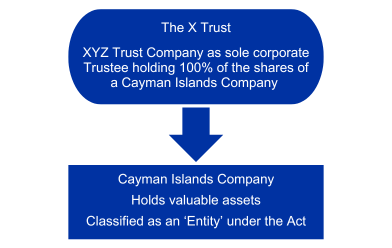
The Act requires all beneficial owners of an Entity to be identified and reported on a monthly basis via a secure online government portal[4]. In scenarios where a trust structure contains one or more Entities there are four possible outcomes:
- If a trustee owns a minimum of 25% of the shares of an Entity or 25% or more of the voting rights / partnership interests of an Entity such trustee will be classified as a (or the) beneficial owner.
- If a trustee exercises control of an Entity it will be classified as a beneficial owner.
- If an individual, not being the trustee, owns more than 25% of the Entity or 25% or more of the voting rights / partnership interests such individual will be classified as a (or the) beneficial owner.
- If an individual, not being the trustee, exercises control over the Entity by some means, such individual will be classified as a beneficial owner.
Ascertaining the ownership of an Entity should usually be quite straightforward. If the Entity is a company, any shareholder owning 25% or more of the shares of such Entity will be a beneficial owner. For partnerships, any person holding voting rights or partnership interests in excess of the 25% threshold should qualify as a beneficial owner.
Ascertaining which person or persons ‘controls’ an Entity is not always straightforward where a Cayman Islands trust is involved at the top of the structure either. This will require an analysis of the trust instrument itself as well as an examination of the circumstances surrounding the administration of the trust or Entity.
All Cayman Islands trusts fall into three distinct categories for these purposes:
- Trustee controlled. This means all powers contained in the trust instrument are vested in the trustee alone allowing such trustee to exercise shareholder or related powers for any underlying Entities in the structure as they see fit. In such a scenario the trustee should be identified as the beneficial owner of an Entity under the Act[5].
- Trustee fettered. This means some trust powers are reserved to persons other than the trustee. This can be an ‘enforcer’ or a ‘protector’ or some other person, such as the settlor of the trust. In this scenario, such persons may also be classified as beneficial owners of the Entity.
- Trustee usurped. This is where on the face of the trust instrument all of the trust powers are all vested in the trustee, but in practice some other person or persons are actually controlling the administration of the trust from the shadows to include controlling any Entity owned by the trust. Such trusts are sometimes referred to as ‘sham trusts’ and are extremely rare in practice, especially where professional trustees are involved, but there are numerous examples in trust jurisprudence[6]. In this scenario such persons lurking in shadows may in extreme circumstances be classified as a beneficial owner of an Entity.
Trustee Controlled
Assuming the trustee owns 25% or more of an Entity (or in the case of a partnership, 25% or more of the voting rights or partnership rights), it will be classified as a (or the) beneficial owner under the Act and no further analysis is required.
In instances where the trustee owns less than 25% of an Entity (or in the case of a partnership, 25% or more of the voting rights or partnership rights), yet somehow exercises control over an Entity, such trustee should also be classified as a beneficial owner.
Trustee Fettered
Section 14 of the Trusts Act (2021 Revision) allows the settlor of a Cayman Islands trust to reserve a range of key powers to himself or others (“Powerholders”) in the trust instrument. Such powers include powers to:
- Revoke, vary or amend the trusts or powers contained in the trust instrument;
- Appoint income or capital of the trust fund;
- Enable a settlor to reserve a limited beneficial interest in trust property in some manner;
- Act as a director or officer or any company owned by the trust;
- Give binding directions to a trustee concerning the management of trust investments;
- Appoint, add, or remove any trustee, protector or beneficiary;
- Change the governing law and the forum of administration of the trust; and
- Impose consent requirements on the exercise of one or more trustee powers.
An assessment will have to be made on a case-by-case basis whether (or not) one or more of these reserved powers amount to ‘control’ in the hands of a Powerholder for the purposes of the Act. For example, any consent requirements imposed on a trustee over the exercise of their powers would almost certainly amount to ‘control’ according to Regulation 29(3)(c) of the Beneficial Ownership Transparency Regulations (31 July 2024 version).
Trustee Usurped
Highly unlikely to ever occur as it would require a trustee to concede they have relinquished control over the administration of the trust to a non-Powerholder.
In this unlikely scenario, an Entity and the corporate service provider would have to include any such non-Powerholder as a beneficial owner in their reporting.
Foundation Companies
The same concepts applicable to trusts apply equally to foundation companies. Therefore, a careful review of the constitutional documents of the Foundation Company and ownership structure[7] will have to be conducted to ascertain whether there are any Powerholders and, if so, what specific powers are reserved to them. Then a determination will have to be made whether (or not) such reserved powers are sufficient to constitute “ultimate effect control” for the purposes of the Act[8]. Special focus should also be given to the powers reserved to the Supervisor and the Founder.
Private Trust Companies
All private trust companies are in scope under the Act. As such, analysis of the constitutional documents and the ownership structure will now be required. Given that the shares of private trust companies are typically held in private purpose trusts / STAR trusts, the terms of such private purpose trusts / STAR trusts and the conduct of their administration will require careful analysis.
Summary
The steps and time required to accurately comply with the recent changes to the Cayman Islands beneficial ownership regime should not be underestimated especially in light of the looming enforcement deadline of 1 January 2025 (just over eight weeks from the date of this article) and given the consequences for non-compliance can be dire[9].
Trustees should identify any relevant Entities in their trust structures, and then complete the analysis of their trust instruments and surrounding circumstances to ensure their reporting is accurate and complete at the Entity level.
Directors of foundation companies and private trust companies should also conduct a similar exercise with respect to their constitutional documents and ownership structure to include an examination of circumstances surrounding the conduct of the administration of these Entities to ensure accurate reporting.
HSM’s team can assist with the necessary review and coordination of requirements to ensure accurate reporting is accomplished.
Footnotes
[1] Entities include companies, foundation companies, limited liability partnerships, limited partnerships, exempted limited partnerships, private trust companies, and other legal persons as may be prescribed in relevant regulations (none are specified at this moment in time). Trusts are not classified as Entities under the Act.
[2] The competent authority in this case is the Minister of Financial Services, who has delegated this function to the Cayman Islands General Registry.
[3] One change for example appears in Section 8 of the Act requires (subject to certain exemptions) persons who have been identified as beneficial owners to be given notice in writing, and such beneficial owners have a 30-day window to agree (or otherwise) their status as a beneficial owner and to confirm or correct their particulars. This 30-day window will have to be factored into the 1 January 2025 enforcement deadline.
[4] The information stored on this portal is not currently publicly accessible.
[5] This is separate and distinct from usual trust principles. An orthodox trust arrangement requires the trustee to hold legal title to trust property for the benefit of its beneficiaries, and it is the beneficiaries who are considered to be the collective beneficial owners as a matter of equity.
[6] See Rahman v Chase Bank (CI) Trust Co. Ltd [1991] JLR for a particularly stark example.
[7] Most foundation companies are structed as limited by guarantee companies and do not have shares or shareholders. As a result, thought will have to be given as to whether the guarantee members qualify as beneficial owners.
[8] ‘Ultimate Effective Control’ is defined in the Act to include ownership and control exercised through a chain of ownership or (rather cryptically) by means of control other than direct control.
[9] CI$5,000 per breach, with a rolling penalty of CI$1,000 for each month the breach remains unremedied. There is also scope for fines of up to CI$100,000 for repeatedly failing to comply with certain obligations arising under the Act. Non-compliance can also result in an Entity being struck from the Register. There are also possible custodial sentences up to two years for mangers, directors, members or other officers of any non-complaint Entity in certain circumstances.
The HSM Group is pleased to announce that Robert Mack has rejoined HSM Chambers as a Partner to lead the firm’s Private Client practice.
Robert has more than twenty years of experience in trusts and private client matters. He specialises in private and commercial trusts of every description, including discretionary trusts, fixed/life interests trusts, charitable trusts, unit trusts, private purpose/STAR trusts and reserved powers trusts. Robert also has deep expertise concerning the establishment and administration of Cayman Islands foundation companies, wills and estates, and regulatory matters touching on wealth management and the administration of trusts and estates.
Robert advises high-net-worth families, professional service providers, banks, institutional and lay trustees, executors, protectors, enforcers, and foreign attorneys, in both non-contentious and contentious trust and estate matters.
Robert has been consistently ranked by leading directories including Chambers and Partners and Who’s Who Legal in offshore trusts. He is also widely published and his articles have appeared in Trusts & Trustees, the STEP Journal, LexisNexis and the Trust Quarterly Review on a diverse range of topics including the effects of technology on succession planning, Cayman Islands foundation companies and the transmission of digital assets on death.
He has been practicing Cayman Islands law exclusively since 2007. Prior to that he was an English qualified solicitor practicing in London. Robert was a leading Council Member of Cayman’s branch of the Society of Trust and Estate Practitioners (“STEP”) for over twelve years where he held several roles including being a member of the legislative sub-committee which develops and refines the laws of the Cayman Islands in partnership with the Cayman Islands government. He remains an active STEP member in a non-executive capacity.
HSM Managing Partner, Huw Moses, OBE shares: “We are thrilled to welcome back Robert Mack. He is an exceptional private client practitioner that goes above and beyond for clients. We look forward to Robert leading this practice.”

The HSM Group is thrilled to announce that they have recruited two of their interns from the Cayman Islands Further Education Centre (CIFEC) Internship Programme.
Javari Pearson has joined HSM IP Ltd. as an Intellectual Property Assistant and Alanee Morgan has joined HSM Corporate Services Ltd. as a Compliance Assistant. They originally joined the firm as CIFEC interns from October 2023 through April 2024 and recently completed HSM’s 2024 Summer Internship Programme.
In addition to working full-time, they are interested in pursuing further education. Javari is exploring online legal degrees and aspires to become an attorney. Alanee is pursuing an associate’s degree in business administration at the University College of the Cayman Islands.
HSM Managing Partner, Huw Moses OBE shares: “We are excited to have Javari and Alanee join the HSM group as full-time assistants. They have shown great potential during their internship and we are confident they will continue to make a strong impact.”
HSM has partnered with the CIFEC progamme since 2012 and plans to attend the CIFEC Careers Fair on 27 September 2024, where they will interview students for the next internship programme. HSM plans to welcome at least 10 interns next month through April 2025.

Photo (L-R): Shantel Ritch (Javari’s Supervisor and IP Office Actions & Changes Coordinator at HSM IP), Javari Pearson, Huw Moses (HSM Managing Partner), Alanee Morgan and Terek Stewart (Alanee’s Supervisor and Compliance Officer at HSM Corporate Service Ltd.)
HSM is pleased to announce the promotion of Alastair David to Partner at HSM Chambers, effective 13 September 2024.
Alastair has specialised in immigration and employment law in the Cayman Islands since he joined HSM in 2016. Alastair advises on all aspects of those laws with a specific focus on contentious matters. Alastair has represented clients before the Labour Tribunal and Labour Appeals Tribunal with respect to employment issues and has represented clients before the Summary Court, Grand Court and Court of Appeal with respect to immigration matters in the Cayman Islands. Prior to joining HSM, Alastair practiced as a Barrister in the UK for 10 years.
Throughout Alastair’s career, he has been passionate about Human Rights, advocating for fair treatment and justice for individuals navigating complex legal issues. His dedication has been a driving force behind notable cases, which include a domestic violence victim challenging Cayman’s immigration law and another case where the Court of Appeal declared that Cayman’s Immigration Act is incompatible with section 9 of the Bill of Rights, which deals with the right to a family and private life.
HSM Managing Partner, Huw Moses, OBE shares: “I have no doubt that Alastair will make an excellent addition to the partnership at HSM. His contributions and expertise in navigating contentious matters continues to elevate our practice and benefit our clients.”
While a trusted advisor for permanent residency, immigration appeals and reconsiderations, Alastair also advises on race discrimination, disability discrimination, sex discrimination, unfair dismissal, protected disclosures and breach of contract.
Recently, we were faced with two individuals whose Permanent Residence applications were rejected. Both of these applications were, in our mind, applications which should be granted and therefore the fact that they were not granted surprised us. Upon reviewing the points which they had been awarded, it appeared to us that there were clear errors made in assessing the applications which if resolved in our clients’ favour would lead to the award of Permanent Residence to them.
Our clients were then faced with the decision of whether to appeal the decisions or to ask for a reconsideration of their decisions. There is no formal reconsideration process, and we believe that it should only be used in situations where there is a clear administrative error. In both of these cases reconsideration requests were made and approved prior to the time limit for any appeal to be filed expiring.
In some cases, reconsideration requests are not appropriate, however in these cases the Department exercised their discretion in a reasonable manner and accepted the submissions we made and in doing so our clients not only obtained Permanent Residence in a far quicker manner than they eventually would via an appeal but incurred less legal fees.
Latest Statistics
Currently there are 37,334 work permits held in the Cayman Islands. This is an increase of 25 work permits from the number reported to us as at 17 July 2024.
The top nationalities are: Jamaica (15,427), Philippines (6,463), India (2,081), United Kingdom (2,024), Nepal (1,246), Canada (1,197), Honduras (1,172), United States of America (919) and Nicaragua (715).

Most of the top 10 nationalities increased in work permits, however; there was a slight reduction in work permits held by Indians by 11 and Nicaragua by 5.
In June 2024 the Board determined:
- 138 Right to be Caymanian (“RTBC”) applications on the basis of naturalisation.
- 58 Right to be Caymanian applications on the basis of marriage.
- Right to be Caymanian applications – up to 12 months.
- PR point based applications – up to 12 months.
- RERC as spouse of a Caymanian – between 3-6 months.
- RERC as Spouse of a PR holder – between 3-6 months.
- Work Permit grant – 12 weeks.
- Work Permit renewal – 12 weeks.
- Variations to work permit – between 3-6 months.
HSM Wins Gold Medal for Immigration Law by Best of Cayman 2024
HSM’s immigration team has been recognised for the second consecutive year with a gold medal by the Best of Cayman Islands for their 2024 awards. Our team handles everything from work permit applications to the right to be Caymanian to permanent residency and everything in between, including relocation assistance, registration as a British Overseas Territory Citizen and passport applications. Should a matter become contentious, we can assist our clients with court proceedings.
The Best of Cayman Islands is a vote-based contest and nominations are provided by the community. This recognition is a testament to HSM’s high-quality immigration support in the Cayman Islands and personal attention to our clients.
HSM is thrilled to be featured again and thanks our clients as well as the public for their votes.
Succession laws in the Cayman Islands are based on the principle of testamentary freedom, which means that a person can, if not incapacitated, choose how their estate is dealt with after their passing, but only if they have a properly drafted and valid Will in place. If a person dies without a Will in place, then they will be considered to have died “intestate” and their assets will be passed on in accordance with the applicable rules and proportions set out in relevant provisions of the Succession Act (2021 Revision). However, the beneficiary entitled to receive the assets under this legislation may be a person that you do not wish to inherit your assets.
Benefits of a Will
As the saying goes “you can’t take it with you”, but with a properly drafted Will you can at least decide what you wish to happen to “it”, whether it be moveable or immovable property.
A properly drafted and validly executed Will allows you to document your wishes and appoint a trustworthy representative, known as an executor, who will be responsible for administering your estate and giving legal effect to your last wishes. Having a formal Will in place may help to avoid the additional costs associated with dealing with an intestate estate.
Another benefit of a properly drafted Will is the ability to incorporate a testamentary trust allowing you to decide when a beneficiary is able to take control of the estate assets. This type of trust is particularly useful in situations where a beneficiary is a minor and may not be mature enough to receive and manage a vast amount of inheritance.
Formalities of a Cayman Will
In the Cayman Islands, the validity of a Will depends on strict compliance with the relevant statutory requirements as set out in section 6 of the Wills Act (2021 Revision).
Broadly speaking, for a Will to be valid:
1. the person making the Will, known as the testator, must be of sound mind, at least 18 years of age, and must not be under any undue influence or coercion whilst making the Will.
2. it must be in writing;
3. the testator (or by some other person at their direction) must sign the end of the Will;
4. the testator must sign the Will or acknowledge their signature in the presence of two witnesses present at the same time. Importantly, these witnesses should not be the beneficiaries; and
5. the witnesses must attest and subscribe the Will in the presence of the testator.
Whilst some of the requirements appear straightforward, there are plenty of pitfalls in the drafting, signing and execution process which could result in the Will being deemed invalid or challenged during the probate process.
Whilst it is always recommended to create a Will using your legal name, it can be possible to find a Will legally valid if the Testator uses a name that doesn’t match their legal name. In the recent decision of Smith v Smith et al -G 135 of 2020 the Honourable Justice Asif K.C. ruled on 12 June 2024 that:
“the crucial features for a will to be valid are the identification of the testator, however that is done, coupled with the testator’s intention that the document shall have testamentary effect.”
In this particular case the Testator created the Will using a name that was different from his legal name (he added his stepfather’s surname to his own). The Court found that even though it wasn’t his legal name, it was easy to show that the Will was valid because it was a name that he was known to use, and he was easily identifiable through other means.
Other issues which ought to be considered include the location of the estate assets and/or whether the testator is domiciled in the Cayman Islands, as legal advice may be required from other jurisdictions.
Pursuant to the Formal Validity of Wills (Persons Dying Abroad) Act, 2018, the legislation requires individuals domiciled outside of the Cayman Islands to execute a valid foreign Will dealing with movable property with a Cayman Islands connection such as shares in a Cayman Islands company as long as certain conditions are met.
Importance of Attorney’s Expertise
Whilst creating a Will might seem straightforward, the expertise and guidance of a qualified attorney are indispensable in ensuring that your final wishes are accurately documented, legally binding, and aligned with the laws of the Cayman Islands.
The Honourable Justice Doyle summed up the position well in his closing remarks in this recent Judgment In the Estate of Robert Michael Hamaty, Deceased – FSD 249 of 2021):
“If there is a lesson to be learnt from this case, apart from the importance and desirability of family unity, it is that it is well worthwhile spending money on practicing lawyers qualified in the relevant jurisdiction to get things right and to ensure that testamentary documents are duly prepared, signed and attested. It is often a false economy to try and undertake important legal matters without the benefit of assistance from duly qualified independent lawyers.”
By seeking professional legal counsel, you provide yourself and your loved ones with peace of mind, knowing that your estate will be handled according to your intentions, thus avoiding potential disputes and legal complications in the future. HSM has extensive private client experience and can assist with preparing, maintaining and executing Wills.
Fatal error: Uncaught Error: Call to undefined function twentythirteen_paging_nav() in /home/clients/d17af2243e6f179e393695ba6e9ce04e/hsmnew/wp-content/themes/hsm/category.php:31 Stack trace: #0 /home/clients/d17af2243e6f179e393695ba6e9ce04e/hsmnew/wp-includes/template-loader.php(86): include() #1 /home/clients/d17af2243e6f179e393695ba6e9ce04e/hsmnew/wp-blog-header.php(19): require_once('/home/clients/d...') #2 /home/clients/d17af2243e6f179e393695ba6e9ce04e/hsmnew/index.php(17): require('/home/clients/d...') #3 {main} thrown in /home/clients/d17af2243e6f179e393695ba6e9ce04e/hsmnew/wp-content/themes/hsm/category.php on line 31