HSM LAW
HSM Celebrates Another Gold-Winning Year at Best of Cayman 2026
The HSM Group is proud to announce its outstanding success in the 2026 Best of Cayman Islands awards, achieving Gold medals across multiple categories: Law Firm Immigration Law Estate Law Corporate Services The Best of Cayman Islands is a vote-based Read more +
HSM Welcomes Three Interns to 2026 Summer Internship Programme
68 Fort Street, Grand Cayman (27 July 2026): The HSM Group is proud to continue its summer internship programme with three young professionals: Dimitri Seymour (Corporate/Compliance), Diego McLaughlin (Intellectual Property) and Alicia Allen (Intellectual Property). HSM’s Summer Internship Programme commenced Read more +
Trump v Barbara: Why Birthright Citizenship Still Matters in Cayman
A U.S. case with a Cayman history behind it At first glance, Trump v Barbara looks like a purely American case. It concerns President Trump’s attempt to restrict birthright citizenship under the United States Fourteenth Amendment. Cayman does not have Read more +
Cayman Islands Immigration Update – June 2026: An Act of Unintended Consequences, New Work Permit Conditions and Statistics
When the Cayman Islands Government proposed changes to the Immigration Law, released last year, there was one change that stood out and that was the proposed changes to Section 64 of the Immigration (Transition) Act (2022 Revision). This was the Read more +
Cayman Islands Immigration Update – June 2026: An Act of Unintended Consequences, New Work Permit Conditions and Statistics
When the Cayman Islands Government proposed changes to the Immigration Law, released last year, there was one change that stood out and that was the proposed changes to Section 64 of the Immigration (Transition) Act (2022 Revision). This was the section requiring work permit holders to leave the Cayman Islands for a year who had left their employment within the first two years of a work permit grant, if prescribed circumstances did not exist.
The consultation regarding Section 64 was largely meaningless without sight of the relevant regulations. How was an Immigration Services Professional to comment on this significant policy change, when it was not clear how this law was going to operate? On 16 April 2026, 2 weeks before coming into force the Caymanian Protection (Amendment) Regulations 2026 were published which sought to set out how the new Section 64 was going to operate.
These Regulations were not subject to consultation and as a result there was no opportunity for Immigration Service Professionals to express their concerns to the Department regarding potential pitfalls and issues.
For example, any application for exemption must be made within three working days of cessation of employment. This poses challenges, which we addressed in our last immigration update. Click here for details.
The Regulations raised more questions than they answered.
- Was the three-day requirement to apply to the Director a hard deadline or could it be extended?
- Whether the new Section 64 applied to existing work permits or only those granted post 1 May 2026
- How would transitional cases operate, i.e. those who ceased employment prior to 1 May 2026, but the application for a new permit was submitted post 1 May 2026.
- Despite requests for clarity being made more than a month ago from HSM Chambers and other immigration practitioners, no response has been received from the relevant authorities in respect to the issues raised in this article.
One such issue, which could have been addressed can be found in the interplay between Regulation 8A and Section 43 of the Labour Act (2021 Revision).
The Structure of Regulation 8A
Regulation 8A permits a work permit holder who “ceases to be employed” to apply to the Director of WORC for exemption from the requirement to leave the Islands before taking up new employment. One of the qualifying circumstances under Regulation 8A(2) is redundancy:
The procedural requirements are onerous. The application must:
- be made within three working days after the employee ceases employment;
- be in writing; and
- be supported by evidence of the relevant circumstance.
- Unlike complaints involving harassment, discrimination or retaliation, redundancy applications do not require proof of a prior complaint to a government authority, although proof of the redundancy will need to be provided.
At first glance, the redundancy ground appears straightforward. In practice, however, complications arise where the employee is not truly losing employment altogether but is instead moving immediately to a successor employer following, for example, a business sale or a restructuring.
Section 43 of the Labour Act
Section 43 of the Labour Act addresses precisely those circumstances.
The provision states that where employment terminates upon a transfer in ownership of a business:
severance pay is not owed if the employee is offered the same employment by a successor employer “without a break in service”; and
continuity of employment is preserved for future severance calculations.
The purpose of section 43 is clear. It avoids artificial severance liability where the employee’s practical employment situation continues uninterrupted despite a technical change in employer identity.
For Caymanian employees and many permanent residents, the operation of section 43 is relatively uncomplicated. They may move seamlessly from predecessor employer to successor employer without interruption to lawful employment.
For work permit holders, however, Regulation 8A complicates matters considerably.
The “Cessation” Problem
A strict reading of Regulation 8A suggests that a work permit holder may only apply for exemption after employment has ceased. The wording is important:
“where a person who is the holder of a work permit ceases to be employed…”
The application must then be filed:
“within three working days after the person ceases to be employed”.
On a conservative interpretation, this means:
- the employment relationship must first terminate;
- only then can the Regulation 8A application be made; and
- only after approval may the employee lawfully commence work with the successor employer.
- If that interpretation is correct, then there is necessarily at least some interruption in employment continuity. The Director does have up to 30 days to decide in respect to a Regulation 8A application.
The problem with the interruption of this continuity is that Section 43 of the Labour Act requires there to be no such break.
That interruption may create an unexpected consequence, namely, severance liability may crystallize because the employee’s service with the predecessor employer has genuinely ended before successor employment begins.
An Unequal Outcome?
This creates a striking anomaly.
A Caymanian or RERC holder may transition directly to the successor employer with no break in service and thus no severance entitlement under section 43.
A work permit holder who has held a permit for less than 2 years, by contrast, may:
- technically cease employment;
- trigger severance entitlement;
- apply under Regulation 8A; and
- subsequently obtain permission to work for the successor employer.
- Ironically, the stricter immigration process may place the work permit holder in a financially better position than the Caymanian employee performing the same role, because severance will have to be paid to that individual.
It is difficult to believe that this was the intended legislative outcome.
Conclusion
The obvious solution to this issue and potentially other issues is to allow the work permit holder to apply for leave to obtain a new employer during their notice period or before their dismissal. This would require Regulation 8A to be interpreted in a more liberal manner than currently drafted but perhaps in a more consistent manner with the Bill of Rights.
For many years, HSM Chambers have raised the issue of insufficient policies and how clear policies are needed. Perhaps, the Department will take the opportunity with the new law and regulations to publish policies which will clarify issues such as the issues raised by the new Section 64 and Regulations 8A, and engage with the immigration practitioners in that process. Employers and employees are left facing uncertainties.
New Work Permit Conditions
Since 1 May 2026, the Department has issued the following condition to the standard conditions found on the last page of the work permit grant.
(3) That the holder of this Work Permit will not be allowed to change his employer during the term of this Work permit except in special extenuating circumstances and with the prior approval of the Board or Director of WORC as applicable.
These conditions are “in part” in line with the new Section 64 of the Cayman Protection Act. However that Act and the associated Regulations make it clear that it is the Director of WORC, not the Board, who makes the decision as to whether or not an individual can change their employment during the first two years of that individual’s work permit.
What is more surprising is that the above condition is found on the standard conditions of work permit renewals where the individual has held a work permit with his/her employer for more than 2 years. It is not clear therefore whether this condition is an accidental addition to work permit renewals or whether the Department are attempting to re-introduce the old Section 64 Regime whereby permission to change employment was needed regardless of the amount of time the work permit holder had been on island.
If it is the case that the Department are attempting to impose a condition like this on all work permit holders then it is fully expected that this condition will be challenged.
Latest Statistics
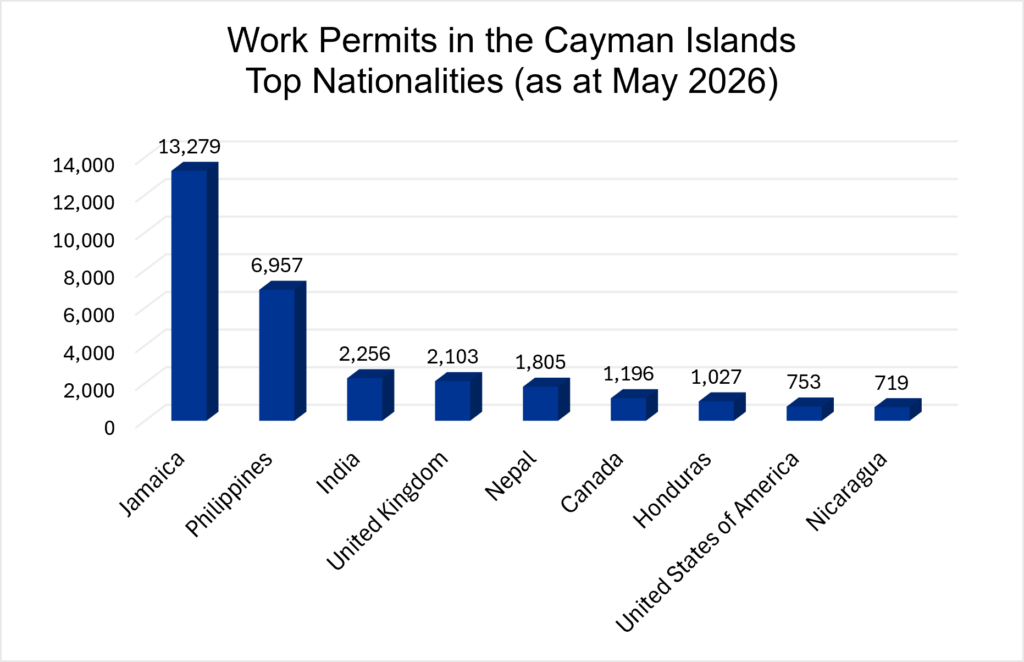
As at May 2026, there are 36,464 work permits held in the Cayman Islands.
The top nationalities continue to be: Jamaica (13,279), Philippines (6,957), India (2,256), United Kingdom (2,103), Nepal (1,805), Canada (1,196), Honduras (1,027), United States of America (753) and Nicaragua (719).
Processing times from application to the notification of the result of the application continue (based on matters we are handling) remain consistent. We are currently advising clients to expect the following approximate processing times:
- Right to be Caymanian applications – 12 months
- PR point based applications – 10-12 months
- Variations to PR – up to 6 months
- RERC as spouse of a Caymanian – up to 6 months
- RERC as Spouse of a PR holder – 6-8 months
- Work Permit grant – 12 weeks (we are yet to file an expedited application)
- Work Permit renewal – 12 weeks
- Variations to work permit – up to 6 months